Photoisomeric BTTM Stabilizes Perovskite, Boosts UV Durability
- Boost halide perovskite solar cells with BTTM: efficiency jumps to 24.71% (from 22.07%) and UV durability soars—over 90% retention after aging vs ~61% controls.
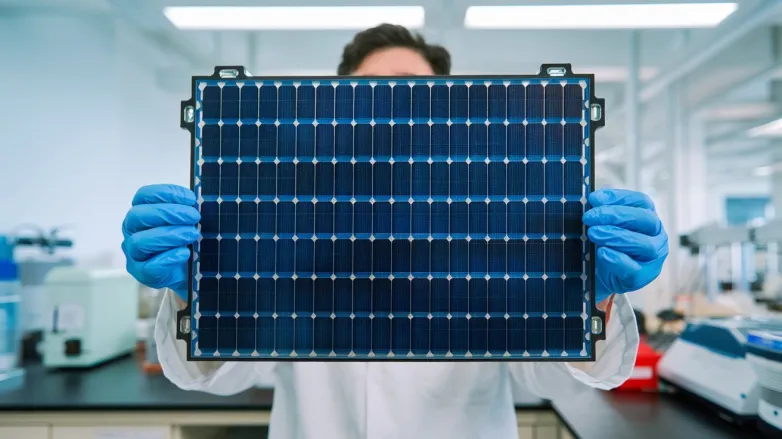
Researchers from Northwestern Polytechnical University, Harbin Institute of Technology, and Beijing Solarverse Optoelectronic Technology report a molecular additive strategy for halide perovskite solar cells that both raises efficiency and improves ultraviolet durability. They embedded the light-responsive molecule 2,3-bis(2,4,5-trimethyl-3-thienyl) maleimide (BTTM) into the perovskite absorber layer, increasing power conversion efficiency to 24.71% from 22.07% in unmodified devices. The approach also stabilized output to 24.12% and improved film crystallinity, grain size, reduced residual PbI2, and extended carrier lifetimes.
BTTM combats UV-driven degradation from within the device. The molecule photoisomerizes under alternating UV (365 nm) and visible light and anchors mobile ions via dual bonding: carbonyl groups coordinate to lead, while N–H groups hydrogen-bond with iodide. This suppresses iodide migration, oxidation, iodine release, defect formation, and lattice breakdown. After accelerated UV aging totaling 5 kWh/m², BTTM devices retained over 90% of initial efficiency versus ~61% for controls. Stored in nitrogen for 1,000 hours, unencapsulated BTTM cells kept 96.9% versus 54.3% without the additive.
How does BTTM boost perovskite solar efficiency and UV durability?
How BTTM boosts perovskite solar efficiency
- Better film quality: BTTM acts during growth to promote improved crystallinity and larger, more ordered perovskite grains, reducing the density of detrimental grain-boundary sites.
- Fewer chemical leftovers: it helps limit formation of residual PbI2, which can otherwise create recombination pathways and lower voltage.
- Reduced recombination: by passivating defect-related regions in/near the perovskite, BTTM lowers non-radiative carrier loss and supports longer carrier lifetimes.
- More effective charge transport: the combination of higher-quality crystal domains and defect suppression improves charge extraction, raising the fill factor and overall power conversion efficiency.
How BTTM improves UV durability
- Internal UV “self-regulation”: BTTM is a light-active molecular additive that undergoes photoisomerization when exposed to UV and then reverts under visible illumination, helping the material resist UV-induced chemical changes.
- Ion immobilization to stop degradation: BTTM’s functional groups form strong interactions with lead (through carbonyl coordination) and with iodide (via hydrogen bonding). This dual binding helps restrain mobile ions that typically drive UV-related phase and chemical degradation.
- Suppression of iodine-related failure modes: by limiting ion migration and related reactions, the additive reduces pathways that lead to oxidation, iodine release, and defect generation.
- Lattice and interface stabilization: with fewer UV-triggered chemical reactions and fewer newly created defects, the perovskite structure and its interfaces degrade more slowly under continued UV exposure.
- Improved retention under harsh testing: devices containing BTTM maintain substantially higher fractions of their starting efficiency after accelerated UV exposure and extended storage (even without encapsulation), compared with unmodified controls.
Also read
- ARRAY Adds Aeeris Hail Alerts to Stow Australian Solar Trackers
- Optivolt Raises $32 Million for Power Electronics Built Into Panels
- UNSW Catalyst Lifts Hydrogen Output 10-Fold From Biodiesel Glycerol
- Sparc Hydrogen Owners Commit A$1.3 Million to Solar Water Splitting
- SunPower Origin Launches in Europe With 505 W, 40-Year Warranty