Best Portable Power Stations (2026): 15 Models Compared on Capacity, Solar Input and Price
Updated: November 2026 · Data: manufacturer specifications and US store prices checked 7 November 2026, CPSC recall notices 2023–2026, Ukrainian customs data to June 2026 · Primary sources listed at the end
Key figures
- 11 of 12: models from the 2024 edition of this list that are no longer in their brands' US line-ups
- $530/kWh: lowest regular price per kWh among the 15 current models (Jackery HomePower 3600 Plus), against $1,493/kWh for the priciest small unit (Anker SOLIX C300)
- 10,000 cycles: Anker's rating for the SOLIX S5000 (to 60% capacity), the longest in this list; most LFP units are rated 4,000–6,000
- 46,200: Goal Zero YETI 3000X units recalled in the US on 20 August 2026 for overheating circuit boards, the largest CPSC power-station recall we found since 2023
- 29.6 kWh: what an average US home used per day in 2022 (EIA); a 1 kWh station delivers about 0.9 kWh at the outlet
- 3.3x: growth of Ukraine's battery imports in January–June 2026, to $1.81 billion, while generator imports fell 34%
Anker launched its SOLIX C1000 Gen 2 at $799 in September 2025. On 7 November 2026 its own US store sold it for $549.99. Jackery's HomePower 1000 v2 fell from $849 at its June 2026 launch to $559, and it carries a 6,000-cycle battery rating. Prices for 1 kWh of portable storage are falling faster than the models can stay on the market: eleven of the twelve stations on list.solar's May 2024 edition of this page are no longer sold new in their makers' US stores. The twelfth, the original EcoFlow DELTA Pro, is still listed, but EcoFlow's newer flagships have replaced it.
The category has also split in two. Small and mid-size units are still the camping and blackout boxes they were. The big ones now weigh 30 to 52 kg, output 120 and 240 volts and grow to 12–30 kWh with add-on batteries, which makes them home backup systems on wheels. This edition compares 15 models on sale in November 2026, from a 288 Wh unit at $289.99 to a 5 kWh unit with a 10,000-cycle rating. All specifications come from the manufacturers. Every price is the brand's own US store price on 7 November 2026, and there are no affiliate links on this page.
Best Portable Power Stations of 2026 at a Glance
No single model wins on every count. Price per kilowatt-hour favours the big Jackery and EcoFlow units, Anker leads on cycle life, and BLUETTI makes the only sodium-ion station on general sale. The table picks one model per need. Full specifications follow in the class sections and the comparison table.
| Need | Pick | Why (key number) |
|---|---|---|
| Phones, laptops, camping | BLUETTI Elite 30 V2 | 288 Wh LFP, 600 W, 4.3 kg, $289.99; the cheapest unit with a full AC inverter |
| Blackout essentials for a flat | BLUETTI Elite 100 V2 | 1,024 Wh, 1,800 W, 1,000 W solar input; $499 on sale, $487/kWh |
| Fastest recharge from the wall | Anker SOLIX C1000 Gen 2 | 0–100% in 49 minutes at 1,600 W, a Guinness-certified record for a 1 kWh station |
| Highest cycle rating at 1 kWh | Jackery HomePower 1000 v2 | 6,000 cycles to 70%; $649 regular, launched at $849 in June 2026 |
| Cold climates | BLUETTI Pioneer Na | Sodium-ion; discharges at −25 °C with 80% of capacity, charges down to −15 °C |
| 2 kWh for the money | Anker SOLIX C2000 Gen 2 | 2,048 Wh, 2,400 W, expandable to 4 kWh; $999.99 on sale ($488/kWh) |
| Whole-home backup, 240 V | Anker SOLIX S5000 | 5,024 Wh, 4,500 W at 120/240 V, 10,000 cycles, expandable to 30 kWh |
| Most storage per dollar | Jackery HomePower 3600 Plus | 3,584 Wh for $1,899: $530/kWh at regular price |
Prices: brand US online stores, 7 November 2026. $/kWh = price ÷ rated capacity, list.solar calculation. Early Black Friday discounts were running at EcoFlow, Anker SOLIX, Jackery and BLUETTI on that day.
Small Power Stations (Under 500 Wh): Phones, Laptops and Camping
A 288 Wh station is the smallest size that still makes sense with an AC socket. It charges a 53.8 Wh MacBook Air about four times, or runs a 56 W CPAP machine for roughly four hours. Both small picks use lithium iron phosphate (LFP) cells.
1. BLUETTI Elite 30 V2: the cheapest real inverter
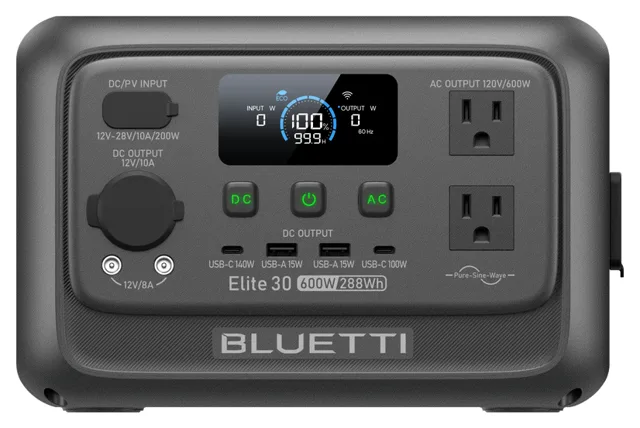
BLUETTI Elite 30 V2. Image: BLUETTI
The Elite 30 V2 puts 288 Wh behind a 600 W inverter for $289.99, which is double the continuous output of Anker's similar-sized C300. BLUETTI rates the LFP pack for 3,000 cycles to 80% and covers it for five years. It weighs 4.3 kg, fills to 80% from the wall in 45 minutes and takes up to 200 W of solar. A 1,500 W "lifting" mode runs resistive loads such as a kettle at reduced power, so the water heats slowly instead of tripping the inverter. The unit cannot take an extra battery. In late October 2026 BLUETTI added a cheaper Elite 30 mini ($249.99, 300 W), but the V2 is the one with the stronger inverter.
2. Anker SOLIX C300: a USB-C hub with a socket
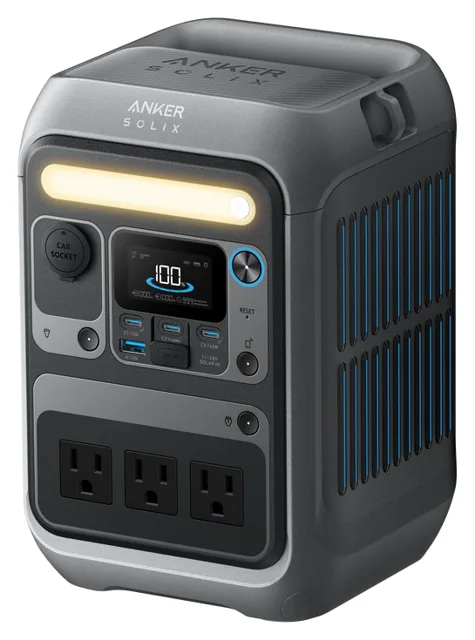
Anker SOLIX C300. Image: Anker
The C300 costs $429.99 for the same 288 Wh, or $1,493 per kWh, the highest in this list. What the money buys is two 140 W USB-C ports and a narrow upright body of about 4.1 kg. Its AC side is weak: 300 W continuous, 600 W with Anker's SurgePad mode, and 100 W of solar input. It switches to battery in 10 ms when the grid drops, so it can sit under a desk as a small UPS for a router and a laptop. It is the only small Anker station still in stock in the US store; the C300X, C200X and C300 DC were sold out on 7 November.
1 kWh Power Stations: The Blackout Workhorses
The 1 kWh class is where prices fell furthest. On 7 November 2026 four of the five picks below sold for $499–$719 in their brands' stores, and three of them can take 1,000 W of solar or recharge from the wall in under an hour. At the outlet, a 1,024 Wh unit delivers about 875 Wh. That is enough to keep an ENERGY STAR refrigerator running for about 17 hours, or a CPAP for 13.
3. EcoFlow DELTA 3 Plus: two solar inputs and a path to 5 kWh
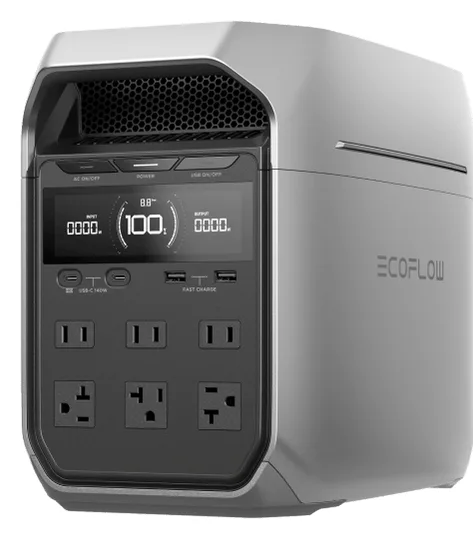
EcoFlow DELTA 3 Plus. Image: EcoFlow
The DELTA 3 Plus is the only 1 kWh pick with two separate solar charge controllers, each taking 500 W at 11–60 V. With both in use EcoFlow quotes a full solar charge in 70 minutes; from the wall it takes 56 minutes. The inverter delivers 1,800 W, or 2,200 W in X-Boost mode, and the LFP pack is rated for 4,000 cycles to about 80%. One extra battery lifts capacity to 5 kWh. At $799 regular and $719 on sale it costs more than the BLUETTI and Anker rivals, but Anker's C1000 Gen 2 and Jackery's HomePower 1000 v2 cannot be expanded at all. EcoFlow's own FAQ gives two weights, 12.5 kg and "≤16.5 kg"; we use 12.5 kg, the figure tied to its published dimensions. Buyers who need neither expansion nor dual solar can take the DELTA 3 Classic, launched on 16 March 2026, at $599 regular and $479 on sale.
4. Anker SOLIX C1000 Gen 2: 49 minutes from empty to full
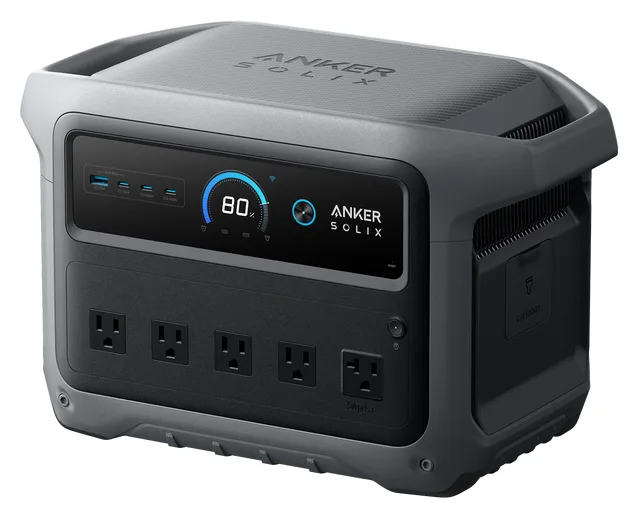
Anker SOLIX C1000 Gen 2. Image: Anker
Anker's second-generation C1000 holds a Guinness World Records title, certified on 14 August 2025, as the fastest-recharging 1 kWh portable power station. In UltraFast mode, set in the app, it draws 1,600 W from a wall socket and goes from 0 to 100% in 49 minutes. The default is 1,200 W. It also has the strongest inverter of the 1 kWh picks, 2,000 W continuous and 3,000 W peak, plus 600 W of solar input and two 140 W USB-C ports, in 11.3 kg. The battery is rated for 4,000 cycles to 80%. The trade-off is that it cannot take an extra battery. It launched in September 2025 at $799. On 7 November 2026 the store listed it at $699.99, on sale for $549.99, with new orders shipping from 21 November.
5. Jackery HomePower 1000 v2: the longest-rated 1 kWh battery
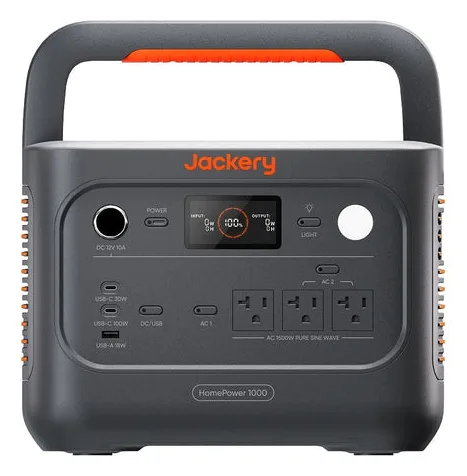
Jackery HomePower 1000 v2. Image: Jackery
Jackery moved its 1 kWh model into a new HomePower line in June 2026, and the Explorer 1000 v2 it replaced is sold out. The HomePower 1000 v2 is the lightest 1 kWh pick at 10.6 kg, and its cells carry the highest cycle count in the class: 6,000 cycles to 70%, which Jackery equates to 16 years. Its inverter is the weakest of the LFP 1 kWh picks, 1,500 W (3,000 W peak), and 400 W of solar over two parallel inputs. A full wall charge takes 75 minutes, or 50 in emergency mode. Its price fell fast: $849 at launch on 17 June, $649 regular in November and $559 on sale. The warranty runs three years, plus two more after registration.
6. BLUETTI Elite 100 V2: most solar input per dollar
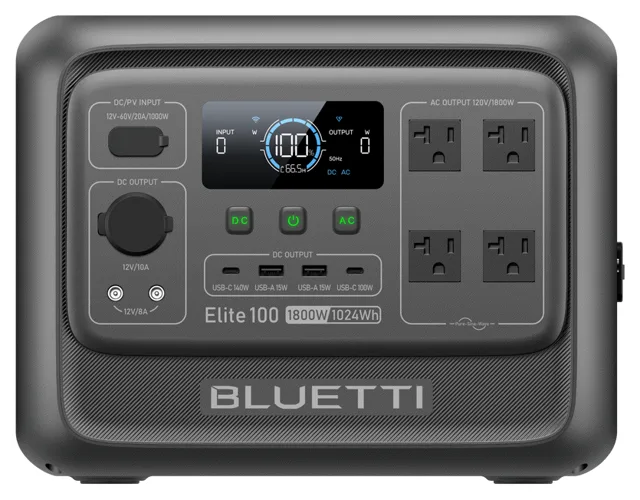
BLUETTI Elite 100 V2. Image: BLUETTI
At $499 on sale ($699 regular), the Elite 100 V2 was the cheapest of the five 1 kWh picks on 7 November. It also accepts the most solar of any 1 kWh pick: 1,000 W at 12–60 V through a single input, which BLUETTI says refills the pack in 70 minutes. The inverter delivers 1,800 W (3,600 W surge), the battery is rated for 4,000 cycles to 80%, and it weighs 11.5 kg. From the wall it charges at up to 1,200 W, reaching 80% in 45 minutes. The warranty is five years. New orders were shipping from 12 November.
7. BLUETTI Pioneer Na: sodium-ion for sub-zero use
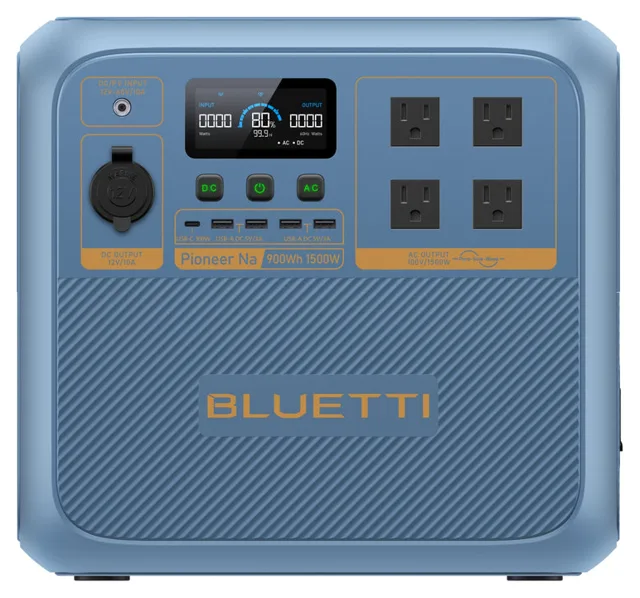
BLUETTI Pioneer Na. Image: BLUETTI
The Pioneer Na went on sale on 15 October 2025 as what BLUETTI calls the first mass-produced sodium-ion portable power station, and a year later it is still the only one we found on general sale. Sodium-ion's selling point is cold. BLUETTI says the 900 Wh unit charges down to −15 °C and discharges down to −25 °C, still delivering 80% of its capacity there. By comparison, Goal Zero's LFP Yeti PRO 4000 accepts a charge only from 0 °C. The catches are real. Below −10 °C it recharges only to 60%. It weighs 16 kg, about 56 Wh per kg against roughly 90 Wh/kg for the LFP Elite 100 V2 (list.solar calculation). Its warranty is three years, against five on BLUETTI's LFP models. It costs $899 regular and $700 on sale, and it delivers 1,500 W.
2 kWh Power Stations: Fridge, Freezer and Furnace Fan
Doubling capacity to about 2 kWh lets a station carry a refrigerator through a full day and night with power to spare for lights, phones and a gas furnace's blower. All three picks also take an extra battery, and that is the real dividing line from the 1 kWh class. Weights rise to 19–22 kg, still carryable by one adult over a short distance.
8. EcoFlow DELTA 3 Max Plus: 3,000 W and a 10 kWh ceiling
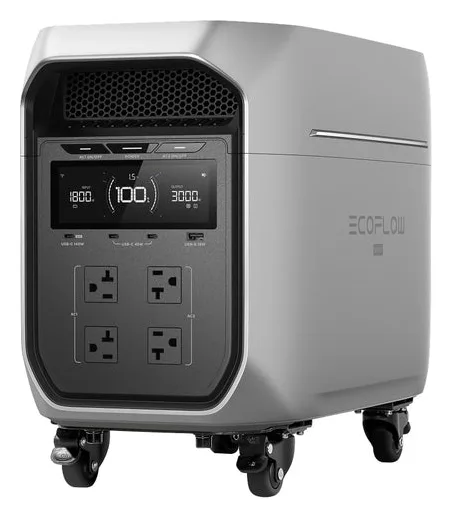
EcoFlow DELTA 3 Max Plus, shown with optional detachable wheels. Image: EcoFlow
The DELTA 3 Max Plus has the most powerful inverter of the 2 kWh group: 3,000 W continuous, 3,800 W in X-Boost and 6,000 W surge. It takes 1,000 W of solar over two 500 W inputs, and with two DELTA Pro 3 extra batteries it reaches 10 kWh. EcoFlow lists the weight at 22.1 kg. It switches to battery in under 10 ms. EcoFlow does not publish a cycle rating for this model on its US page, only a "10-year" lifespan. At $1,599 regular it is the most expensive 2 kWh pick, but on 7 November it sold for $1,149.
9. Anker SOLIX C2000 Gen 2: the value pick at 2 kWh
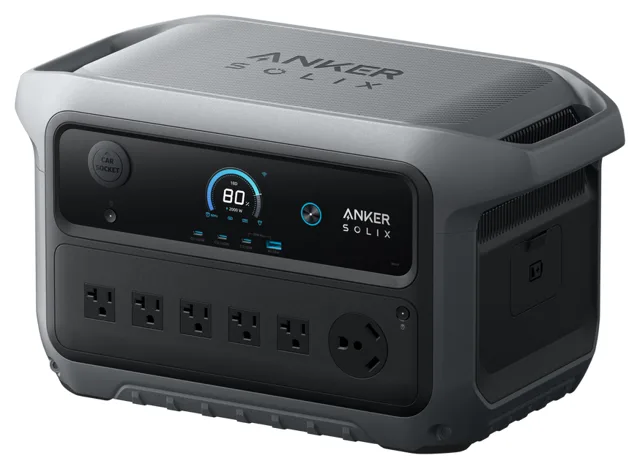
Anker SOLIX C2000 Gen 2. Image: Anker
Anker launched the C2000 Gen 2 in October 2025 at $1,499. By November 2026 the store listed it at $1,199.99 and sold it for $999.99, or $488 per kWh, the lowest sale price per kWh of any 2 kWh model here. It weighs 18.9 kg, delivers 2,400 W (4,000 W peak) and is rated for 4,000 cycles to 80%. With 1,800 W from the wall it refills in 88 minutes, or 58 minutes with solar added. One 800 W solar input is its weak point; EcoFlow and BLUETTI take 1,000 W. One BP2000 expansion pack doubles it to 4 kWh, and idle draw is 9 W. Orders were shipping from 21 November.
10. Jackery HomePower 2000 Plus v2: a lighter successor
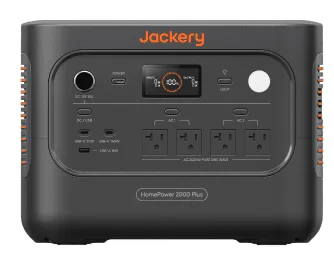
Jackery HomePower 2000 Plus v2. Image: Jackery (cropped from a kit photo)
The HomePower 2000 Plus v2 weighs 18.8 kg, which Jackery says is 34% less than the Explorer 2000 Plus it succeeds. It carries the same 6,000-cycle rating (to 70%) as the 1 kWh HomePower, a 2,400 W inverter with 4,800 W peak, and 800 W of solar over two inputs. Five battery packs take it to 12 kWh, the highest ceiling in the 2 kWh group. A wall recharge takes 98 minutes. Jackery launched it in June 2026 at $1,799. On 7 November the standalone unit was listed at $1,199 for pre-order, shipping on 19 November. A Red Cross Edition was in stock at $1,299.
Home Backup Power Stations (3.5–5 kWh, Expandable)
The top class is where 2026 brought the most new hardware. Anker's S5000 went on sale on 27 October and EcoFlow's DELTA 3800 Gen4 went on pre-order on 4 November, while EcoFlow's 2024 flagship, the DELTA Pro 3, was sold out in every variant on 7 November. These units weigh 30–52 kg and most roll on wheels. Three things separate them: whether they output 240 V from one unit, how far they expand, and whether they carry a home-storage safety listing (UL 9540) or only the portable standard (UL 2743).
| Model | Capacity | AC output | 240 V from one unit | Max expansion | Weight | Regular / sale price |
|---|---|---|---|---|---|---|
| EcoFlow DELTA 3800 Gen4 | 3,763 Wh | 3,600 W | No | 12 kWh | 30.6 kg | $2,199 / $1,699 |
| Anker SOLIX S5000 | 5,024 Wh | 4,500 W | Yes | 30 kWh | 44.0 kg | $3,599.99 / $2,499.99 |
| BLUETTI Apex 300 | 2,765 Wh | 3,840 W | Yes | 6 batteries per unit | ~38 kg | $1,699 / $1,499 |
| Jackery HomePower 3600 Plus | 3,584 Wh | 3,600 W | No (two units) | ~21.5 kWh | ~35 kg | $1,899 / — |
| Goal Zero Yeti PRO 4000 | 3,994 Wh | 3,600 W | No | 20 kWh | 52.5 kg | $3,999.95 / — |
Source: manufacturer product pages and spec FAQs, checked 7 November 2026. BLUETTI quotes two system maximums for the Apex 300 (58 kWh in its August 2025 release, about 100 kWh on the current page), so we list the per-unit limit. Jackery pages give 21–21.6 kWh for the 3600 Plus.
11. EcoFlow DELTA 3800 Gen4: the new compact 4 kWh
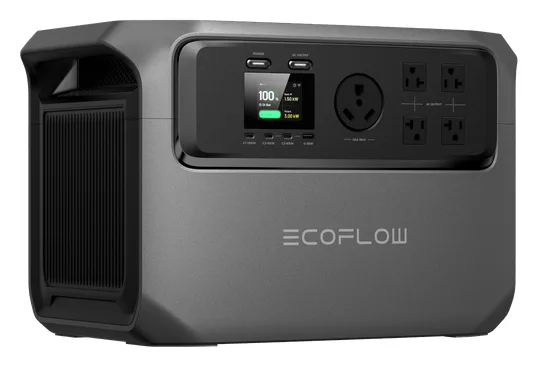
EcoFlow DELTA 3800 Gen4. Image: EcoFlow
EcoFlow put the DELTA 3800 Gen4 on its US store on 4 November 2026 with first shipments due in late November. It packs 3,763 Wh into 30.6 kg, against 51.5 kg for the 4,096 Wh DELTA Pro 3. EcoFlow says that makes it the smallest and lightest 3–4 kWh, 3,600 W station on the market. The cells are rated for 6,000 cycles to 70%, the inverter gives 3,600 W (7,200 W surge) at 120 V only, and two 1,000 W solar inputs take 2,000 W in total. Two extra batteries reach 12 kWh. The early-bird price of $1,699 against a $2,199 list runs to 7 December, and at that price it costs $452 per kWh. EcoFlow's warranty is three years, plus two more after app registration. It is too new for any independent test to exist; treat the specifications as the maker's claims.
12. Anker SOLIX S5000: 10,000 cycles and split-phase power
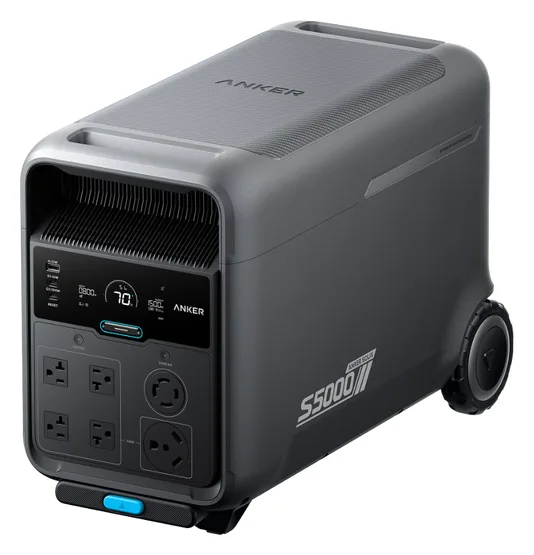
Anker SOLIX S5000. Image: Anker
The S5000 is the most complete home-backup unit in this list, and also the newest: Anker announced it on 9 October 2026 and began selling it on 27 October. It holds 5,024 Wh and delivers 4,500 W at 120 V and 240 V from one box, so it can feed a 240 V well pump through a transfer switch. Anker rates the cells for 10,000 cycles to 60% capacity, or a 15-year life. It is also the only unit in this list whose spec page, in our check, cites UL 9540 and UL 9540A, the listings that US fire codes require for installed home batteries. Solar input is 3,000 W over two inputs, one of them high-voltage (16–165 V). From a 240 V source it fills in 99 minutes. Five BP5000 packs take it to 30 kWh. It weighs 44 kg. Launch pricing of $2,499.99 against a $3,599.99 MSRP was due to end around 10 November, and orders placed from 1 November ship in seven to eight weeks.
13. BLUETTI Apex 300: 240 V for the lowest entry price
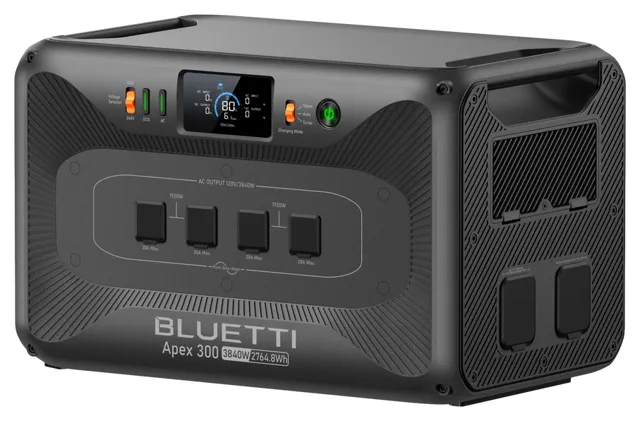
BLUETTI Apex 300. Image: BLUETTI
The Apex 300 is the cheapest way into split-phase 120/240 V output in this list, at $1,699 regular and $1,499 on sale. It holds 2,764.8 Wh, rated for 6,000 cycles to 80%, and delivers 3,840 W. Its two 1,200 W solar inputs (12–60 V) can be joined by an optional 4,000 W high-voltage SolarX 4K controller. It has no USB ports or DC outlets of its own; those come with a separately sold hub. Idle draw is high, 20 W with the AC side on, against 9 W for Anker's C2000 Gen 2. BLUETTI gives two transfer times, 0 ms and 20 ms, depending on operating mode. TIME named it one of its Best Inventions of 2025. New orders were shipping from early December.
14. Jackery HomePower 3600 Plus: the most kWh per dollar
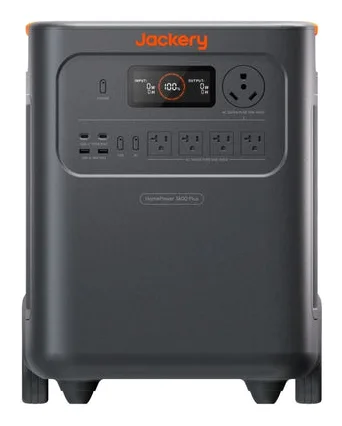
Jackery HomePower 3600 Plus. Image: Jackery (cropped from a kit photo)
At $1,899 for 3,584 Wh, the HomePower 3600 Plus is the cheapest station per kWh at regular price: $530. Jackery rates the cells for 6,000 cycles to 70%. It delivers 3,600 W (7,200 W peak) at 120 V; 240 V requires a second unit and Jackery's connector. Solar input is 1,000 W, low for a 3.6 kWh battery: Jackery's own figure for one 500 W panel is a 12-hour charge. Five battery packs take it to about 21.5 kWh. Jackery's spec FAQ gives a 20 ms switch-over and says plainly that this is not a 0 ms UPS, while a September 2026 press release says 10 ms or less; we use the FAQ figure. The standalone black unit was on pre-order, shipping by 20 November.
15. Goal Zero Yeti PRO 4000: the high-voltage solar specialist
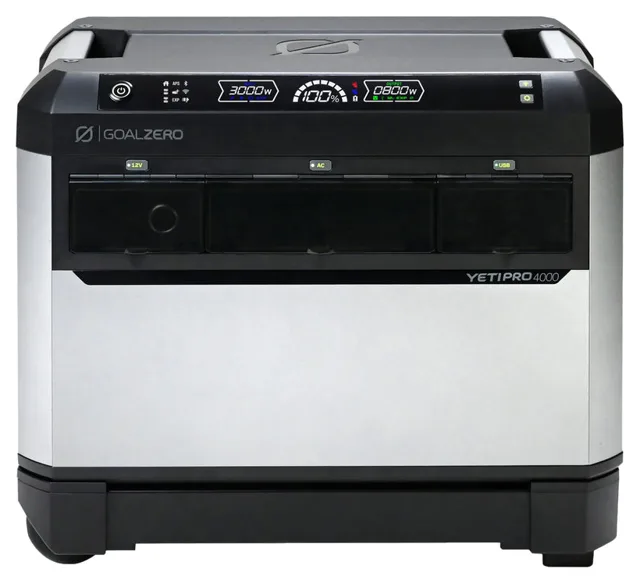
Goal Zero Yeti PRO 4000. Image: Goal Zero
Launched in October 2023, the Yeti PRO 4000 is the oldest model in this list and the most expensive per kWh among the large units, at $1,002. It earns its place on solar. Its high-voltage input takes 3,000 W at 13.3–150 V, so long strings of rooftop-style panels can feed it directly, and Goal Zero quotes 0–80% in under 90 minutes. A second, low-voltage input adds 275 W. It holds 3,994 Wh, delivers 3,600 W (7,200 W surge), is listed to UL 2743 and expands to 20 kWh with four Tank PRO 4000 batteries. At 52.5 kg, or 57 kg with its built-in cart, it is the heaviest unit here. Goal Zero publishes no standalone transfer time. Under 10 ms applies only with its Haven 10 transfer switch. Goal Zero was not discounting it on 7 November.
All 15 Models Compared
| Model | Wh | Chemistry, rated cycles | AC cont. / surge, W | Solar max, W | Weight, kg | Warranty | Regular price | $/kWh |
|---|---|---|---|---|---|---|---|---|
| BLUETTI Elite 30 V2 | 288 | LFP, 3,000 to 80% | 600 / 1,500* | 200 | 4.3 | 5 yr | $289.99 | 1,007 |
| Anker SOLIX C300 | 288 | LFP, n/p | 300 / 600 | 100 | ~4.1 | 5 yr | $429.99 | 1,493 |
| EcoFlow DELTA 3 Plus | 1,024 | LFP, 4,000 to ~80% | 1,800 / 3,600 | 1,000 | 12.5 | 5 yr | $799 | 780 |
| Anker SOLIX C1000 Gen 2 | 1,024 | LFP, 4,000 to 80% | 2,000 / 3,000 | 600 | 11.3 | n/p | $699.99 | 684 |
| Jackery HomePower 1000 v2 | 1,024 | LFP, 6,000 to 70% | 1,500 / 3,000 | 400 | 10.6 | 3+2 yr | $649 | 634 |
| BLUETTI Elite 100 V2 | 1,024 | LFP, 4,000 to 80% | 1,800 / 3,600 | 1,000 | 11.5 | 5 yr | $699 | 683 |
| BLUETTI Pioneer Na | 900 | Sodium-ion, 4,000 | 1,500 / 2,250* | 500 | 16.0 | 3 yr | $899 | 999 |
| EcoFlow DELTA 3 Max Plus | 2,048 | LFP, n/p | 3,000 / 6,000 | 1,000 | 22.1 | 3+2 yr | $1,599 | 781 |
| Anker SOLIX C2000 Gen 2 | 2,048 | LFP, 4,000 to 80% | 2,400 / 4,000 | 800 | 18.9 | 5 yr | $1,199.99 | 586 |
| Jackery HomePower 2000 Plus v2 | 2,048 | LFP, 6,000 to 70% | 2,400 / 4,800 | 800 | 18.8 | n/p | $1,199 | 585 |
| EcoFlow DELTA 3800 Gen4 | 3,763 | LFP, 6,000 to 70% | 3,600 / 7,200 | 2,000 | 30.6 | 3+2 yr | $2,199 | 584 |
| Anker SOLIX S5000 | 5,024 | LFP, 10,000 to 60% | 4,500 / 8,000 | 3,000 | 44.0 | 5 yr | $3,599.99 | 717 |
| BLUETTI Apex 300 | 2,765 | LFP, 6,000 to 80% | 3,840 / 7,680* | 2,400 | ~38 | 5 yr | $1,699 | 615 |
| Jackery HomePower 3600 Plus | 3,584 | LFP, 6,000 to 70% | 3,600 / 7,200 | 1,000 | ~35 | 3+2 yr | $1,899 | 530 |
| Goal Zero Yeti PRO 4000 | 3,994 | LFP, 4,000 to 80% | 3,600 / 7,200 | 3,275 | 52.5 | 5 yr | $3,999.95 | 1,002 |
Source: manufacturer product pages, spec FAQs and user guides; prices from brand US stores, 7 November 2026. * "Lifting" or "power lifting" mode for resistive loads, not a motor-starting surge rating. n/p = not published on the official US page. "3+2 yr" = standard warranty plus extension after registration. Cycle ratings use different end points (60%, 70% or 80% of capacity), so a 6,000-to-70% rating is not directly comparable with a 4,000-to-80% one. $/kWh = regular price ÷ rated Wh × 1,000, list.solar calculation.
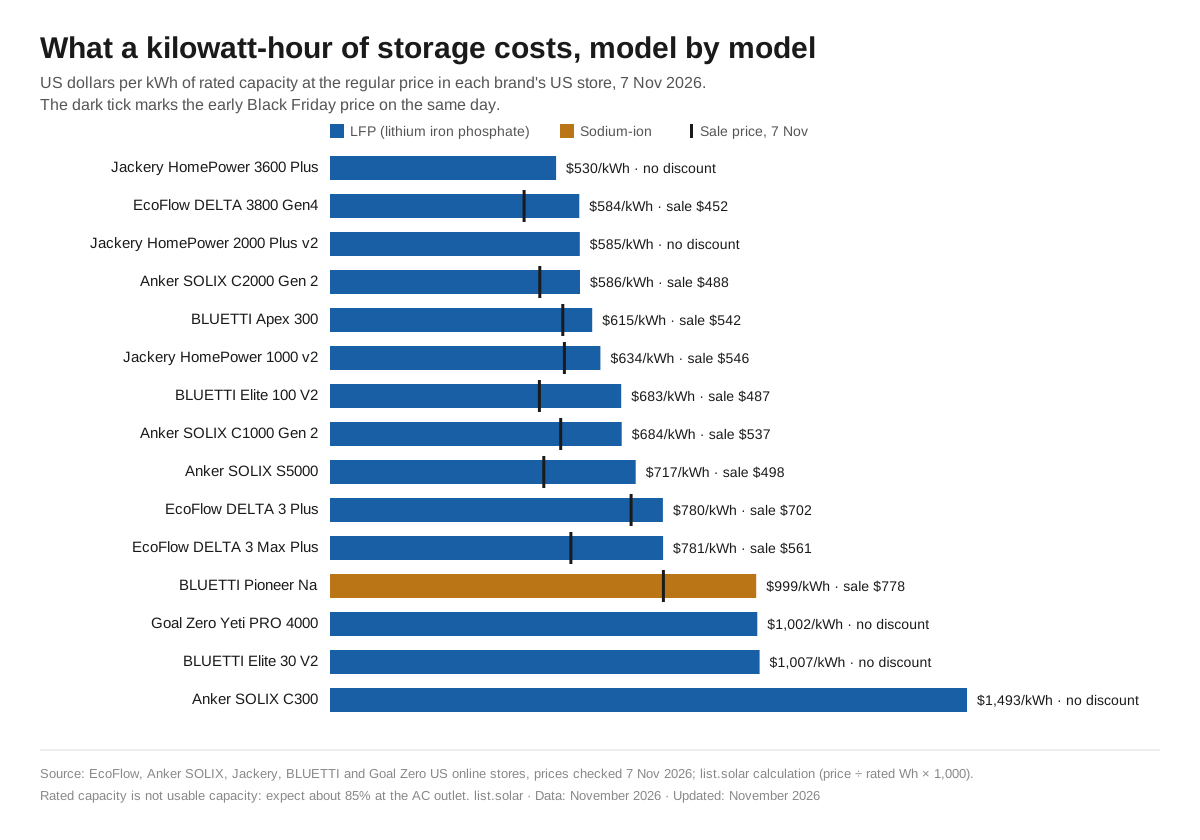
Two patterns stand out in the price data. Small units cost the most per kWh, because the inverter, case and ports cost roughly the same whatever the battery size. And the sales are deep: on 7 November ten of the fifteen models were discounted, by up to 31% (Anker S5000). Several regular prices have themselves already been cut from launch MSRPs. The Jackery HomePower 2000 Plus v2 launched at $1,799 in June 2026 and was listed at $1,199 five months later.
What Happened to the 2024 List
The 2024 edition of this page named 12 models. On 7 November 2026 only one, the original EcoFlow DELTA Pro, was still offered new in its brand's US store, and EcoFlow has since launched two flagships above it. The rest have been replaced, mostly by LFP successors with more cycles and faster charging.
| 2024 pick | Status on 7 Nov 2026 | Current equivalent in this list |
|---|---|---|
| EcoFlow DELTA Pro | Still listed in EcoFlow's US store; its successor, DELTA Pro 3, sold out | EcoFlow DELTA 3800 Gen4 |
| EcoFlow DELTA 2 | Not in EcoFlow's US line-up | EcoFlow DELTA 3 Plus |
| EcoFlow DELTA Mini | Not in EcoFlow's US line-up | EcoFlow DELTA 3 Plus |
| BLUETTI EB55 | Not in BLUETTI's US line-up | BLUETTI Elite 30 V2 |
| BLUETTI EB70 | Not in BLUETTI's US line-up | BLUETTI Elite 100 V2 |
| BLUETTI AC50S | Not in BLUETTI's US line-up | BLUETTI Elite 30 V2 |
| BLUETTI AC200P | Not in BLUETTI's US line-up (its successor AC200L also out of stock) | BLUETTI Apex 300 |
| Anker 535 | Not in Anker SOLIX's US line-up | Anker SOLIX C1000 Gen 2 |
| Anker 757 | Not in Anker SOLIX's US line-up | Anker SOLIX C1000 Gen 2 |
| Jackery Explorer 1000 Pro | Not in Jackery's US line-up; Explorer 1000 v2 also sold out | Jackery HomePower 1000 v2 |
| Jackery Explorer 1500 | Replaced by Explorer 1500 v2 and 1500 Ultra | Jackery HomePower 2000 Plus v2 |
| Goal Zero Yeti 1400 | Not in Goal Zero's US line-up; 2026 Yeti 1500 replaces the mid-size range | Goal Zero Yeti PRO 4000 |
Source: power-station collections of the EcoFlow, BLUETTI, Anker SOLIX, Jackery and Goal Zero US online stores, 7 November 2026. "Not in line-up" means the model was not offered new; refurbished or third-party listings may still exist.
Myth: A Portable Power Station Can Run Your Whole House
Marketing for the large units leans on the phrase "whole-home backup". The arithmetic is less generous. In 2022 the average US household bought 10,791 kWh of electricity, or 29.6 kWh a day (EIA). A 1,024 Wh station delivers about 875 Wh at the socket after inverter losses. That covers an average home for about 42 minutes. The 5 kWh Anker S5000 stretches that to roughly three and a half hours, and a fully expanded 30 kWh S5000 system to about 21 hours (list.solar calculation, 95% depth of discharge and 90% inverter efficiency).
Power is the second limit. Central air conditioning, electric ranges, dryers, well pumps and electric water heaters mostly run on 240 V. Of the 15 models here, only the Anker S5000 and BLUETTI Apex 300 supply 240 V from a single unit. What a power station does well is keep the essentials running. A refrigerator, internet router, lights, phones, a CPAP and a gas furnace's blower together need well under 10 kWh a day (list.solar estimate from the loads in the sizing table below). Shed the electric heating and cooling, and a 2–4 kWh station topped up by a few hundred watts of solar can stretch those loads across a multi-day outage.
There is also a code question. UL Solutions says that a portable pack listed to UL 2743, wired to a home through a transfer switch, does not become a certified home energy storage system. Model codes (IRC R328, NFPA 855) require UL 9540 for that. Plugging appliances into the station is fine. Wiring it permanently into the house panel needs an electrician and, in many jurisdictions, a unit listed to UL 9540, such as the S5000.
Safety: Recalls, Standards and LFP vs NMC
The US Consumer Product Safety Commission (CPSC) recalled or warned about at least six portable power stations between December 2023 and August 2026. The two largest recalls, both from established brands, were fixed with firmware updates. The only death in the period involved the HALO 1000, a unit made by an outside manufacturer. We found no CPSC recall for Jackery or BLUETTI power stations as of November 2026.
| Date | Product | US units | Hazard | Remedy |
|---|---|---|---|---|
| 21 Dec 2023 | Klein Tools KTB1000 / Blackfire PAC1000 | ~3,800 | Inverter boards overheat; 4 reports | Refund |
| 29 Aug 2024 | HALO 1000 | ~5,740 | Fire; 4 fires, 1 death | Replacement |
| 3 Jul 2025 | Harbor Freight Predator 2000W | ~6,500 | AC wires reversed in EPS mode, shock | Replacement |
| 4 Sep 2025 | Aeiusny 400W / 500W (warning, not a recall) | n/a | 24 fire or explosion reports, 3 injuries | Stop use, dispose |
| 9 Oct 2025 | EcoFlow Delta Max 2000 | ~25,030 | Overheating; 6 fires, over $850,000 damage | Firmware update |
| 20 Aug 2026 | Goal Zero YETI 3000X | ~46,200 | Circuit board overheats; 4 reports | Firmware update |
Source: CPSC recall and warning notices 24-067, 24-350, 25-366, 25-454, 26-010 and 26-712. Units are those sold in the US. None of the recalled models is among the 15 picks on this page.
Three standards matter when reading a spec sheet. UL 2743, revised in September 2025, is the US safety standard for portable power packs; it caps lithium-ion and sodium-ion units at 20 kWh and excludes anything wired into a building, which falls under UL 9540. IEC 62368-1 covers the electronics. UN38.3 is a transport test that lithium and sodium-ion batteries must pass to be shipped. It is not a safety listing for home use.
Chemistry is the other safeguard. All 14 lithium models in this list use LFP. In a 2023 study at Karlsruhe Institute of Technology, LFP cells reacted "more slowly and at significantly higher temperatures" than NMC or NCA cells, and none went into thermal runaway when pierced with a nail. Sandia National Laboratories' multi-year cycling tests found that commercial LFP cells lasted far longer than NMC and NCA cells. Those two findings explain why every major brand now builds its stations on LFP.
How Big a Power Station Do You Need?
Runtime is capacity divided by load, minus losses. BLUETTI publishes a usable formula: runtime in hours equals capacity in Wh × 0.95 (usable depth of discharge) × 0.90 (inverter efficiency), divided by the load in watts plus about 10 W that the station itself consumes with its outlets on. The table applies it to common loads.
| Load | Draw | 288 Wh | 1,024 Wh | 2,048 Wh | 3,584 Wh |
|---|---|---|---|---|---|
| ENERGY STAR refrigerator, 18 ft³ | ~1.0 kWh/day (42 W avg) | 5 h | 17 h | 34 h | 2.5 days |
| Large refrigerator, 30 ft³ | ~2.2 kWh/day (90 W avg) | 2.5 h | 9 h | 17 h | 30 h |
| CPAP (ResMed AirSense 11, no humidifier) | 56 W typical | 4 h | 13 h | 27 h | 46 h |
| Laptop (MacBook Air M4) | 30–35 W charger | 5.5 h | 19 h | 39 h | 68 h |
| Sump pump (Zoeller M53) | ~1,100 W running | exceeds inverter | 47 min | 1.6 h | 2.8 h |
| Microwave (1,200 W cooking) | 1,480 W from the outlet | exceeds inverter | 35 min | 70 min | 2 h |
| Space heater, high | 1,500 W | exceeds inverter | 35 min | 70 min | 2 h |
Draw: DOE FEMP and ENERGY STAR (refrigerators), ResMed AirSense 11 user guide (CPAP), Apple (laptop adapter), Zoeller (9.7 A at 115 V), Panasonic NN-SN686S manual (microwave input), Lasko (heater). Runtime: list.solar calculation with BLUETTI's formula; laptop runtime assumes the charger runs at 35 W. Motor loads such as pumps and compressors draw several times their running current at start-up, so check the station's surge rating.
Two rules follow from the table. If the plan is to keep a refrigerator and a CPAP going overnight, 1 kWh is the minimum and 2 kWh is comfortable. Anything that heats, such as space heaters, kettles, microwaves or hair dryers, empties even a 3.6 kWh unit in about two hours. Those loads are where a fuel generator, or a much larger installed battery, still wins.
Charging a Power Station from Solar Panels
Solar input is the spec most buyers underrate. A station's maximum is reached only with enough panels, at the right voltage, in full sun. Three numbers decide what you actually get.
Voltage window. Most mid-size stations accept 11–60 V per input. Portable 100–220 W panels have an open-circuit voltage (Voc) of about 21.5–24.8 V, so two in series (about 44–50 V) are safe on a 60 V input and three are not. Voc rises in cold weather, so leave a margin. Large units with high-voltage inputs, such as the Goal Zero Yeti PRO 4000 (150 V) and Anker S5000 (165 V), can take longer strings of standard rooftop modules.
Peak sun hours. Solar resource data from the National Laboratory of the Rockies (NREL until December 2025) put the yearly average for a panel tilted at the local latitude at 6.68 kWh/m² a day in Phoenix, 4.62 in New York, 4.50 in Chicago and 3.98 in Seattle. In December those figures drop to 5.53, 3.34, 2.65 and 1.65.
Real-world losses. Heat, panel angle, wiring and the charge controller take roughly a quarter of the rated output. A 200 W panel in Chicago's average 4.5 peak sun hours yields about 0.7 kWh a day (list.solar calculation, 0.75 derate). In Seattle in December the same panel gives about 0.25 kWh. Keeping a 1 kWh-a-day refrigerator going on solar alone takes about 400 W of panels on an average Chicago day, and far more in winter.
For panel choice, see our comparison of the best solar panels of 2026; for fixed systems, the best solar inverters.
Prices, Tariffs and Tax Credits in 2026
Three things set US prices this year. First, the federal 30% Residential Clean Energy Credit (Section 25D) ended: the IRS says it is "not available for any property placed in service after December 31, 2025". Even before that, a plug-in portable station's eligibility was doubtful, because the credit required battery storage of at least 3 kWh "installed in connection with" a home.
Second, tariffs rose. The Section 301 duty on Chinese lithium-ion non-EV batteries went from 7.5% to 25% on 1 January 2026, under a USTR decision published in September 2024. How a finished power station is classified at the border varies, so the effect on shelf prices is hard to isolate. Third, competition offset much of it. Regular store prices for four of the newest 1 and 2 kWh models are 12–33% below their launch MSRPs, and November sales cut a further 10–31%.
Market estimates vary widely depending on what they count. Grand View Research puts the global portable power station market at $4.2 billion in 2025 and $4.8 billion in 2026, with North America 40.8% of revenue. Coherent Market Insights, using a narrower definition, estimates $1.52 billion for 2025. Both name emergency backup as the largest use.
Ukraine: Power Stations as Wartime Infrastructure
No country has tested portable power stations harder. Russian strikes on the grid have brought scheduled outages every winter since 2022. On 13 January 2026 about 70% of Kyiv was without power, and in mid-January President Zelensky declared a state of emergency in the energy sector. Autumn 2026 brought the same pattern. On 14 October Ukrenergo introduced schedules of up to eight hours a day without power in Kyiv and seven regions. On 30 October outages hit Kyiv and four regions again after overnight attacks.
Customs data show how households and businesses have responded. Ukraine reports no separate line for portable power stations, so the table uses the two closest categories: generating sets and battery imports. The battery figure also includes cells for electric vehicles, drones and grid storage.
| Period | Generating sets (HS 8502), $m | Change | Batteries (HS 8507), $m | Change | Generators' share of the two |
|---|---|---|---|---|---|
| Jan–Nov 2022 | 355 | units 6x y/y | n/a | — | — |
| 2023 | ~706 e | — | <475 e | — | — |
| 2024 | 732.5 | ▲ 3.7% | 950.6 | ▲ more than 2x | 44% |
| 2025 | 1,691 | ▲ 131% | 1,476 | ▲ 55% | 53% |
| Jan–Jun 2026 | 499.6 | ▼ 34.4% y/y | 1,806 | ▲ 3.3x y/y | 22% |
Source: State Customs Service of Ukraine, as published by Forbes Ukraine (2022), Interfax-Ukraine (2024–2025) and Mind (2026). e = list.solar estimate: 2023 generators = 2024 value ÷ 1.037; batteries "more than doubled" in 2024, so 2023 was below half the 2024 value. Share = generators ÷ (generators + batteries), list.solar calculation.
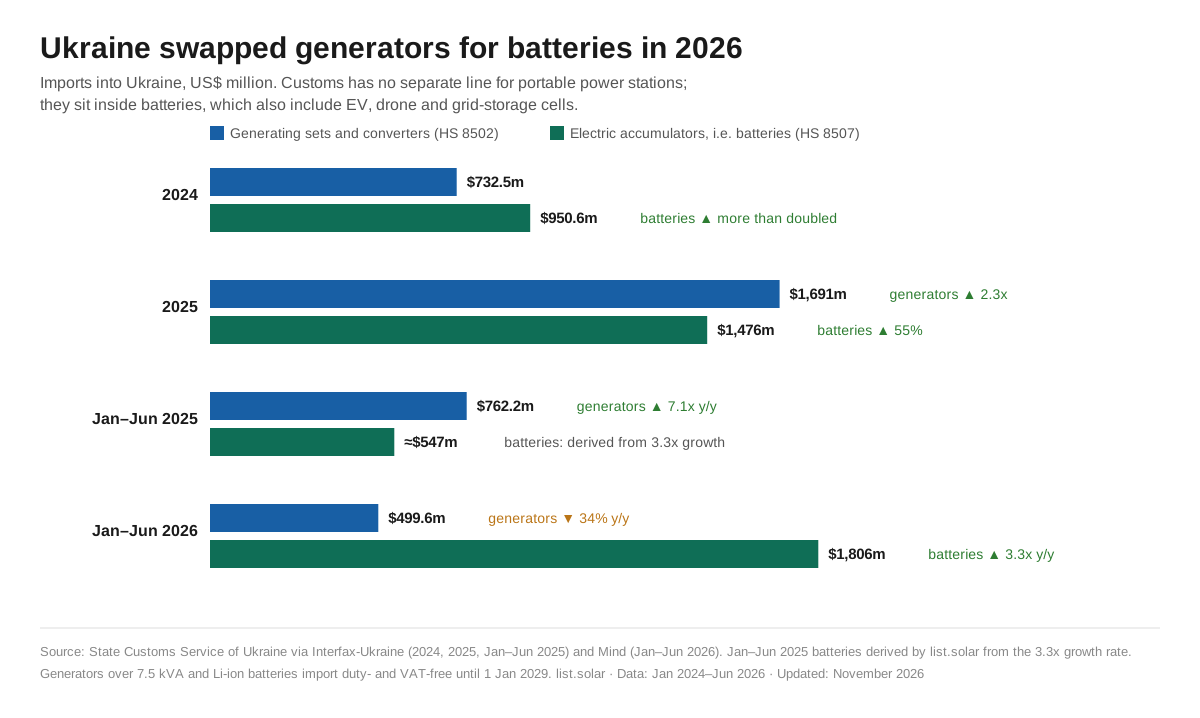
The swing in 2026 is the striking part. In the first half of the year generator imports fell by a third, while battery imports more than tripled to $1.81 billion, about 90% of them from China. Part of that is grid-scale storage and drones, but the shelves show the consumer side. The Ukrainian online retailer Rozetka listed 2,340 power stations on 7 November 2026. A 1 kWh LFP station sold for 26,000–50,000 hryvnias there (DJI Power 1000 V2 26,290; Jackery Explorer 1000 v2 28,999; BLUETTI Elite 100 V2 about 33,500; EcoFlow DELTA 3 from 35,995; Anker SOLIX C1000X Gen 2 37,249). A 2 kWh unit cost 50,000–70,000, and the 4 kWh EcoFlow DELTA Pro 3 about 142,000.
Two policies shape those prices. Since 27 July 2024, Laws 3853-IX and 3854-IX have exempted generating sets, solar panels and lithium-ion batteries from import duty and VAT. Laws 4698-IX and 4710-IX of December 2025 extended the exemption to 1 January 2029. Stations and power banks under 300 W are excluded and pay full duty and VAT. The state "energy credit", available through six banks including Oschadbank, PrivatBank and Ukrgasbank, lends households 10,000–480,000 hryvnias at 0% in the first year and repays 20–30% of the principal. By 24 July 2026 it had issued 7,490 loans worth 2.64 billion hryvnias. Every package includes a generator, though, so a power station bought on its own does not appear to qualify (list.solar's reading of the package list, not an official ruling).
From a Power Station to a Home Battery
A large power station is often the first step toward a fixed home battery. The two converge in units like the Anker S5000, which carries the UL 9540 listing that installers need. Once a household needs more than 10–15 kWh, wants the battery wired into the panel permanently, or wants it to charge from rooftop solar every day, a wall-mounted system with a hybrid inverter usually costs less per kWh and is easier to permit. Our pages on the best solar batteries and how to choose a battery for a solar system cover that step, and the largest energy storage companies shows who builds the cells inside both.
Methodology and Data Sources
Selection. We started from the full US power-station collections of EcoFlow, Anker SOLIX, Jackery, BLUETTI, Goal Zero and DJI on 7 November 2026, and kept models with an AC inverter and solar input that were in stock or on dated pre-order. DJI Power 1000 V2 and Power 2000 were out of stock in the partner-run US store, and EcoFlow's DELTA Pro 3, Anker's F3800 Plus and Jackery's Explorer 1000 v2 were sold out, so they are excluded. EcoFlow's RIVER 3 Plus product page returned an error in the US store.
Specifications come from manufacturer product pages, spec FAQs, user guides and press releases. Where a maker publishes conflicting figures, we say so in the text and use the more conservative or more specific one: Jackery 3600 Plus switch-over (20 ms per spec FAQ, not 10 ms per press release), EcoFlow DELTA 3 Plus weight (12.5 kg with published dimensions, not "≤16.5 kg"), and BLUETTI Apex 300 system capacity (per-unit limit only). The solar input and weight of the EcoFlow DELTA 3 Max Plus come from EcoFlow's official spec tables as indexed by search, because its spec tab did not render for us. "n/p" means the figure is not published on the official US page. We did not test any unit ourselves.
Prices are the brand's own US online store on 7 November 2026, during early Black Friday sales. "Regular" is the store's reference (compare-at) price, which can be lower than the launch MSRP. Prices per kWh, runtimes, solar yields, energy density and Ukrainian import shares are list.solar calculations, labelled in the text. Ukrainian retail prices are from Rozetka on 7 November 2026 and include marketplace sellers.
Updates. This page replaces the May 2024 edition. We plan to recheck stock and prices after the November 2026 sales and update the list in the first quarter of 2027.
FAQ
Can a portable power station power a whole house?
Not for long. An average US home used 29.6 kWh a day in 2022, according to the EIA, and a 1 kWh station delivers about 0.9 kWh at the outlet, or roughly 42 minutes of average use. Even a 5 kWh unit covers about three and a half hours. Power stations are best at keeping essentials running: refrigerator, router, lights, medical devices and a furnace fan.
What is the best portable power station in 2026?
It depends on size. For 1 kWh, the BLUETTI Elite 100 V2 offers the most solar input for the money and the Anker SOLIX C1000 Gen 2 recharges fastest (49 minutes). For whole-home backup with 240 V output, the Anker SOLIX S5000 leads on cycles (10,000) and expansion (30 kWh). The Jackery HomePower 3600 Plus is cheapest per kWh at $530.
How long does a portable power station last?
Current LFP models are rated for 4,000 to 6,000 full cycles, and Anker rates the S5000 for 10,000. At one cycle a day, 4,000 cycles is about 11 years. The ratings use different end points (60%, 70% or 80% of original capacity), so compare them carefully. Warranties run three to five years. Sodium-ion units such as the BLUETTI Pioneer Na carry three.
Are portable power stations safe indoors?
They produce no fumes, so unlike fuel generators they can run indoors. The main risk is battery fire. LFP cells, used in all 14 lithium models here, are far more resistant to thermal runaway than older NMC cells. Check for UL 2743 listing, keep the unit ventilated and away from bedrooms, and register it so you hear about recalls. CPSC recalled the EcoFlow Delta Max 2000 and Goal Zero YETI 3000X in 2025–2026.
How many solar panels does a power station need?
Enough to reach its solar input limit without exceeding its voltage window. In a typical US location a 200 W portable panel yields about 0.7 kWh a day, so refilling a 1 kWh station in one day needs about 300–400 W of panels. Larger stations with 1,000–3,000 W inputs need several panels, often wired in series. Stay below the input's maximum voltage even on cold days.
Related on List.Solar
Sources
- EcoFlow US store: DELTA 3 Plus, DELTA 3 Classic, DELTA 3 Max Plus, DELTA 3800 Gen4, DELTA Pro 3 (accessed 7 Nov 2026); EcoFlow DELTA 3 Plus FAQ (June 2025)
- Anker SOLIX: C300, C1000 Gen 2 specs, C2000 Gen 2, S5000 specs (accessed 7 Nov 2026); press releases C1000 Gen 2 (19 Aug 2025), C2000 Gen 2 (10 Oct 2025), S5000 (9 Oct 2026)
- Jackery: HomePower 1000 v2, HomePower 2000 Plus v2, HomePower 3600 Plus spec FAQs; HomePower launch release (17 Jun 2026); US store (accessed 7 Nov 2026)
- BLUETTI: Elite 30 V2, Elite 100 V2, Pioneer Na, Apex 300, Elite Series buying guide, warranty periods (accessed 7 Nov 2026); Pioneer Na market launch (Oct 2025); Pioneer Na EU page, runtime formula
- Goal Zero: Yeti PRO 4000 (accessed 7 Nov 2026); launch release (3 Oct 2023)
- US Consumer Product Safety Commission: recalls 24-067, 24-350, 25-366, 26-010, 26-712; warning 25-454
- UL: ANSI/CAN/UL 2743:2025 (24 Sep 2025); UL Solutions, Q&A: portable power packs (2025)
- Ohneseit et al., Thermal and mechanical safety assessment of type 21700 lithium-ion batteries with NMC, NCA and LFP cathodes, Batteries 9(5), 237 (2023); Preger et al. (Sandia), Degradation of commercial lithium-ion cells as a function of chemistry and cycling conditions, J. Electrochem. Soc. 167 (2020)
- US EIA, How much electricity does an American home use? (2022 data); DOE FEMP, Purchasing energy-efficient residential refrigerators; ResMed, AirSense 11 user guide; Apple, MacBook Air (M4) specifications; Zoeller, M53 sheet; Panasonic, NN-SN686S manual
- National Laboratory of the Rockies (formerly NREL), Solar Resource API (accessed 7 Nov 2026); US DOE, Energy Department renames NREL (1 Dec 2025)
- IRS, Residential Clean Energy Credit and Instructions for Form 5695 (2025); USTR, Section 301 modification, 89 FR 76581 (18 Sep 2024)
- Grand View Research, Portable Power Station Market report (2026); Coherent Market Insights, press release (Sep 2025)
- Ukraine: State Customs Service via Interfax-Ukraine, 2024–2025 imports and H1 2025; Mind, H1 2026; Forbes Ukraine, 2022 generator imports; State Customs Service, exemption extended to 2029; Verkhovna Rada, Law 4698-IX; Kyiv Independent, energy emergency (Jan 2026); Ukrainska Pravda, outage schedules, 14 Oct 2026; Ukrinform, outages, 30 Oct 2026; Ukrainian Development Fund, energy credit for households; Minfin, programme results to 24 Jul 2026; Rozetka, charging stations category (accessed 7 Nov 2026)
Also read
- Ember Finds Wind Cuts Cost of Near-Firm Solar and Batteries by 18%
- Enphase to Show 80-kWh Commercial Battery and IQ Battery G5 at RE+
- Kansai Electric Agrees to Buy 49.99% of 600-MWh Virginia Battery
- Flower, dces File Permits for 500-MW, 2-GWh Battery Near Berlin
- Sungrow Launches PowerStack 3.0 C&I Battery With Four-Module Dock