Best Solar Power Banks and Solar Chargers (2026): 14 Models Compared by the Numbers
Updated: November 2026 · Data: manufacturer specifications and US store prices checked 7 November 2026, CPSC recall notices June 2024 to October 2026, airline rules checked November 2026 · Primary sources listed at the end
Key figures
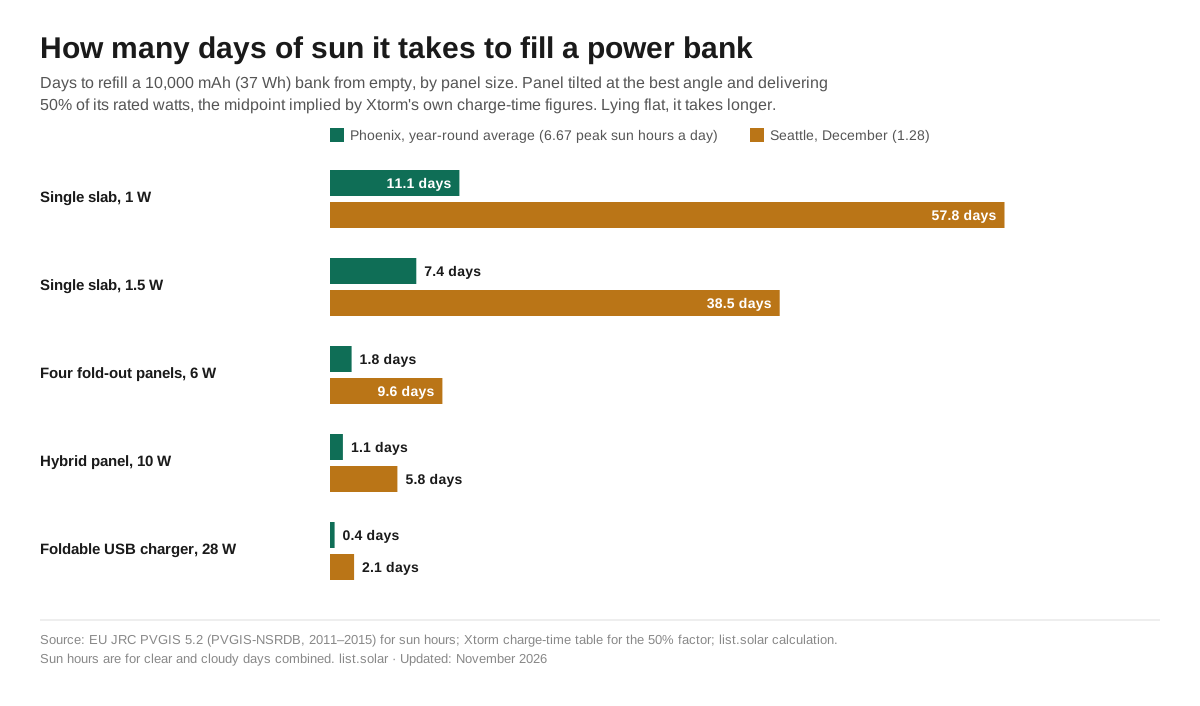
- 11 to 58 days: time a 1 W built-in panel needs to refill a 10,000 mAh bank, from Phoenix's year-round average to Seattle in December (our calculation)
- 12 to 17 hours: Xtorm's own estimate for filling a 10,000 mAh bank from a 5 W panel in the best sun; in weak sun, more than 45 hours
- About 4 hours: Xtorm's estimate for the same bank on a separate 28 W foldable panel
- 2.6 million: power banks recalled in 14 CPSC recalls between June 2024 and October 2026
- 100 Wh: the per-bank limit on American and Delta, and the IATA ceiling for power banks from 1 January 2027
- $37.99 to $149.95: official US store prices across the 10 models in this list with a battery
Anker, one of the biggest names in power banks, told buyers in Japan that its 10,000 mAh solar model would reach at most 50% after 14 hours of clear sky, and that a full charge would take several days. We found no solar power bank in Anker's current line-up: the US page for its 20,000 mAh model returns a 404, and both Japanese listings are sold out. Xtorm says of the 1 W panel on its newest model that it is a "backup power source rather than a primary charger."
A panel the size of a phone collects very little energy, so the useful question is which kind of product suits the trip. This edition compares 14 models sold from US-dollar stores in November 2026: eight power banks with built-in panels, two panel-and-battery hybrids, and four foldable USB chargers. It replaces our May 2024 list of 13 marketplace products. Specifications come from the makers' own sites, prices from each brand's own store on 7 November 2026. We did not bench-test these units, so the comparison rests on published specifications and arithmetic, and there are no affiliate links on this page.
Best Solar Power Banks and Chargers of 2026 at a Glance
If you expect the sun to do most of the charging, buy a foldable panel of 20 W or more and pair it with an ordinary power bank. Built-in panels make sense as a free extra on a bank you mostly charge from the wall. The table picks one model per need.
| Need | Pick | Why (key number) |
|---|---|---|
| Real solar charging on a budget | BigBlue SolarPowa 28 | 28 W, three USB-A ports, $84.99 |
| Charging over USB-C at speed | BigBlue SolarPowa X60 | 60 W panel, 45 W USB-C PD, $109.99 |
| Everyday bank with solar as a bonus | ToughTested ROC10 | 20 W USB-C PD, 15 W Qi, IP65, 5-year warranty, $59 |
| Most capacity you can fly with | Hiluckey Hi-S225P | 27,000 mAh, 99.9 Wh, $46.99 on sale |
| Backpacking, panel with a buffer | BioLite SolarPanel 10+ | 10 W, 550 g, battery rides out passing cloud |
| Camp light and charger in one | ToughTested Switchback | 550-lumen LED panel, 18 W USB-C PD, $59 |
| Lowest price | FEELLE Wireless 10000 | Three fold-out panels, 5 W Qi, $37.99 |
| Add-on for a power station | Jackery SolarSaga 40 Air | 40 W, 0.9 kg, DC8020 plus USB ports, $129 |
Prices: each brand's US store, 7 November 2026. Picks are based on published specifications, not lab tests.
Solar Power Banks with Built-In Panels
None of the eight is sold as LFP. Most makers do not publish panel wattage, which tells you something on its own. Where the wattage is missing on a single-slab model, assume 1 to 2 W: Renogy's spec sheet for its similar E.POWER 16000 lists solar input of 5 V at 300 mA, or 1.5 W.
1. ToughTested ROC10: the most complete 10,000 mAh bank
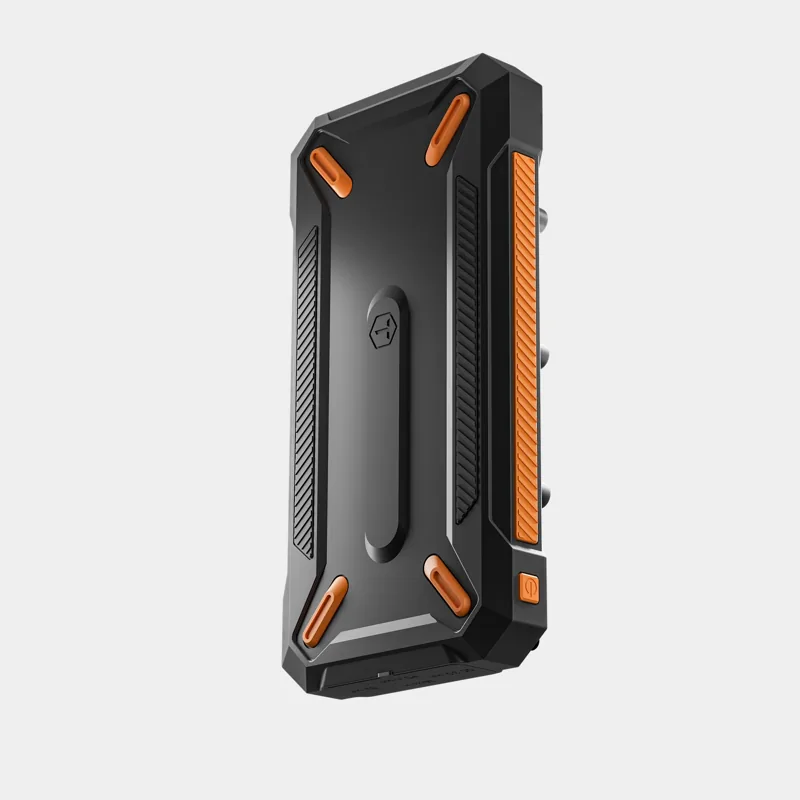
ToughTested Solar ROC10, wireless side; the panel is on the other face. Image: ToughTested
The ROC10 combines 20 W USB-C Power Delivery with 15 W Qi wireless charging and an IP65 rating for $59. ToughTested backs its products with a five-year warranty, the longest we found in this list. The 10,000 mAh cell (37 Wh by our math) refills an iPhone 17 about 1.9 times. ToughTested calls the panel a backup and does not give its wattage, and its own charging guide tells owners to fill up from the wall first and use the sun to extend runtime.
2. ToughTested ROC16: 60% more capacity for $10
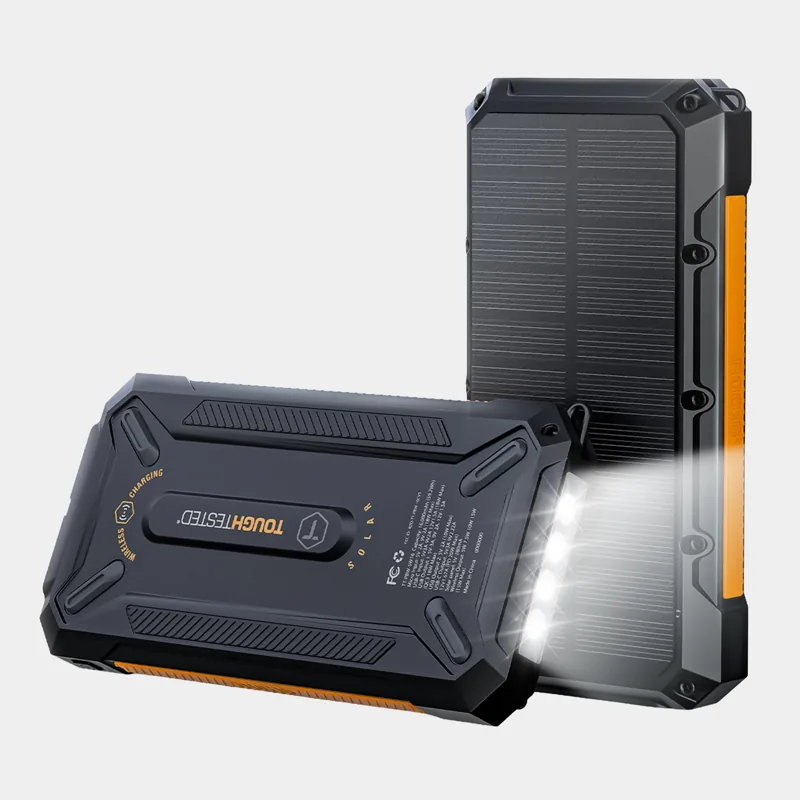
ToughTested Solar ROC16. Image: ToughTested
The ROC16 keeps the ROC10's 20 W USB-C and 15 W Qi outputs and raises capacity to 16,000 mAh for $69. That works out to $1.17 per watt-hour against $1.59 for its smaller sibling, and about 3.1 iPhone 17 charges. The product description says IP65 while a store tag says IP67, so count on the lower figure.
3. ToughTested Switchback: a lantern that also charges
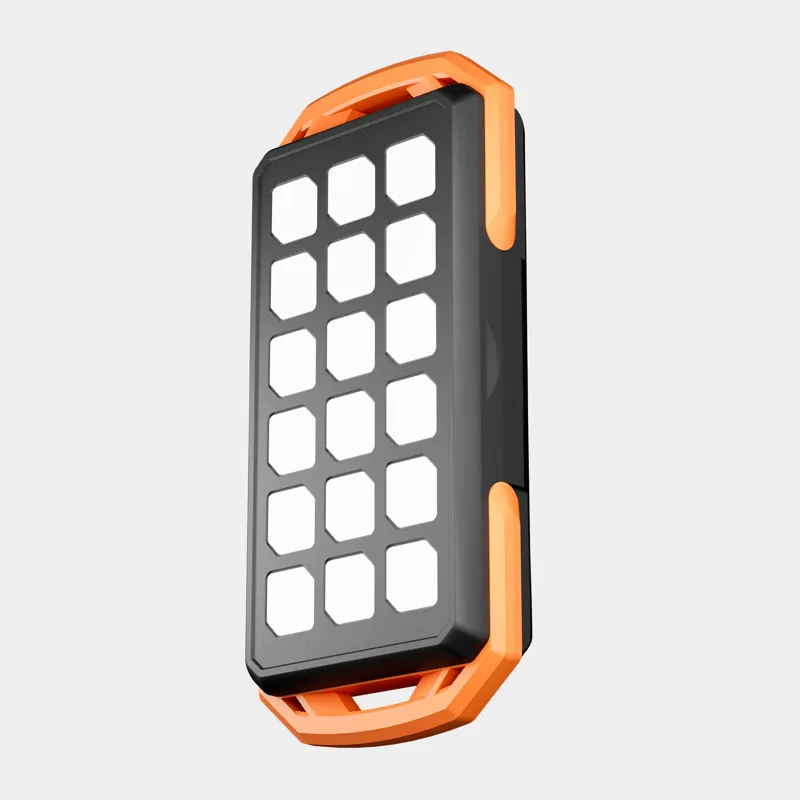
ToughTested Switchback, LED panel side. Image: ToughTested
The Switchback's selling point is a 550-lumen LED panel with high, low, strobe and SOS modes, paired with dual fold-out solar panels and 18 W USB-C PD at $59. Its water resistance is the one to read carefully. The description states IP44, which means splashes, while the page's web address still says IP65. Treat it as rainproof at best and keep it out of puddles.
4. ToughTested Solar24: the big one in the range
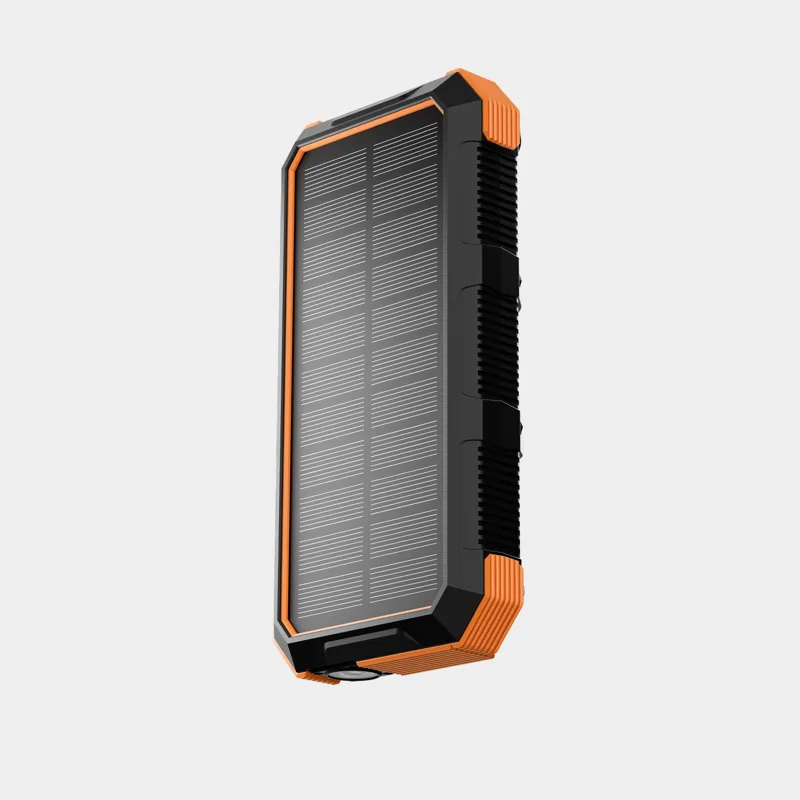
ToughTested Solar24. Image: ToughTested
At 24,000 mAh (88.8 Wh by our math) the Solar24 delivers roughly 4.6 iPhone 17 charges and stays under the 100 Wh airline limit, for $99. It has USB-C PD, whose wattage ToughTested does not state, plus QC 3.0 and an LED flashlight. Store data gives 998 g packaged, the heaviest shipping weight among the banks here. The description says IP66 and the web address says IP67.
5. BLAVOR PN-W05: compact, but the range is thin
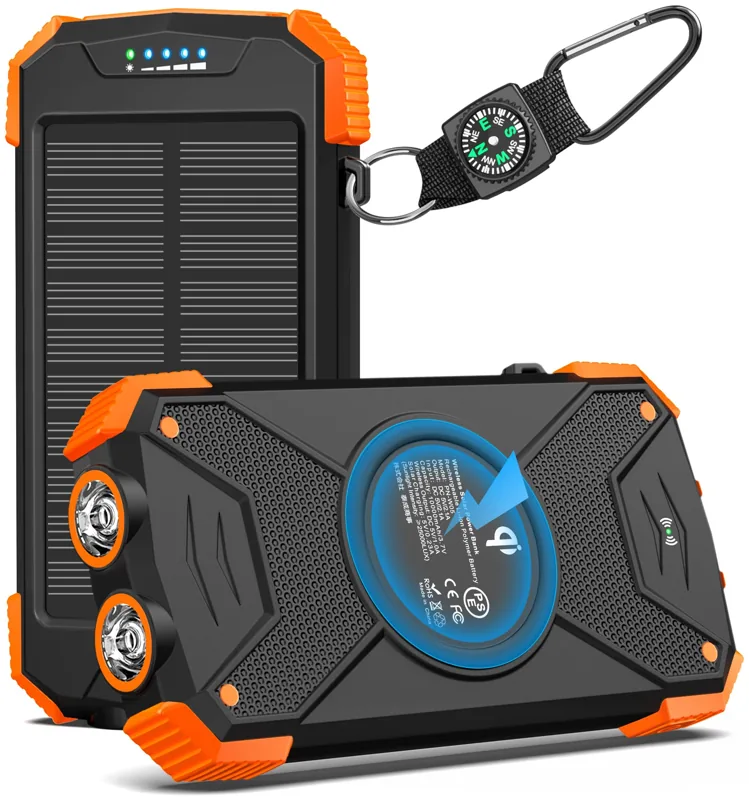
BLAVOR PN-W05. Image: BLAVOR
The PN-W05 packs 20 W USB-C PD, Qi wireless, IPX5 protection, dual flashlights and a compass carabiner into a 10,000 mAh body for $69.99. On 7 November only the orange and black versions were in stock, and every other BLAVOR solar bank on the official store was sold out, including the 20,000 mAh W12, W39 and new W51. BLAVOR credits a lithium-cobalt cell with 50% more cycles than ordinary lithium-polymer, but gives no test data. The official store is blavorpowerbank.com. The similar-looking blavor.com is an unrelated firm.
6. Hiluckey Hi-S225P: most capacity per dollar
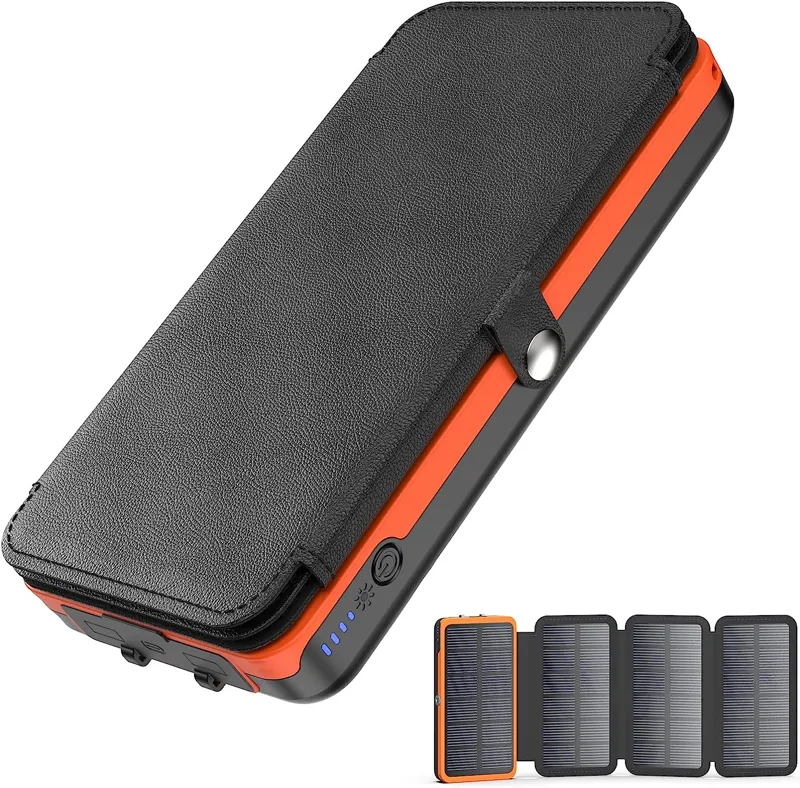
Hiluckey Hi-S225P, closed, with the four panels shown unfolded. Image: Hiluckey
At $46.99 on sale (regular $59.99), the Hi-S225P costs 47 cents per watt-hour, less than half the next-cheapest bank here. Its 27,000 mAh comes to 99.9 Wh using the formula American Airlines publishes, 0.1 Wh under the limit. Hiluckey quotes up to 6 W from the four fold-out panels in direct sun, and it is the only maker of these eight to state a wattage. Even so, a full refill would take about 33 peak-sun hours at realistic output, or five average days in Phoenix. USB-C runs at 18 W each way, and a 20 W charger fills the battery in five hours. No IP rating is given. Hiluckey's 25,000 mAh HI-S025 costs more ($79.99) and holds less, so skip it.
7. FEELLE 10000: the honest spec sheet
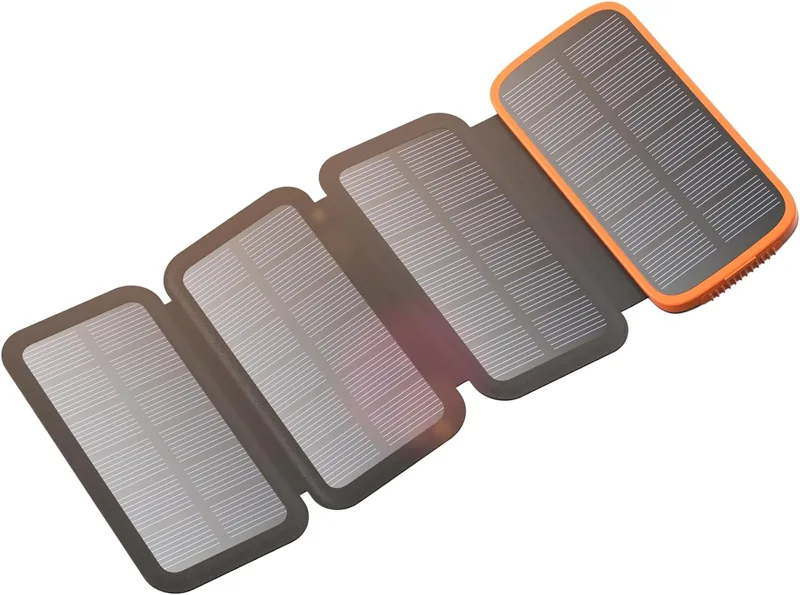
FEELLE 10000 four-panel. Image: FEELLE
FEELLE says plainly that this $39.99 bank needs about 15 to 20 hours of direct sun at best, with all four panels unfolded. At 8.5 oz (241 g) it has the lowest stated weight of the eight. USB-C works both ways and the two USB-A ports output 5 V at 3 A, but FEELLE lists no PD rating, so phones will charge at up to 15 W. There is no IP number. FEELLE and Hiluckey share model codes in their manuals, which suggests a common manufacturer.
8. FEELLE Wireless 10000: the cheapest entry
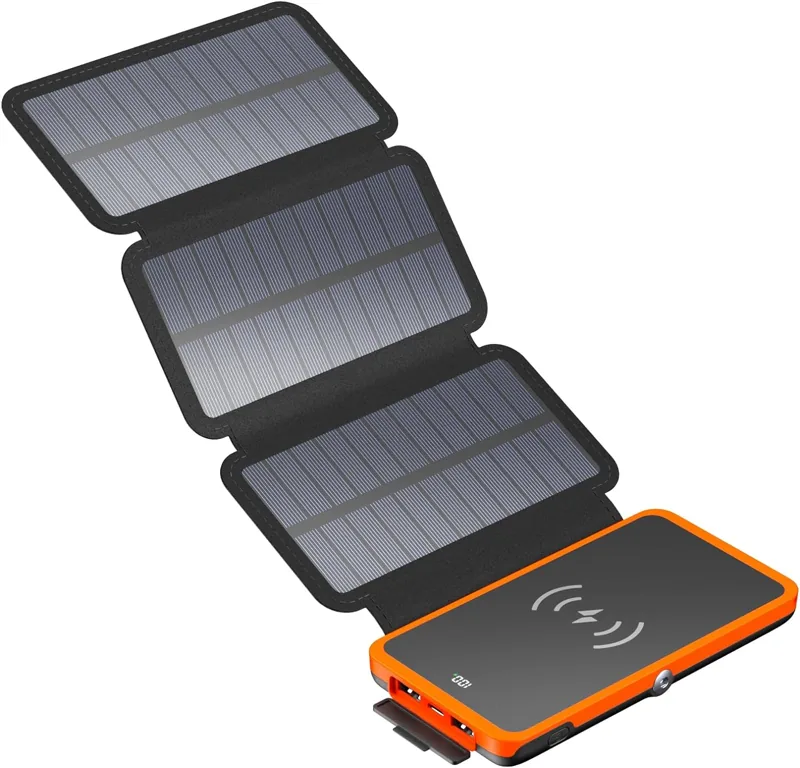
FEELLE Wireless 10000. Image: FEELLE
For $37.99 this model swaps one panel for a 5 W Qi pad and adds an LED display and a flashlight with strong, SOS and strobe modes. A full wall charge takes six hours on a PD charger. Five watts is slow by 2026 standards, when the iPhone 17 accepts 25 W on Qi2, and FEELLE does not give the weight or an IP rating.
Panel-and-Battery Hybrids
BioLite turns the formula around. Its products are proper panels with a small battery attached, so the panel area is much larger relative to the energy it has to store.
9. BioLite SolarPanel 10+: the panel that buffers clouds
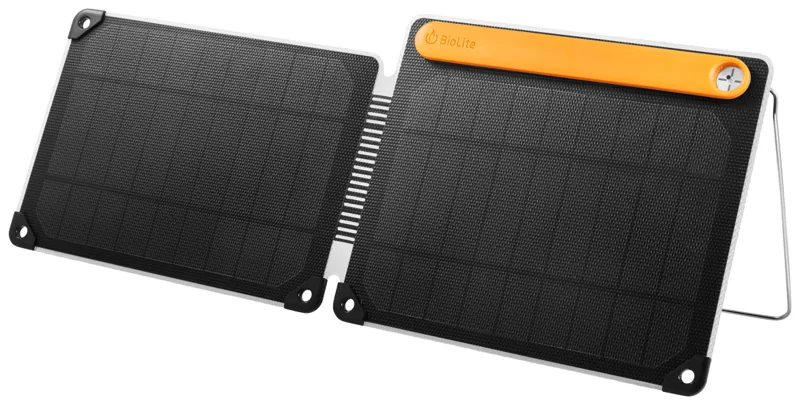
BioLite SolarPanel 10+. Image: BioLite
The 10+ pairs a 10 W folding panel with a 3,200 mAh battery, 550 g and IPX4 protection for $149.95. The battery stores what the panel collects, so a passing cloud does not interrupt your phone. A sundial and 360-degree kickstand help with aiming, and BioLite says poor alignment can cost up to 30% of output. BioLite claims a phone charge from the sun in about an hour at peak. Its help center lists the battery at 8 Wh, lower than the 11.8 Wh that 3,200 mAh would imply at 3.7 V, so expect about half an iPhone 17 from storage. The single USB-A port and one-year warranty are dated at this price.
10. BioLite SolarPanel 5+: the slimmer version
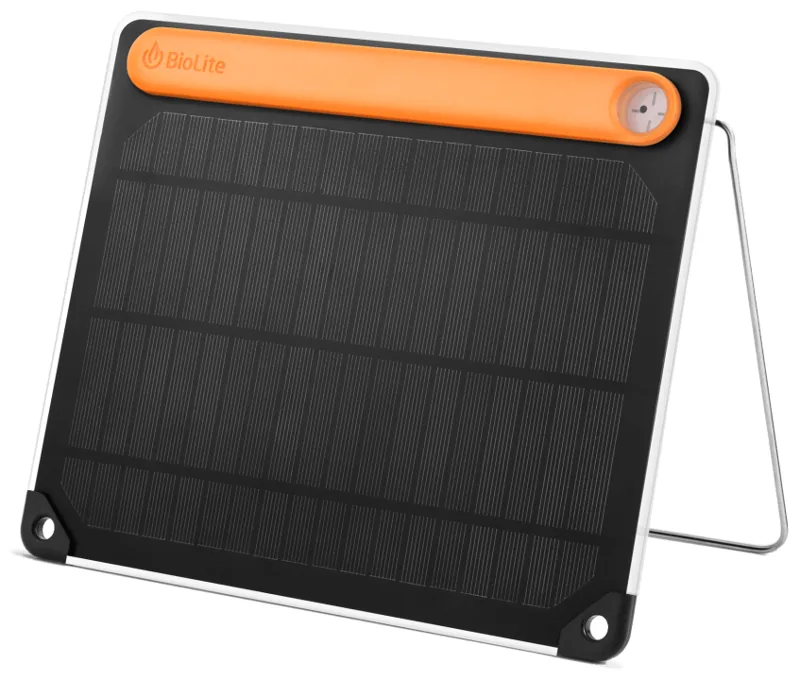
BioLite SolarPanel 5+. Image: BioLite
The 5+ uses a single 5 W panel with the same 3,200 mAh battery and weighs 0.9 lb, for $99.95. BioLite puts a phone charge at about two hours of peak sun, and its guide says a 5 W panel adds roughly 1,000 mAh per hour of direct light. It has the same IPX4 rating and USB-A port as the 10+. The 10+ costs $50 more and doubles the panel, which makes it the better buy for most trips.
Foldable USB Solar Chargers
These panels have no battery, so output stops when the sun does. They do have 5 to 60 times the wattage of a built-in slab, and that is the number that decides how much energy you collect in a day.
11. Goal Zero Nomad 10: simple and well documented
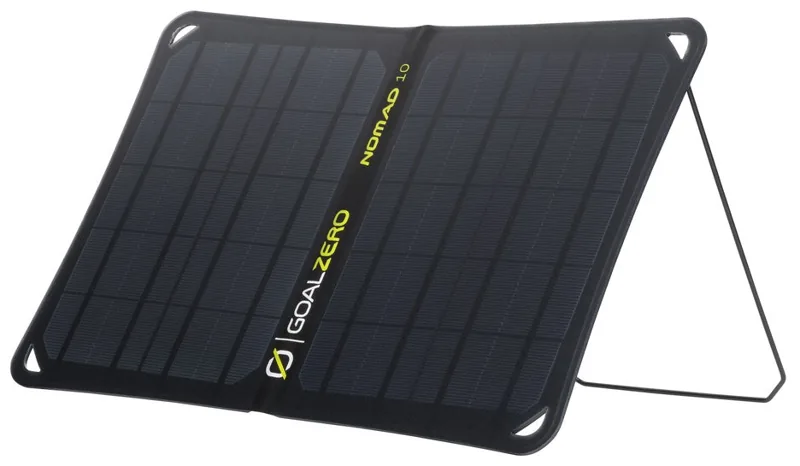
Goal Zero Nomad 10. Image: Goal Zero
Goal Zero is one of the few makers to publish charge times for each pairing. It quotes 4 to 8 hours to fill its Flip 24 and 4.5 to 9 hours for the Venture 35 from this 10 W panel. The $99.95 price buys a 510 g panel with a kickstand, a built-in dock for Flip power banks and a two-year warranty. Output is limited to USB-A at 7.5 W, and there is no IP rating. Goal Zero also sells a 5 W Nomad at $59.95 and a 20 W Nomad at $149.95.
12. BigBlue SolarPowa 28: the value pick
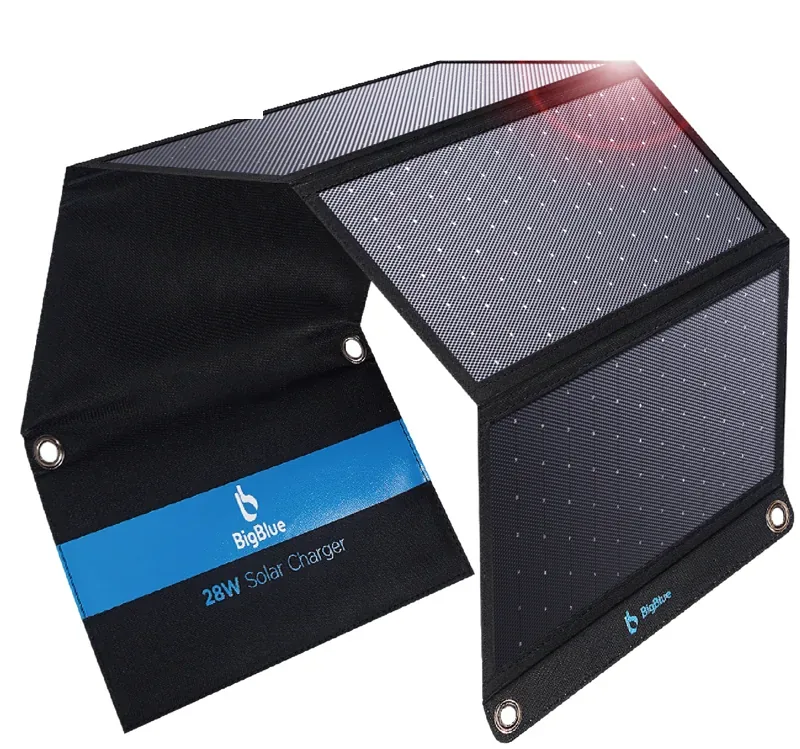
BigBlue SolarPowa 28. Image: BigBlue
BigBlue's 28 W panel uses SunPower cells rated at 21.5 to 23.5% efficiency and sells for $84.99, about $3 per rated watt. Three USB-A ports share 24 W, enough for two phones at once. It weighs about 584 g and folds to the size of a thick paperback. There is no USB-C, and BigBlue says to replug the device if cloud slows charging, so it won't reliably resume by itself. The practical fix is to charge a power bank from it and top up your phone from the bank.
13. BigBlue SolarPowa X60: USB-C that matters
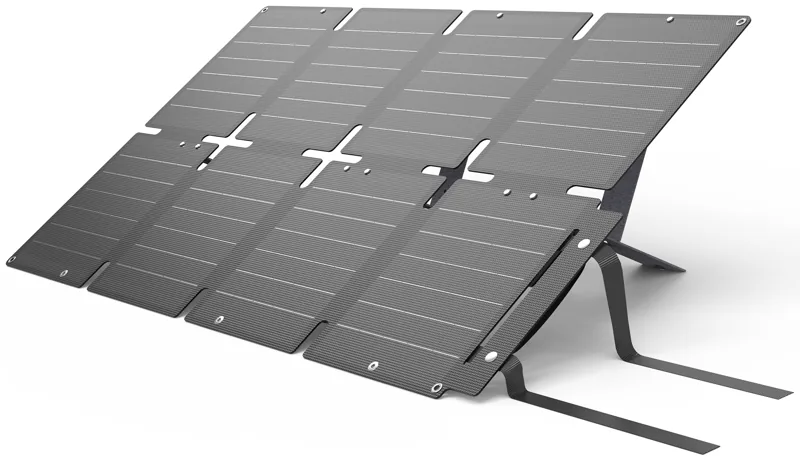
BigBlue SolarPowa X60. Image: BigBlue
The X60 is the only one of these four panels with a stated USB-C Power Delivery rating, up to 45 W, alongside USB-A and a DC output for power stations. Its TOPCon cells are rated at 24.3% and the $109.99 price comes to under $2 per rated watt, the lowest in this list. At 1.95 kg it is car-camping gear, not hiking gear. BigBlue's IP68 rating covers the panel only and excludes the junction box, so keep the electronics dry.
14. Jackery SolarSaga 40 Air: for power station owners
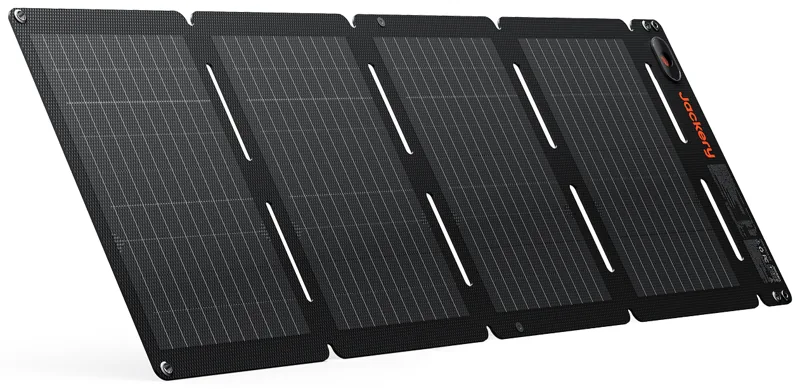
Jackery SolarSaga 40 Air. Image: Jackery
Jackery's 40 W panel weighs 0.9 kg, uses bifacial cells rated up to 23% and carries a three-year warranty for $129. USB-C and USB-A ports sit on its cable, along with a DC8020 connector for Jackery power stations. Jackery does not list per-port USB wattage on its US page. It rates the panel IP68, but its FAQ warns against leaving it in the rain, so treat that as splash protection.
Three more panels were listed but could not be bought for immediate delivery on 7 November: the EcoFlow 45W Type-C ($99, pre-order, and its USB-C port gives only 15 W), the Renogy E.Flex 30W ($73.99, backordered, 20 W USB-C PD at 0.56 kg) and the Nitecore FSP30 ($119.95, backordered). Readers in Europe should also look at Xtorm's XR203 (5 W panel, €99.95), its SolarBooster 28W (€99.95) and the Sunslice Photon (4 W, €109.95), which we left out because they sell in euros from European stores.
All 14 Models Compared
| Model | Battery | Panel | Fastest output | Weight | Water rating | Price |
|---|---|---|---|---|---|---|
| ToughTested ROC10 | 10,000 mAh / 37 Wh* | Not stated | 20 W USB-C PD; 15 W Qi | 363 g† | IP65 | $59 |
| ToughTested ROC16 | 16,000 mAh / 59.2 Wh* | Not stated | 20 W USB-C PD; 15 W Qi | 499 g† | IP65 (tag: IP67) | $69 |
| ToughTested Switchback | 10,000 mAh / 37 Wh* | Dual fold-out, not stated | 18 W USB-C PD | 499 g† | IP44 (URL: IP65) | $59 |
| ToughTested Solar24 | 24,000 mAh / 88.8 Wh* | Not stated | USB-C PD (W not stated) | 998 g† | IP66 (URL: IP67) | $99 |
| BLAVOR PN-W05 | 10,000 mAh / 37 Wh* | Not stated | 20 W USB-C PD; Qi | 350 g† | IPX5 | $69.99 |
| Hiluckey Hi-S225P | 27,000 mAh / 99.9 Wh* | 4 fold-out, up to 6 W | 18 W USB-C (22.5 W max) | 499 g† | None stated | $46.99 |
| FEELLE 10000 | 10,000 mAh / 37 Wh* | 4 fold-out, not stated | 5 V/3 A (15 W) | 241 g | None stated | $39.99 |
| FEELLE Wireless 10000 | 10,000 mAh / 37 Wh* | 3 fold-out, not stated | 15 W wired; 5 W Qi | Not stated | None stated | $37.99 |
| BioLite SolarPanel 10+ | 3,200 mAh / 8 Wh | 10 W | USB-A (10 W usable) | 550 g | IPX4 | $149.95 |
| BioLite SolarPanel 5+ | 3,200 mAh / 8 Wh | 5 W | USB-A | 0.9 lb | IPX4 | $99.95 |
| Goal Zero Nomad 10 | None | 10 W | USB-A 7.5 W | 510 g | None stated | $99.95 |
| BigBlue SolarPowa 28 | None | 28 W | 3× USB-A, 24 W total | ~584 g | None stated | $84.99 |
| BigBlue SolarPowa X60 | None | 60 W | 45 W USB-C PD | 1.95 kg | IP68 (panel only) | $109.99 |
| Jackery SolarSaga 40 Air | None | 40 W | USB-C, USB-A (W not stated) | 0.9 kg | IP68 (see text) | $129 |
*Calculated as mAh × 3.7 ÷ 1,000. †Shipping weight from store data, not a net specification. Prices: each brand's US store, 7 November 2026; Hiluckey at sale price.
Myth: The Sun Will Recharge Your Power Bank
The arithmetic is short. A 10,000 mAh bank holds about 37 Wh. Xtorm estimates 12 to 17 hours in optimal sun to fill one from a 5 W panel, which implies the panel delivers 44 to 62% of its rated power. Using 50% as a working figure, a 1 W panel supplies about 3.3 Wh on an average day in Phoenix. That is a quarter of an iPhone 17 battery before any losses in the bank.
Season and latitude make it worse. Peak sun hours at the ideal tilt range from 6.67 a day in Phoenix across the year to 1.28 in Seattle in December. Most people will not hold that ideal tilt: lay the panel flat on a pack in Seattle in December and the figure falls to 0.72.
| City | Peak sun hours a day (year / December) | 1 W panel, Wh a day | 6 W panel, Wh a day | 28 W panel, Wh a day |
|---|---|---|---|---|
| Phoenix | 6.67 / 5.21 | 3.3 / 2.6 | 20.0 / 15.6 | 93.4 / 72.9 |
| Denver | 5.73 / 4.38 | 2.9 / 2.2 | 17.2 / 13.1 | 80.2 / 61.3 |
| Chicago | 4.56 / 2.14 | 2.3 / 1.1 | 13.7 / 6.4 | 63.8 / 30.0 |
| Seattle | 3.95 / 1.28 | 2.0 / 0.6 | 11.9 / 3.8 | 55.3 / 17.9 |
Panel at optimal tilt, delivering 50% of rated watts. Sun hours: PVGIS-NSRDB averages for 2011–2015, all weather. Wh a day are our calculation. An iPhone 17 battery holds about 14 Wh.
Glass makes things worse again. Renogy advises against charging behind a window because output may be low, and Xtorm says panels work much less efficiently behind glass or a windshield. Other makers agree on cloud. BigBlue's FAQ points out that rated power is measured under laboratory conditions and that real output is lower.
What Happened to the Big Names
| Product | Status, November 2026 |
|---|---|
| Anker PowerCore Solar 10000 and 20000 | Sold out in Anker's Japanese store; the 20000's US page returns a 404 |
| Anker SOLIX PS30 foldable panel | US and UK pages gone, sold out in Australia; Anker's US panels are now power-station models |
| Nitecore FSP100 | Marked discontinued on Nitecore's site |
| Renogy E.POWER 16000 | Sold out and backordered |
| Jackery SolarSaga 40W Mini | Refurbished units only, replaced by the 40 Air |
| WakaWaka Power+ | Company went bankrupt in 2018; the relaunched brand sells a separate bank and panel |
| Powertraveller | Its web address now hosts an unrelated travel blog |
Safety: 2.6 Million Recalled Power Banks
The US Consumer Product Safety Commission announced 14 power bank recalls between June 2024 and October 2026, covering about 2.6 million units. Anker accounts for 1.64 million of them, across recalls in June and September 2025. The Casely recall, re-announced in April 2026, followed a death and an in-flight fire. HAIARA's W5 PRO, recalled on 29 October 2026, drew 600 reports of fire or thermal incidents from just 11,000 units sold.
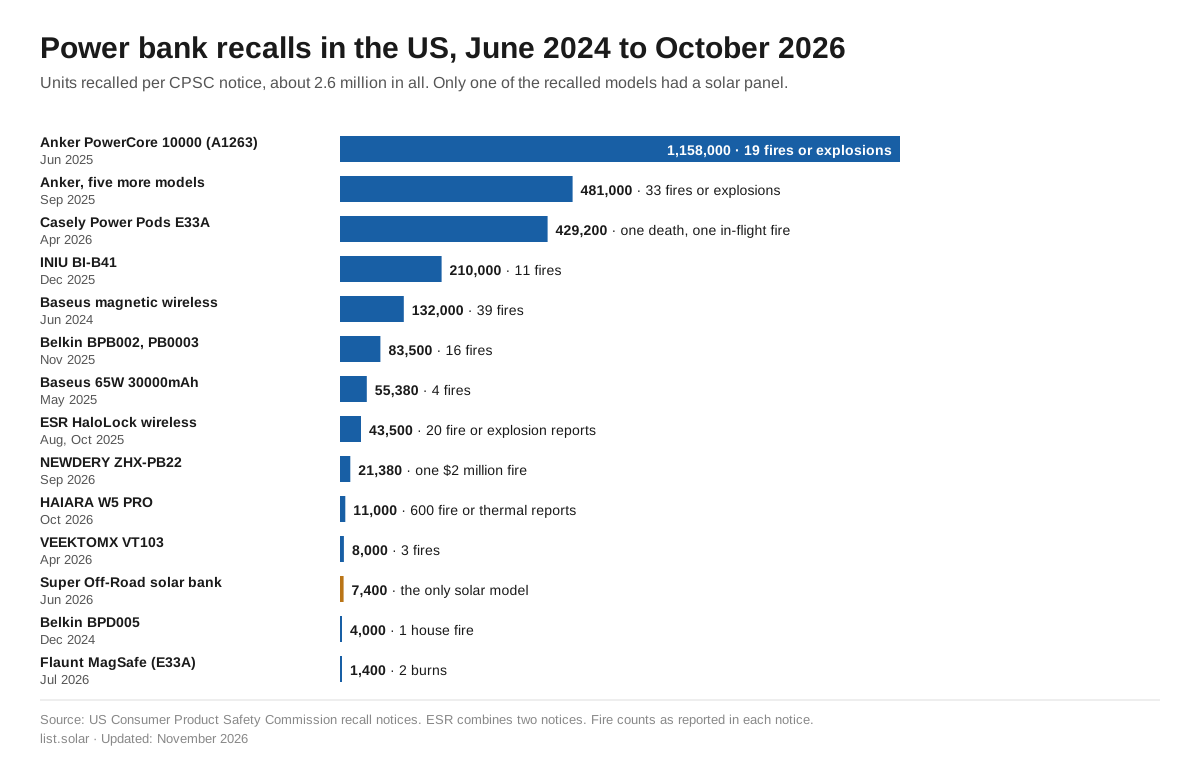
One solar model appears on the list: the 12,000 mAh Super Off-Road wireless bank, a promotional giveaway recalled on 25 June 2026 after two swelling reports. None of the 14 models on this page appears in those recalls. A clean record is limited comfort with brands this small, so three checks help.
Look for a certification. UL 2056 is the US power bank safety standard, and the full ANSI/CAN/UL 2056:2024 edition took effect on 22 October 2026. IEC 62133-2 covers the cells, and UN 38.3 is the transport test any lithium battery needs in order to fly. If a listing names none of them, ask the seller.
Mind the heat. Xiaomi's power bank specifications, for example, allow charging between 32 and 113 °F (0 to 45 °C). A dark bank left in direct sun can pass the upper limit, and solar charging invites exactly that, so shade the battery and expose only the panel where the design allows it. Do not charge it below freezing.
Treat swelling as the end of the road. CPSC's advice is to keep damaged and recalled lithium batteries out of the trash, curbside bins and retail recycling boxes, and to call a household hazardous waste center first. Check serial numbers at cpsc.gov before you keep using an older bank.
Flying with a Power Bank in 2026
US rules have tightened quickly, and airlines now go further than the FAA. Wireless banks are drawing attention too: IATA's guidance calls induction power banks an emerging concern after passengers reported thermal runaway.
| Authority or airline | Limit | On board |
|---|---|---|
| FAA and TSA | Carry-on only; 100 Wh without approval; up to two at 101–160 Wh with airline approval | Many airlines set stricter limits, the FAA notes |
| American Airlines | Two power banks, 100 Wh each, carry-on only | Keep visible and in reach while in use; no recharging from seat power; not in overhead bins |
| Delta Air Lines | Two power banks, 100 Wh each, no exceptions | No recharging on board; no use during taxi, take-off or landing; not in overhead bins |
| Southwest Airlines | One power bank per customer, carry-on | See Southwest's help center for current in-flight rules |
| ICAO (from 27 March 2026) | Two power banks per person | Must not be recharged on board; use to charge devices is discouraged |
| IATA (from 1 January 2027) | Allowance for 101–160 Wh power banks ends | 100 Wh becomes the ceiling under IATA's rules |
American and Delta from their official pages, November 2026. We could not confirm a published limit on United's own site, so check before you fly. Rules abroad can be stricter: Emirates bans all power bank use on board and Lufthansa Group has banned use and charging since January 2026.
Every battery product in this list is under 100 Wh. The Hiluckey Hi-S225P is the one to watch, at 99.9 Wh by the formula American publishes. If the Wh figure is not printed on the case, gate staff may have no way of confirming it, so check before you pack it.
How to Choose: Capacity, Panel and Port
Convert capacity first: Wh = mAh × 3.7 ÷ 1,000. Then allow for losses. Xiaomi publishes a 74% conversion rate for one 10,000 mAh model at 5 V, and that is a sensible working figure for banks that give no number.
| Bank size | Cell energy | Usable at 74% | iPhone 17 charges | Galaxy S25 charges | iPhone 17 Pro Max charges |
|---|---|---|---|---|---|
| 10,000 mAh | 37 Wh | 27.4 Wh | 1.9 | 1.8 | 1.4 |
| 16,000 mAh | 59.2 Wh | 43.8 Wh | 3.1 | 2.9 | 2.2 |
| 24,000 mAh | 88.8 Wh | 65.7 Wh | 4.6 | 4.4 | 3.4 |
| 27,000 mAh | 99.9 Wh | 73.9 Wh | 5.2 | 4.9 | 3.8 |
Our calculation. Phone batteries estimated from published mAh at 3.85 to 3.9 V: iPhone 17 about 14.2 Wh, Galaxy S25 about 15.1 Wh, iPhone 17 Pro Max about 19.6 Wh. Charging losses inside the phone are not included.
Weekend away, near a wall outlet before you leave: a built-in-panel bank such as the ROC10 is fine, because the battery does the work and the panel is insurance. Several days off-grid: a panel of 20 W or more plus a 10,000 to 20,000 mAh bank collects a full phone charge or more even in a Chicago December. Laptop or tablet: only USB-C PD at 45 W will do, which in this list means the X60. Heavy use at camp: move up to a portable power station.
Prices and Tariffs
The Section 301 duty on Chinese lithium-ion non-EV batteries rose from 7.5% to 25% on 1 January 2026. How a finished power bank is classified at the border varies, so its effect on shelf prices is hard to isolate. Store prices themselves vary widely per unit of storage: the Hiluckey costs $0.47 per Wh, the ROC16 $1.17, the ROC10 $1.59, the PN-W05 $1.89, and the BioLite 10+ $18.74, though most of that BioLite price buys panel rather than battery.
When a Power Station Makes More Sense
A power bank stops being the right tool once you need an AC outlet or more than about 100 Wh, which is also where airline rules end. We compare 15 current models, from $289 to 5 kWh units, in our guide to the best portable power stations of 2026. For fixed home systems, see our guides to home solar batteries and solar panels.
Methodology and Data Sources
Selection. We looked for solar power banks and USB solar chargers from brands that sell through their own US-dollar store, and kept models that were in stock on 7 November 2026. Marketplace-only brands without an official store were excluded. Models sold only in euros are mentioned separately.
Specifications come from manufacturer product pages, manuals and help centers. Where a maker publishes conflicting figures, the text says so and we use the more conservative one. Most makers give capacity in mAh only, so Wh figures are calculated at 3.7 V. Weights marked † are shipping weights from store data. We did not test any product ourselves.
Solar yields. Peak sun hours come from the European Commission's PVGIS 5.2 service, using the PVGIS-NSRDB dataset for 2011–2015 at each location's optimal tilt. The 50% output factor is our own estimate, based on the range of 44 to 62% implied by Xtorm's charge-time table for a 5 W panel and a 10,000 mAh battery.
Recalls. The 2.6 million total sums US units from 14 CPSC recalls, treating ESR's August 2025 recall and its October expansion as one and counting the Casely re-announcement once.
Updates. This page replaces the May 2024 edition. Prices are from the first week of November and may shift during holiday sales. We plan to recheck stock and airline rules after 1 January 2027, when the IATA change takes effect.
FAQ
Do solar power banks actually charge from the sun?
Yes, but slowly. A 1 W built-in panel needs about 11 days of average Phoenix sun to refill a 10,000 mAh bank at realistic output. FEELLE quotes 15 to 20 hours for a four-panel bank at best. Charge the bank from a wall before a trip and treat the panel as emergency backup.
What is the best solar power bank in 2026?
For a bank with a built-in panel, the ToughTested ROC10 has the strongest specifications for its price: 20 W USB-C PD, 15 W Qi, IP65 and a five-year warranty at $59. For charging mainly from the sun, a foldable panel such as the $84.99 BigBlue SolarPowa 28 paired with an ordinary power bank collects far more energy.
Can I take a solar power bank on a plane?
Yes, in carry-on bags only and generally up to 100 Wh, or about 27,000 mAh at 3.7 V. American and Delta allow two per person and Southwest allows one. Keep it out of overhead bins and do not recharge it from seat power. Check your airline before flying, since rules changed several times in 2026.
How long does a solar charger take to charge a phone?
Xtorm estimates about four hours for its 28 W panel to fill a 10,000 mAh bank, which implies roughly two hours for a phone in strong sun. BioLite claims about an hour for its 10 W panel at peak and two hours for its 5 W model. Passing cloud can interrupt charging from panels with no battery.
Do solar chargers work through a window or on a cloudy day?
They work poorly in both cases. Renogy advises against charging behind a window because output may be low, and Xtorm says panels are much less efficient behind glass or a windshield. Goal Zero notes that reflected light still produces some energy, only less of it. Put the panel outside and aim it at the sun, and expect a fraction of rated power under cloud.
Related on List.Solar
Sources
- ToughTested: ROC10, ROC16, Switchback, Solar24, solar charger guide (accessed 7 Nov 2026)
- BLAVOR: PN-W05 (accessed 7 Nov 2026)
- Hiluckey: Hi-S225P, HI-S025 (accessed 7 Nov 2026)
- FEELLE: 10000 four-panel, Wireless 10000 (accessed 7 Nov 2026)
- BioLite: SolarPanel 10+, SolarPanel 5+, help center, power guide
- Goal Zero: Nomad 10, Nomad 5, Nomad 20, solar panel FAQ
- BigBlue: SolarPowa 28, SolarPowa X60
- Jackery: SolarSaga 40 Air
- Other panels: EcoFlow 45W, Renogy E.Flex 30W, Nitecore FSP30, Renogy E.POWER 16000 with datasheet
- Europe: Xtorm XR203, Xtorm Go2, SolarBooster 28W, Xtorm charging times (21 Mar 2024), Sunslice Photon
- Anker Japan: PowerCore Solar 10000, PowerCore Solar 20000; Nitecore: FSP100; WakaWaka bankruptcy, Solar Magazine
- US Consumer Product Safety Commission recall notices: Anker, Jun 2025, Anker, Sep 2025, Casely, INIU, Baseus, 2024, Baseus, 2025, Belkin, Nov 2025, Belkin, Dec 2024, ESR, NEWDERY, HAIARA, VEEKTOMX, Super Off-Road, Flaunt
- Air travel: FAA PackSafe (updated 11 Aug 2026), TSA, American Airlines, Delta, Southwest help center, IATA guidance to operators (31 Mar 2026), UK CAA on the ICAO addendum, Emirates, Lufthansa Group
- Standards: UL 2056, Intertek notice on ANSI/CAN/UL 2056:2024, IEC 62133-2, WPC, Qi2 25W (23 Jul 2025)
- Sun and battery data: EU JRC PVGIS 5.2 (PVGIS-NSRDB, 2011–2015); Xiaomi 10000mAh 22.5W Lite specifications, Xiaomi power bank temperature range; Apple iPhone 17 specifications, MacRumors on iPhone 17 battery capacities (9 Sep 2025), Samsung Galaxy S25 specifications
- Tariffs: USTR, Section 301 modification, 89 FR 76581 (18 Sep 2024)
Also read
- Ember Finds Wind Cuts Cost of Near-Firm Solar and Batteries by 18%
- Haier Energy Rolls Out 12-20-kW Hybrid Inverters for Hot Asian Markets
- Enphase to Show 80-kWh Commercial Battery and IQ Battery G5 at RE+
- Kansai Electric Agrees to Buy 49.99% of 600-MWh Virginia Battery
- Flower, dces File Permits for 500-MW, 2-GWh Battery Near Berlin