Encapsulation-Free Hybrid Perovskite Hits 27% Efficiency
- Moisture-proof hybrid perovskite/organic solar cells hit 27.18% efficiency, keeping 95% after 3,000 damp-heat hours—engineered cascade hole transfer reduces recombination.
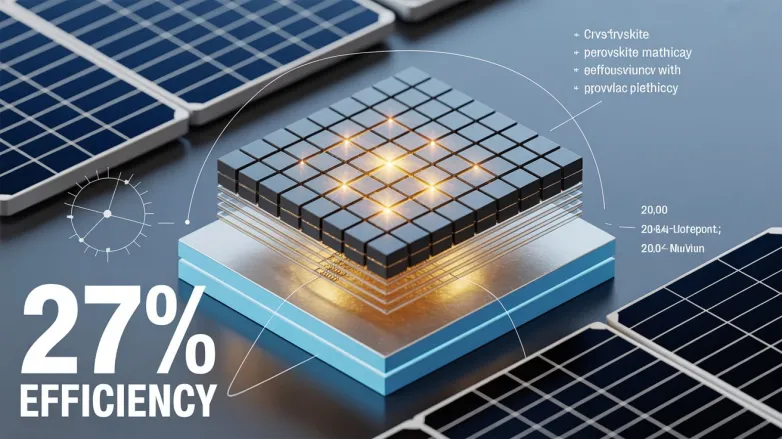
Researchers from Korea’s University of Ulsan, KAIST, UNIST, GIST and Korea University report encapsulation-free hybrid perovskite/organic solar cells designed to tackle two major problems: moisture-driven degradation and charge recombination from interfacial energy mismatch. Traditional perovskites are highly sensitive to water and heat, usually requiring costly encapsulation, while hybrid integration can misalign energy levels and cause hole accumulation that accelerates recombination and reduces lifespan.
The team used multiphysics modeling to identify charge buildup and engineered a cascade hole-transfer energy structure with an electron-donating polymer featuring a deep HOMO to enable directional hole transport and suppress recombination in the perovskite bulk and at interfaces. The optimized cells achieved a champion 27.18% power conversion efficiency (certified 26.71%) and retained over 95% efficiency after 3,000 hours under damp-heat conditions (85°C, 85% RH). Simulations project an 80% efficiency drop time of ~35,590 hours at 25°C, exceeding four years without sealing.
How encapsulation-free hybrid perovskite cells resist moisture and recombination?
- Moisture resistance via an inherently more water-tolerant device architecture: the electron-donating polymer/active-layer design reduces direct exposure pathways for water to reach vulnerable perovskite regions.
- Slower moisture-driven degradation chemistry: improved interfaces limit how quickly water can trigger reactions that form non-radiative recombination sites (e.g., defect-rich phases) in or near the perovskite.
- Defect suppression that indirectly improves hydrophobic stability: by controlling interfacial quality and charge-carrier flow, the cell maintains fewer trap states that moisture would otherwise activate or enlarge.
- Energy-level engineering to prevent charge pile-up: the “cascade” hole-transfer alignment guides holes along a directional path rather than letting them accumulate at interfaces.
- Reduced interfacial recombination: better matching between the perovskite’s extraction pathway and the adjacent polymer’s energy landscape lowers the probability that electrons and holes meet and recombine at the interfaces.
- Fewer non-radiative losses in the perovskite bulk: charge transport designed to be smoother and more selective helps keep carriers away from defect-assisted recombination centers.
- Ion migration and electrochemical degradation mitigation: suppressing detrimental charge accumulation at boundaries reduces local electric fields and chemical conditions that promote ion movement under damp heat.
- Interface “selectivity” (carrier-only behavior): the polymer structure functions to favor hole transport while restricting unwanted carrier leakage, which lowers recombination currents even as conditions become harsh.
- Modeling-guided thickness/energy-structure optimization: multiphysics analysis helps tune transport and buildup so that under humid environments the device reaches a more stable steady-state carrier distribution.
- Mechanical/structural robustness without sealing: optimizing morphology and interfacial contact helps maintain continuity of transport pathways even under thermal stress associated with damp-heat testing.