Donor–acceptor SAMs lift inverted perovskite efficiency to 25%
- Co-assembled SAMs for inverted perovskite solar cells: pair Me4 with new donor–acceptor LYS-H/LYS-F to boost hole extraction, cut recombination, and deliver 25.02% efficiency.
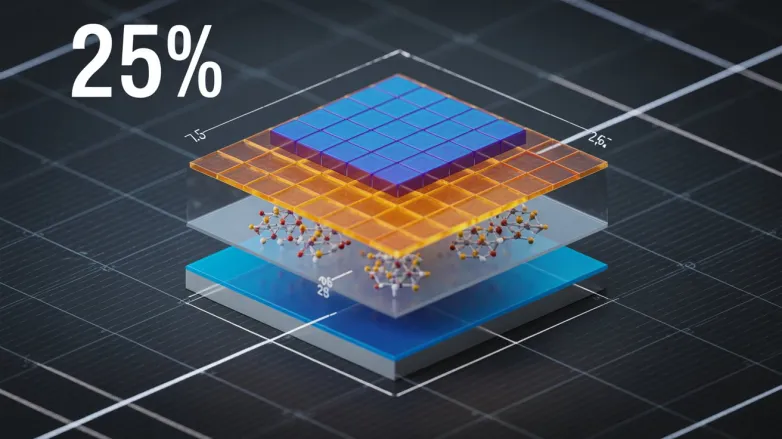
Researchers from Soochow University, National Taiwan University and Chang Gung University report a co-assembled self-assembled monolayer (SAM) approach for inverted perovskite solar cells. The strategy pairs the hole-selective Me-4PACz (Me4) SAM with two newly designed donor–acceptor molecules, LYS-H and fluorinated LYS-F, aimed at resolving buried-interface problems including Me4 aggregation, weak perovskite wettability, poor interfacial contact, subpar crystallinity and resulting non-radiative recombination losses.
The donor–acceptor backbones strengthen interfacial dipoles to enhance hole extraction and include functional groups to passivate buried defects. Triphenylamine enables π–π stacking with Me4 to suppress aggregation and improve uniformity, while LYS-F fluorination deepens HOMO and raises effective work function for better energy-level alignment. Cells using Me4+LYS-F reach 25.02% power conversion efficiency with a 83.64% fill factor and show improved air-stability under ~30% RH at 25°C in the dark.
How does Me4+LYS-F co-assembled SAM improve inverted perovskite solar cell efficiency and stability?
- Forms an interfacial “molecular passivation layer” at the buried hole-transport side, reducing trap densities that typically arise where perovskite first nucleates and where charge-selective layers meet.
- Limits Me4-based SAM clustering/aggregation by co-assembling it with a second donor–acceptor component, yielding a more continuous, defect-scarce coverage across the substrate.
- Improves perovskite film formation through better interfacial affinity: the co-assembly increases wetting and promotes more uniform nucleation, which helps suppress pinholes and local compositional inhomogeneity.
- Enhances contact quality between the hole-selective SAM region and the growing perovskite via additional intermolecular interactions, lowering interfacial contact resistance and facilitating faster hole transfer.
- Strengthens interfacial electrostatics by introducing donor–acceptor dipoles that tune the local energy landscape, improving alignment for hole extraction in inverted device stacks.
- The fluorinated LYS-F component increases the effective work-function of the hole-transport interface, improving the driving force for hole collection and reducing the likelihood of charge accumulation at the buried interface.
- Deepens the hole-selective energy level position (via electronic effects from fluorination), which can help reduce interfacial non-radiative recombination by improving carrier selectivity.
- Provides chemical defect passivation: functional groups on the co-assembled molecules can bind or neutralize undercoordinated ions and other buried-interface defects that otherwise act as recombination centers.
- Suppresses non-radiative recombination losses by combining (i) defect passivation, (ii) improved film quality, and (iii) more favorable energy-level/field conditions at the hole-transport/perovskite boundary.
- Improves operational stability by creating a more robust barrier against moisture and oxygen ingress at the buried interface, slowing chemical degradation pathways that typically start at interfacial defects.
- Maintains performance under ambient exposure by reducing ion migration incentives at the interface (fewer traps, improved interfacial energetics), which helps preserve device efficiency over time.
Also read