LONGi and Soochow Tandem Cell Reaches 35.1% Certified Efficiency
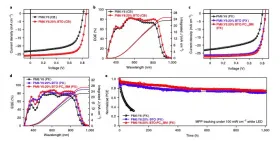
A Soochow University and LONGi perovskite-silicon tandem cell reached 35.1% certified stabilized efficiency in Nature, using a new hole-transport molecule.
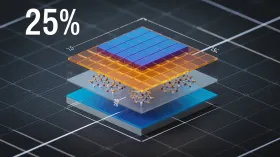
Co-assembled SAMs for inverted perovskite solar cells: pair Me4 with new donor–acceptor LYS-H/LYS-F to boost hole extraction, cut recombination, and deliver 25.02% efficiency.
Nanocomposite boosts tough perovskites: amorphous–crystalline silicon nitride layer tames defects, lifts efficiency to 26.65%, and keeps large modules humming outdoors for 6+ months—real-world scalability in sight.
China-led breakthrough: perovskite–silicon tandem hits 32.12% efficiency via steric-complementary passivation, slashing recombination, edging toward 40%, and retaining 80% after 1,000 hours MPP with HJT.
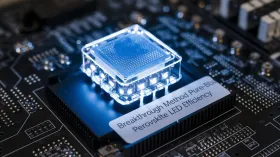
Soochow University researchers unveil a breakthrough in pure-blue PeLEDs, achieving superior efficiency and stability, transforming the future of light-emitting technologies with novel techniques.
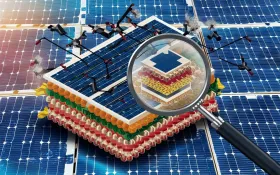
Revolutionary research by top universities shows SCN ions boost perovskite solar cell performance, with PCE of 25.82% and 1,000-hour stability.
Revolutionize solar energy with pseudo-halogen thiocyanate ions in perovskite/organic tandem cells, boosting efficiency and stability for long-lasting power.
This breakthrough in SHJ solar cell technology could revolutionize solar power: Researchers have developed cells with record-breaking power-conversion efficiencies of up to 26.4%, using cost-effective fabrication techniques for large-scale deployment. Let's make solar power a reality!
Scientists from China's East China Normal University (ECNU), Shanghai University, Donghua University and Soochow University have actually fabricated an upside down perovskite solar cell with remarkable charge transport.
Tandem solar cells (TSCs), stacks of p-n junctions based on semiconductors with various bandgaps, are an extremely appealing energy service that could help to minimize carbon emissions.
Over the past couple of years, designers have actually produced progressively sophisticated technologies to create as well as save energy a lot more sustainably. Solar cells made from organic particles or polymers are among the most promising sustainable energy solutions, as they are generally thin, light-weight and also flexible.
We are significantly making use of more smart tools like mobile phones, wise audio speakers, and wearable health as well as health sensing units in our homes, workplaces, and public buildings. Nonetheless, the batteries they make use of can diminish promptly and include hazardous and also uncommon environmentally damaging chemicals, so scientists are searching for far better ways to power the gadgets.
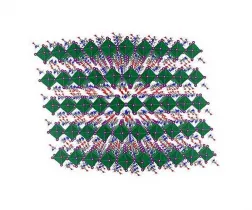
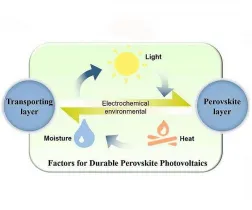
Perovskite products are becoming progressively prominent as the active layer in solar cells. Inner forces in these products trigger distortions in their crystal frameworks, decreasing symmetry and also adding to their intrinsic instability. They are also based on environmental destruction.