organic solar cells

Technology ·

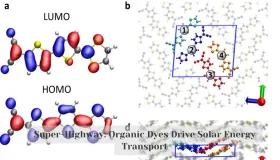
Super-Highway: Organic Dyes Drive Solar Energy Transport

Organic dyes provide virtual highways for energy, leading to light & thin organic solar cells with improved efficiency. TUM research group discovers quinoid merocyanines to increase performance of organic solar cells with fast and targeted exciton transport.


Technology ·

Enhancing organic solar cells' green glow

Organic solar cells could be made even greener by switching over the solvents utilized in their manufacture. Today's toxic chlorinated solvents can be changed by plant-derived options without influencing the resulting solar cells' light-capturing efficiency, KAUST researchers have actually revealed.

Technology ·

A strategy to optimize photocurrent in organic photovoltaics by suppressing recombination loss

Organic photovoltaics (OPVs), solar technologies based on organic semiconductors, have actually revealed excellent promise both for the scalable provision of clean energy and also for the development of solar-powered wearable electronics. Regardless of their benefits, organic solar cells suffer from the so-called recombination loss, a loss of photocurrent resulting from the recombination of photocarriers.

Technology ·

Alkoxy replacement on asymmetric conjugated molecule enables high-efficiency ternary organic solar cells

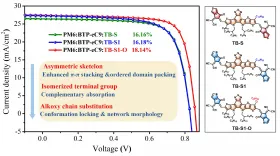
A study team led by Prof. Ge Ziyi at the Ningbo Institute of Materials Technology and Engineering (NIMTE) of the Chinese Academy of Sciences (CAS) has actually established an alkoxy-substituted asymmetric conjugated molecule as well as doped it right into the PM6: BTP-eC9-based binary organic solar cells (OSCs) as a 3rd component, leading to high-efficiency ternary OSCs with a power conversion performance (PCE) of over 18.1%.

Technology ·

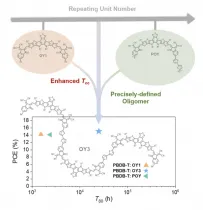
Stable and efficient organic solar cells based upon oligomer acceptors

Organic solar cells are solar technologies with light-absorbing layers made from conductive organic polymers or organic molecules. These solar power solutions can have remarkable advantages over their non-organic counterparts, including lighter weight, a bigger area insurance coverage and lower construction costs.

Technology ·

New understandings right into energy loss open doors for up-and-coming solar tech

Organic solar cells are an emerging technology with a great deal of promise. Unlike the ubiquitous silicon solar panel, they have the possible to be lightweight, flexible, and present a variety of colors, making them particularly eye-catching for urban or façade applications. Nonetheless, continued innovations in device performance have been slow as researchers work to recognize the fundamental processes underlying exactly how organic solar cells operate.

Technology ·

Scientists realize large-area organic solar cells that are low-cost, flexible, and also reliable

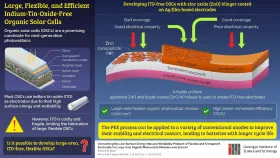
Organic solar cells (OSCs), that make use of organic materials to transform sunlight into electrical power, are an attractive candidate for future photovoltaics. This is because of numerous of their preferable features, such as their light weight, flexibility, pliability, and, most significantly, high power conversion efficiency (PCE). Such top qualities make them optimal for a vast array of applications.

Technology ·

Excitons need space to separate: Free carrier production in organic solar cells

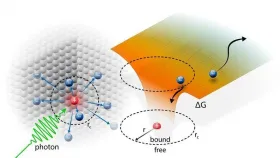
Solar cells based upon organic molecules offer potential advantages over conventional devices for transforming light into electricity. These organic solar cells could be inexpensive, durable, and very easy to make. However, organic cells do not yet have the performance that matches conventional devices.

Technology ·

Being available in 2023, Organic Solar Cells That Can Work Indoors Too

Organic solar cells, with their flexibility and enhanced conversion rates, have the potential to take solar to places it has actually not been seen in yet. With the current cells promising the solar efficiency of silicon cells from a decade back, it is an excellent bet that we will certainly see some success stories soon.

Technology ·

Mapping exactly how energy flows in organic solar cells

Efficient as well as environmentally friendly solar cells are required for a transition to a fossil-free energy supply. Researchers at Linköping University have mapped exactly how energy flows in organic solar cells, something that formerly had been unknown. The outcomes, which can contribute to a lot more efficient solar cells, are published in Nature Communications.

Technology ·

New Study Accelerates Development of Organic Solar Cells

A lot of today's solar cells are made from silicon and are heavy, inflexible, and expensive to create. By comparison, organic solar cells hold the assurance of being light-weight, flexible, and also inexpensive to make.

Technology ·

Machine-learning to forecast the efficiency of natural solar cells

Picture looking for the optimal setup to construct a natural solar cell made from various polymers. Exactly how would certainly you start? Does the energetic layer demand to be extremely thick, or very slim? Does it require a large or a small amount of each polymer? Understanding exactly how to predict the particular structure and also cell design that would cause optimal efficiency is one of the best unresolved problems in products scientific research.

Technology ·

Pollutants improve efficiency of organic solar cells

Sunshine uses a prospective service in the look for an energy resource that does not damage the planet, but this relies on discovering a method to successfully turn electro-magnetic power into electricity. Scientists from KAUST have demonstrated how a recognized herbicide can improve this conversion in natural devices.

Technology ·

Reliable, natural solar cells of the future

As part of his doctoral thesis, a young researcher at the Friedrich-Alexander University of Erlangen-Nuremberg has actually devised a means to make natural solar cells extra effective.