KIT

Technology ·

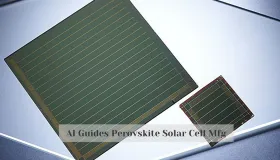
AI Guides Perovskite Solar Cell Mfg

Discover how AI can help produce high-grade perovskite solar cells with greater efficiency. Learn how Karlsruhe Institute of Technology and two Helmholtz platforms used AI to predict the quality of perovskite layers and cells with their Advanced Materials breakthrough.

Technology ·

Thin-film photovoltaic technology combines effectiveness and versatility

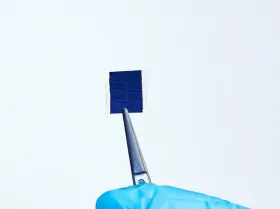
Piling solar cells boosts their efficiency. Dealing with partners in the PERCISTAND project, scientists at the Karlsruhe Institute of Technology (KIT) have produced perovskite/CIS tandem solar cells with an efficiency of nearly 25%-- the highest value achieved so far with this technology.

Technology ·

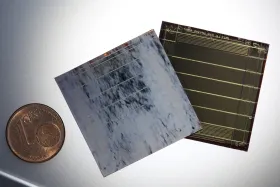
Perovskite solar modules with a marble look

In the laboratory, perovskite solar cells already reach effectiveness above 25 percent. Compared to silicon solar cells of similar effectiveness, the preliminary materials used in the former situation are more affordable and manufacturing methods are less complex. Until now, nonetheless, this has only been true on the little scale.

Technology ·

KIT achieves 18 percent effectiveness with perovskite solar module

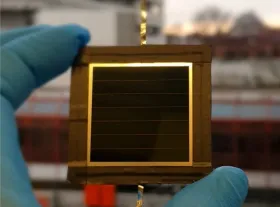
Scientists at the German Karlsruhe Institute of Technology (KIT) have actually produced perovskite solar modules with virtually no scaling losses. They combined serial interconnection by laser with vacuum processing of all layers of the solar cell.

Storage ·

Scientists to study on "flexible" battery systems

Lithium-ion battery cells have actually until now been generated according to standard formats and also in rigid systems. According to German Karlsruhe Institute of Technology (KIT), flexibly versatile cells are necessary to ensure that batteries - as an example for electromobility - can be fitted precisely even in intricate rooms and also can save a lot more energy.

Technology ·

Buckyballs on DNA for harvesting light

Organic molecules that record photons and also convert these into electrical energy have vital applications for generating environment-friendly power. Light-harvesting facilities need 2 semiconductors, an electron benefactor as well as an acceptor. Exactly how well they function is determined by their quantum efficiency, the price whereby photons are exchanged electron-hole pairs.

Technology ·

Losing weight on silver

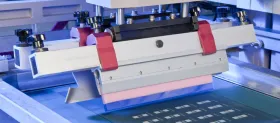
Using an ingenious high-speed video clip arrangement, researchers in Germany had the ability to observe the screen-printing process utilized in solar cell metallization, on a time scale of less than 50 milliseconds. Insights into the paste's behavior and the mechanisms at the workplace during display printing will improve the procedure as well as the formulation of the silver paste it relies upon.

Technology ·

German-led consortium aims for 33% efficient perovskite-silicon solar cell

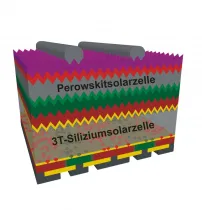
The Institute for Solar Energy Research Hamelin (ISFH), the Karlsruhe Institute of Technology (KIT) as well as the Institute for Materials as well as Components in Electronics at the University of Hannover, in addition to Centrotherm, Singulus, Meyer Burger as well as Von Ardenne are associated with a study project focused on achieving a 27% conversion effectiveness for silicon solar cells based on perovskite.

Storage ·

Perovskite structure additionally profits batteries

Researchers at Germany's Karlsruher Institute of Technology are leading an investigation into a new lithium-ion battery anode. The advancement has a perovskite crystalline structure as well as, according to the scientists, can give solid overall efficiency from less complex, less costly manufacturing methods than those made use of for other anode products.

Manufacturing News ·

German scientists team up for perovskite tandem cells

Two of Germany’s leading research institutes and a CIGS module maker have announced plans to work on the development of perovskite-CIGS tandem cells with a target of producing thin film modules with better than 30% efficiency.