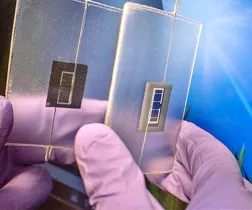
Ambient-Made Perovskite Tandems Hit 31.72% Efficiency
Ambient-air fabrication breakthrough: ternary GDMA/AG SAMs stabilize perovskite and perovskite/Si tandems, boosting efficiencies up to 31.72% and keeping 92%+ after 600h at 85°C.
Boosting solar power: New ionic salt triples perovskite cell strength, achieving 26.1% efficiency and enhanced durability for a brighter, sustainable future.
Breakthrough solar technology! A collaborative team achieves a record 26.05% efficiency in perovskite solar cells, combining unique materials and techniques for lasting power and commercial potential.
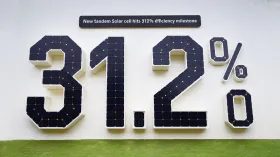
Revolutionizing solar energy, a new perovskite-silicon tandem cell achieves 31.2% efficiency, paving the way for scalable, robust, and innovative renewable energy solutions.
Revolutionize solar energy with diamine chelates! Researchers enhance stability and efficiency in tandem solar cells, paving the way for commercialization.
Revolutionary research enhances silicon/perovskite tandem solar cells with THTZ-H+ additive, achieving 33.7% PCE. A game-changer for renewable energy production.
Revolutionary solar cell design by KAUST researchers achieves record-breaking 31.5% efficiency with innovative hole transport layer technology.
Revolutionary solar cell design achieves 25.6% efficiency with 2D/3D heterojunctions. Groundbreaking research from KAUST, UNIST, and the Chinese Academy of Sciences.
Discover the breakthrough in solar cell technology: a perovskite-silicon tandem cell with a thermally evaporated C60 electron transport layer. Achieving an impressive 30.90% efficiency, this innovation could revolutionize the industry.
Scientists at KAUST have published a roadmap for perovskite/silicon tandem solar cells, combining efficiency and stability for affordable clean energy. Paving the way for a $10 billion market.
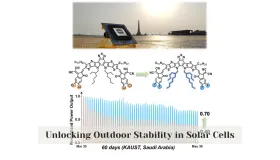
Unlock a new source of energy with KAUST's discovery of a link between organic semiconductor and outdoor stability of organic solar cells. With applications from photovoltaic windows to net-zero greenhouses, this breakthrough could open up a world of possibilities.
Researchers from Princeton University and KAUST have linked silicon and perovskite solar cells to boost efficiency and stability. Partial shading had no effect on the tandem solar module, making it an effective renewable energy resource.
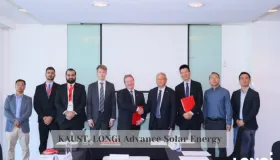
KAUST and LONGi sign MoU to foster innovation in solar energy, leveraging expertise and resources to advance technologies, develop materials, optimize performance, and promote talent development. Helping to address climate change and the Kingdom of Saudi Arabia's Vision 2030.
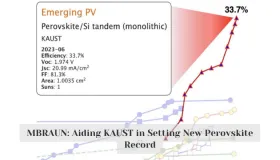
KAUST University in Saudi Arabia breaks new world record in efficiency of perovskite tandem solar cells with the help of MBRAUN systems, reaching 33.7% certified power conversion efficiency. This ultra-high performance photovoltaic technology is essential for fast green energy transition.
KAUST researchers conduct tests to determine accuracy of temperature coefficient metric for perovskite-silicon tandem solar cells. Results show external quantum efficiency, bandgap, local solar spectrum, and operating temperature range all influence assessment. Research team unable to predict changes in tandem cells under outdoor conditions. Findings could help community better understand outdoor data and improve tandem cell efficiency.
Less than 2 months after achieving a new world record for tandem solar cell effectiveness of 33.2%, KAUST scientists have actually introduced an enhancement to this number by getting to a power conversion effectiveness of 33.7% for a perovskite-silicon solar cell.
Making solar cells more efficient is an obvious win for green power. It indicates more electrical power from the very same number of panels as well as the exact same amount of sunlight-- and also scientists are working hard to tackle the challenge.
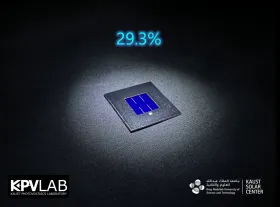
Scientists at Saudi Arabia's King Abdullah University of Science and also Technology (KAUST) have actually established a perovskite/silicon tandem solar cell with the world's highest possible power conversion effectiveness (PCE) of 33.2%, according to an announcement on Monday.
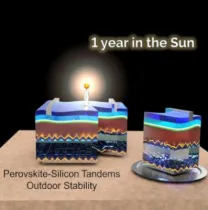
Scientists from Saudi Arabia's King Abdullah University of Science and also Technology (KAUST) have actually reported the results of an one-year outdoor test for a tandem perovskite-silicon solar cell they developed in 2020. They have located that the device retained greater than 80% of its initial performance throughout the testing period between April 2021 as well as April 2022.
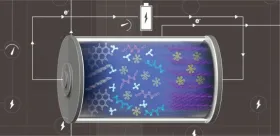
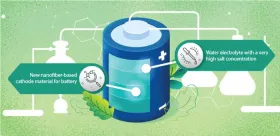
Rechargeable batteries that utilize ammonium cations as charge carriers could provide ecofriendly and sustainable substitutes to metal-ion-based batteries, researchers at KAUST show.
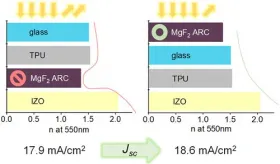
A solar-cell module that mitigates cell-to-module losses has actually been established by KAUST researchers complying with a rethink of the module's optical design as well as how it must be stacked.
Researchers in Saudi Arabia have built an inverted perovskite-silicon tandem device with a 1 nm thick interlayer based on magnesium fluoride (MgFx). They declare it can quit voltage losses and boost power conversion performance, while preserving 95.4% of its initial performance after 1,000 hrs.
Recently, designers worldwide have actually been creating various new technologies to generate and store energy more sustainably. These technologies consist of solar or photovoltaic cells, electrical tools that can convert the light from the sun right into electrical energy.
A thorough view of just how electric charges behave inside perovskites might assist initiatives to improve the performance of next-generation solar cells based upon these materials, KAUST research published in Nature Communications has shown.
Researchers in Saudi Arabia have actually developed photovoltaic panels that soak up water vapour from ambient air. This has actually been utilized to grow spinach in the middle of the desert.
Scientists in Saudi Arabia have actually reported the "the very first" successful damp-heat examination of perovskite solar cells, which they claim has relocated the technology closer in the direction of industrial viability after it held up against 1,000 hours of extreme conditions as well as kept a 95% effectiveness.
A high-performance variation of the zinc-ion battery will enable stationary power storage space that assures to be less expensive, much safer and also a lot more environmentally friendly than lithium-ion batteries.
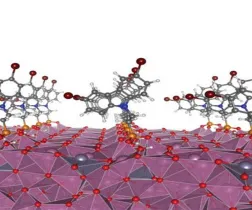
A multifunctional molecule that connects numerous atomic-scale defects in perovskite solar products can dramatically improve the longevity and electric result of this promising solar modern technology, KAUST scientists have revealed.
The previous record for n-type perovskite tandem solar cells was 22% performance. Monolithic perovskite/silicon tandem solar cells have high power conversion efficiency potential at budget-friendly expense.
An electrode coating just one molecule thick can substantially enhance the efficiency of an organic photovoltaic cell, KAUST scientists have actually found. The coating outperforms the leading product currently made use of for this job and may lead the way for enhancements in various other tools that rely upon organic molecules, such as light-emitting diodes and also photodetectors.
A synthetic approach that improves absorber layers in perovskite solar cells might help them accomplish their full potential as well as draw closer to the performance of leading gallium arsenide tools.
2 types of products are better than one when it comes to solar cells, as exposed by a worldwide team that has actually tested a new combination of products and architecture to enhance solar-cell efficiency.
Two types of products are far better than one when it comes to solar cells, as exposed by an international team that has actually checked a new mix of products and also design to boost solar-cell effectiveness.
To raise the performance of solar panels, a team of scientists based in Saudi Arabia, Italy, Germany and Canada has developed a bifacial, or two-sided, tandem solar cell, constructed by combining the very best of the perovskite and silicon innovations.
Sunshine uses a prospective service in the look for an energy resource that does not damage the planet, but this relies on discovering a method to successfully turn electro-magnetic power into electricity. Scientists from KAUST have demonstrated how a recognized herbicide can improve this conversion in natural devices.
Comprehending how fragments take a trip with a tool is important for boosting the effectiveness of solar cells. Scientists from KAUST, dealing with an international group of scientists, have actually currently developed a set of layout guidelines for enhancing the performance of molecular products.
Treating silicon with carbon dioxide gas in plasma handling brings simplicity as well as control to an essential action for making solar cells
High-performance perovskite solar cells are used a manufacturing-friendly liquid-based process suitable for roll to roll production.
Understanding right into energy losses that influence the conversion of light into electrical power can help improve organic solar cell efficiencies. A KAUST-led group of natural drug stores, products engineers, spectroscopists and academic physicists from six study groups has actually thoroughly evaluated efficiency-limiting procedures in organic photovoltaic or pv systems.
A basic procedure for transferring silicon oxide onto silicon wafers could be a fantastic progression for making silicon-based solar cells. Researchers at KAUST have utilized a method called plasma processing in a chamber filled with carbon dioxide gas.
Most of us know with silicon solar cells, which can be discovered on the rooftops of contemporary residences. These cells are constructed from 2 silicon layers, which consist of different atoms such as boron as well as phosphorus. When integrated, these layers direct fees created by the soaked up sunlight towards the electrodes - this (photo)current can after that be used to power electronic tools.
Semiconductive photocatalysts that effectively soak up solar energy might help reduce the energy called for to drive a bioelectrochemical procedure that transforms CO2 emissions into valuable chemicals, KAUST scientists have revealed.
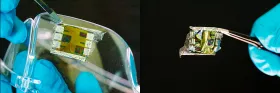
Scientists at Saudia Arabia's King Abdullah University of Science and Technology showed an organic PV cell that can simply be printed onto a piece of paper. The cell established a brand-new performance record for a fully inkjet-printed device, and its designers imagine applications in incorporated medical sensing units.
A straightforward as well as noninvasive treatment could become a prime post-crystallization process to enhance the optoelectronic residential properties of hybrid perovskite solar cell materials.
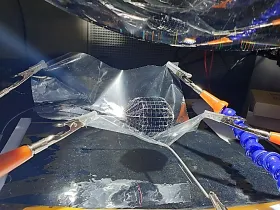
The round 3D cells can apparently generate around 101% even more power than traditional level solar cells. Measurements have actually also shown that the spherical cells provide a 10% reduced optimum temperature compared to flat cells, while accumulating less dirt.
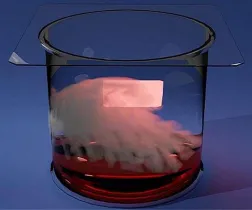
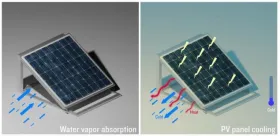
Wetness collected from the atmosphere at night by a hydrogel can be utilized to cool photovoltaic panels throughout the day, improving their efficiency. So claim scientists at the King Abdullah University of Science as well as Technology (KAUST) in Saudi Arabia as well as the Hong Kong Polytechnic University (PolyU) that made the hydrogel from a mix of carbon nanotubes in polymers with a hygroscopic calcium chloride salt. The technology could be an environmentally-friendly method to increase photovoltaic or pv electricity generation and also cool down other gadgets.
Chemists on a regular basis utilize high temperatures to make things take place, however often keeping one's cool can function better. Researchers at KAUST are discovering that a low-temperature method can make better solitary crystals for usage in solar cells.
The tool displayed a little efficiency loss after a 400-hour thermal security examination at 85 levels Celsius as well as after the very same duration under optimal power factor monitoring at 40 levels Celsius, according to its developer. The cell was made by integrating solution-processed, micrometer-thick perovskite leading cells with fully-textured silicon heterojunction base cells.
A natural semiconductor photocatalyst that dramatically improves the generation of hydrogen gas can cause extra effective power storage space innovations.
Saudi scientists have actually created a cell which is stated to display enhanced architectural as well as optoelectronic homes along with boosted provider flexibility as well as diffusion sizes. The accomplishment was attained by decreasing voltage losses utilizing a brand-new passivation strategy.
Showing the latest 50 of 53 stories.