Xi'an Jiaotong Inverted Perovskite Cell Reaches 27.96% Efficiency
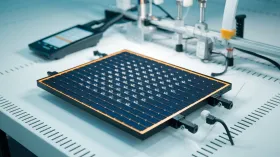
A Xi'an Jiaotong University-led team reports a certified 27.96% inverted perovskite cell in Nature, plus a 34.71% perovskite-silicon tandem cell.
EPFL made a polymer photocatalyst sheet that splits water under simulated sunlight with no bias; it reached about 0.1% solar-to-hydrogen efficiency.
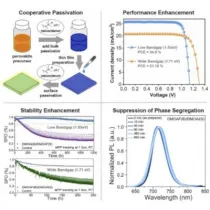
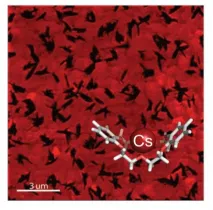
A multinational team reported a novel 2D/3D passivation for fully inorganic perovskites, surpassing 21% cell efficiency and 950 hours of 85°C operation.
Breakthrough perovskite solar cells achieve 25.8% efficiency, outperforming silicon panels, promising reliable, low-cost clean energy with improved stability for commercialization.
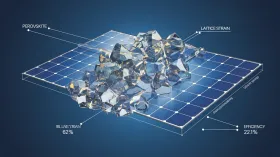
Breakthrough in solar tech: Researchers enhance perovskite cells with lattice strain, achieving 93.5% efficiency limit and improved stability, paving the way for more durable, efficient solar energy solutions.
Revolutionary SINO material boosts solar cell longevity, mimicking nature's adaptability for smarter, more efficient renewable energy solutions.
Revolutionizing solar energy: A global team boosts perovskite cell efficiency to 25.6% with a novel polymer additive, paving the way for cost-effective, stable solar solutions.
Researchers unveil breakthrough bifacial solar cells with over 27 mW cm−2 output, achieving 24% efficiency—pioneering the future of solar energy technology!
EPFL’s groundbreaking tandem solar cell reaches 30.22% efficiency, merging perovskite and silicon innovations to redefine solar technology's future.
Discover how a groundbreaking perovskite structure harnesses visible light to boost charge transport and enhance efficiency in layered devices, paving the way for greener energy solutions!
Revolutionizing solar energy with machine learning: EPFL researchers discover high-efficiency perovskite materials for cost-effective solar panels.
Revolutionary method re-manufactures perovskite solar cells with 88% efficiency. Reduce environmental impact by reusing and recycling components, cutting CO2 emissions by up to 53%.
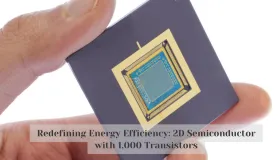
Unlock new possibilities in data-processing with the revolutionary two-dimensional molybdenum disulfide processor from the EPFL LANES team. A processor dedicated to vector-matrix multiplication, perfect for AI accelerators and more, with the potential to reduce energy consumption and revolutionize data-processing.
New method developed by EPFL, University of Toronto and University of Kentucky enables perovskite solar cells to be more durable and efficient under high temperatures and humidity. Quasi-steady-state power-conversion efficiency of 24.09% achieved. Could bring us closer to large-scale deployment of this photovoltaic tech.
Discover the breakthrough findings of two new studies about highly efficient tandem solar cells using perovskite-silicon: a phosphonic acid additive to improve crystallization and an ionic liquid to enhance charge extraction, reaching up to 31.2% and 32.5% power conversion efficiencies.
A worldwide research group that includes scientists from EPFL in Switzerland, Middle East Technical University (METU) in Turkey, Lomonosov Moscow State University in Russia as well as The University of Tokyo has actually produced a quasi-2D perovskite solar cell with a unique type of salt to enhance hole extraction.
Scientists at the National Renewable Energy Laboratory (NREL), City University of Hong Kong, École Polytechnique Fédérale de Lausanne (EPFL), University of Kentucky, University of Colorado, University of Toledo as well as Brown University have actually created a concept that simplifies the process of manufacturing perovskite solar cells, which can increase their path towards commercialization.
A team of scientists, led by Professor Michael Grätzel at EPFL and also Xiong Li at the Michael Grätzel Center for Mesoscopic Solar Cells in Wuhan (China), have actually developed a technique that deals with stability issues of perovskite solar cells (PSCs) as well as raises their effectiveness.
Perovskite solar cells have drawn a significant amount of study attention as a promising option to conventional silicon-based solar cells, as a result of their effectiveness in converting sunlight right into electrical power. Perovskite solar cells are a hybrid of organic as well as not natural materials and also contain a light-harvesting layer as well as a charge-transporting layer.
Scientists at Switzerland's EPFL as well as Sungkyunkwan University in Korea have attended to the issue of perovskite solar cells' stability.
A team of scientists at EPFL have actually developed a method that improves both power conversion performance as well as stability of solar cells based upon pure iodide as well as mixed-halide perovskites.
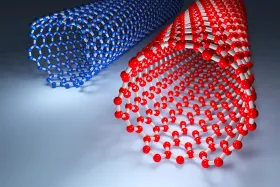
Designers at EPFL have actually discovered a way to insert carbon nanotubes right into photosynthetic bacteria, which significantly improves their electric output. They also pass these nanotubes down to their offspring when they split, through what the group calls "inherited nanobionics."
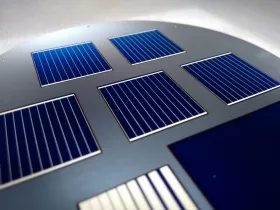
Researchers at EPFL's Photovoltaics and also Thin Film Electronics Laboratory as well as CSEM's Sustainable Energy Centre have actually declared two world records by attaining an effectiveness of over 30% for perovskite-on-silicon-tandem solar cells.
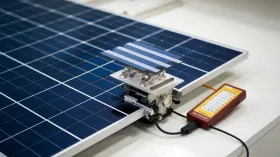
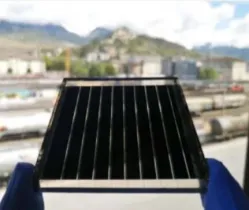
Researchers in Switzerland made substantial progress with a method to perovskite-silicon tandem cell layout that they state might become integrated right into existing silicon PV production. They have announced the success of a 29.2% cell efficiency-- not far from the total record for tandem cells, and confirmed by Germany's Fraunhofer ISE.
Perovskites are hybrid substances made from steel halides and organic components. They show excellent potential in a series of applications, e.g. LED lights, lasers, as well as photodetectors, yet their major payment remains in solar cells, where they are poised to surpass the market from their silicon equivalents.
A team of chemists from Kaunas University of Technology (KTU), Lithuania synthesized materials that were utilized for building a record-breaking perovskite solar module, with an efficiency of 21.4 percent. This was attained with the passivation of the active solar cell layer, which boosts the efficiency of the cell as well as substantially boosts its stability.
EPFL researchers have actually utilized an unmatched method with multimodal host-guest complexation to considerably improve the security of perovskite solar cells while additionally decreasing the launch of lead into the setting
Researchers at EPFL and also the WSL Institute for Snow as well as Avalanche Research SLF have actually issued suggestions wherefore type of renewable resource should be generated in Switzerland's numerous regions, to help achieve the country's goals of carbon neutrality and also energy self-sufficiency.
EPFL researchers have established a new color for solar cells that enables high power-conversion performance while being simple and affordable to make. The color additionally works remarkably well under low-light problems, which is vital for self- as well as low-powered devices.
Scientists at Switzerland's École Polytechnique Fédérale de Lausanne (EPFL) have established an anode from graphene doped with sodium, which they state could possibly overcome a few of the essential concerns in raising storage ability and the life time of sodium-ion batteries.
Scientists from Switzerland's École Polytechnique Fédérale de Lausanne have actually utilized molybdenum oxide as the hole-selective call in an heterojuction silicon cell. The researchers declare the substance can take on conventional get in touches with in spite of a reduced degree of optimization.