Primergy Refinances Nevada Gemini Solar-Storage With $760M
Mar 11, 2026 08:16 PM ET
- Primergy refinances Gemini, America’s largest single-phase solar-plus-storage: $600M notes, $160M LOC, backed by 25-year PPA and 10-year PTC, powering 690 MWac solar with 380 MWac batteries.
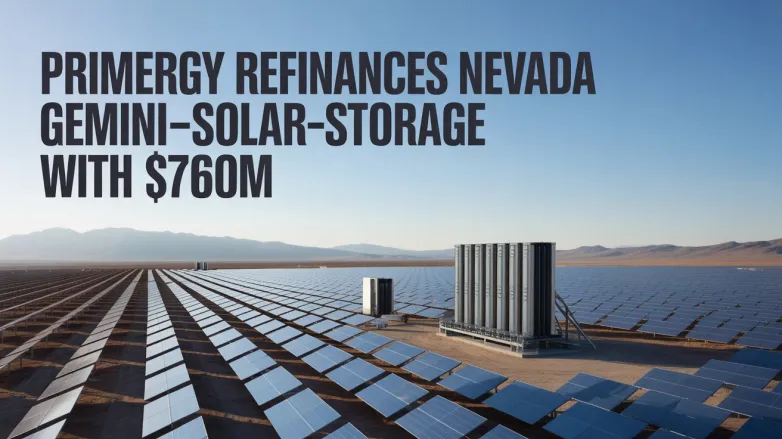
Primergy, a Quinbrook-backed platform, refinanced its Gemini Solar and Storage project in Clark County, Nev., with a $600 million private placement of senior secured notes and a $160 million letter-of-credit facility. Operating since 2024, Gemini pairs 690 MWac of solar with 380 MWac of battery storage and is the largest co-located, single-phase facility in the U.S.
The 24-year, fully amortizing notes are backed by cash flows from a 25-year power purchase agreement and a 10-year production tax credit transfer agreement. BofA Securities, KeyBanc and MUFG led; their affiliates issued the LOC. BNP Paribas and SMBC Nikko co-agented. Primergy’s lifetime closed transactions now exceed $5 billion.
How does Gemini’s refinancing structure impact cost of capital and long-term cash flows?
- Extends tenor and fixes rates: Long-dated, fixed-rate notes replace shorter-term/construction debt, lowering interest-rate risk and typically reducing the weighted average cost of capital (WACC).
- Matches debt to contracted revenue: Amortization aligned with the 25-year offtake smooths debt service, improving DSCR stability and supporting tighter credit spreads.
- Eliminates refinancing cliff: Fully amortizing structure removes balloon risk, cutting future refi costs and safeguarding equity cash flows late in life.
- Enhances credit through collateralization: Senior secured positioning and robust security package attract long-term insurers/pensions, usually at lower coupons than bank mini-perm debt.
- Monetizes tax incentives efficiently: Upfront value from production tax credit transfers boosts early cash flow and coverage, enabling cheaper leverage and earlier sponsor distributions.
- Improves liquidity and counterparty assurance: The letter-of-credit facility backs PPA and operational obligations, lowering perceived default risk and financing margins.
- Increases leverage capacity prudently: Strong, contracted cash flows support moderate additional debt without eroding coverage, reducing equity capital needs and blended cost of capital.
- Stabilizes cash flow timing: Predictable debt service plus contracted revenues yield steadier free cash flow, enabling reliable dividend policies at the project company.
- Shields against market volatility: Long-term fixed notes reduce exposure to future rate cycles and power price swings, preserving value even if merchant tails underperform.
- Supports lifecycle reserves and maintenance: Structured covenants and reserve accounts (e.g., DSRA, O&M, major maintenance) minimize outage/curtailment shocks, smoothing long-run cash flows.
- Improves rating profile and investor base: PPA-backed, amortizing renewables notes suit investment-grade mandates, translating to tighter pricing and lower ongoing financing costs.
- Enhances equity returns: Lower interest expense and removal of refi uncertainty increase net present value of distributable cash, improving project IRR.
Also read