HL220 Interlayer Lifts Inverted Perovskites Above 26%
- HL220 supercharges inverted perovskite cells: smoother interfaces, faster electrons, 26.44% PCE, 85.2% FF, 22.93% on 15 cm²—94.1% retained after 450 hours. Alcohol-processable, silver-synergistic, scale-ready.
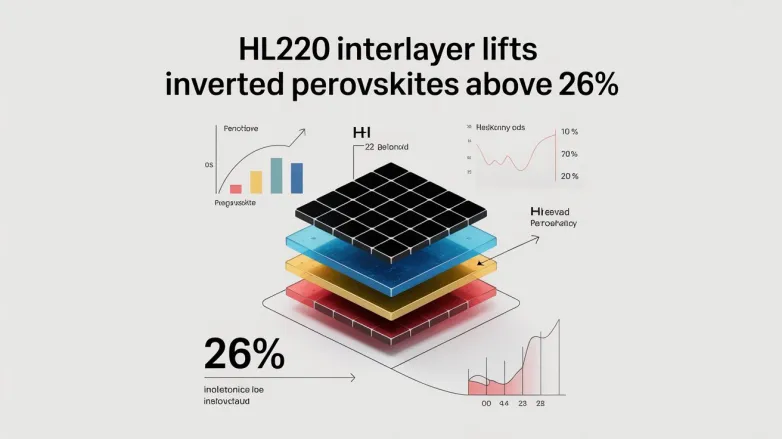
Researchers at Shenzhen University and Ocean University of China unveiled HL220, a small-molecule cathode interfacial layer for inverted (p–i–n) perovskite solar cells that tackles energy-level mismatch, defect formation and electrode degradation. The D–A–D–A–D fused-ring molecule shows strong conjugation with dual absorption at ~544/580 nm, is alcohol-processable, and forms smooth, cohesive films on PCBM, reducing roughness and improving wettability. Analyses indicate suppressed interfacial recombination and lower series resistance.
HL220 chemically interacts with silver to lower its work function, cutting the PCBM/Ag electron-extraction barrier and boosting charge transfer. Devices reached 26.44% PCE with 85.2% FF; a 15 cm² module delivered 22.93%. Unencapsulated cells retained 94.1% after 450 hours of illumination, signaling durability and scalability.
How does HL220 enhance inverted perovskite cells’ efficiency, interfaces, and stability?
Boosts efficiency
- Creates a strong interfacial dipole that lowers the Ag work function, shrinking the PCBM/Ag barrier and improving Voc and FF
- Passivates interfacial traps on the fullerene side, cutting recombination and series resistance
- Provides a continuous, conductive pathway via its conjugated backbone, expediting electron extraction
- Functions as a thin optical spacer that redistributes the optical field, yielding modest Jsc gains without added parasitic loss
Improves interfaces
- Forms uniform, pinhole-free, low-roughness coatings on PCBM, minimizing local contact resistance and shunt pathways
- Alcohol-based processing is orthogonal to underlying layers, preserving perovskite and fullerene morphology while enabling low-temperature deposition
- Enhances wettability and cohesion at the cathode side, delivering more consistent large-area coverage
- Chemically coordinates with Ag to create an intimate, low-barrier contact and suppress interfacial degradation reactions
Enhances stability
- Acts as a diffusion barrier that slows Ag migration into the perovskite and limits halide attack on the electrode
- Densifies the top interface, reducing ingress of moisture and oxygen and mitigating photo-oxidation
- Maintains energy-level alignment under illumination and bias, limiting dipole drift and hysteresis
- Relieves interfacial stress through a compliant, cohesive film, improving thermal and operational cycling durability
- Damps interfacial electric fields, curbing photoinduced ion movement and phase segregation near the cathode
Also read