AI Tunes Perovskite Solar Windows to Any Hue
- AI inverse-designed ZnS/MgF2 coatings paint perovskite solar cells in user-defined colors with minimal loss, boosting PCE on glass and PET—opening sharper-colored solar windows and auto glazing.
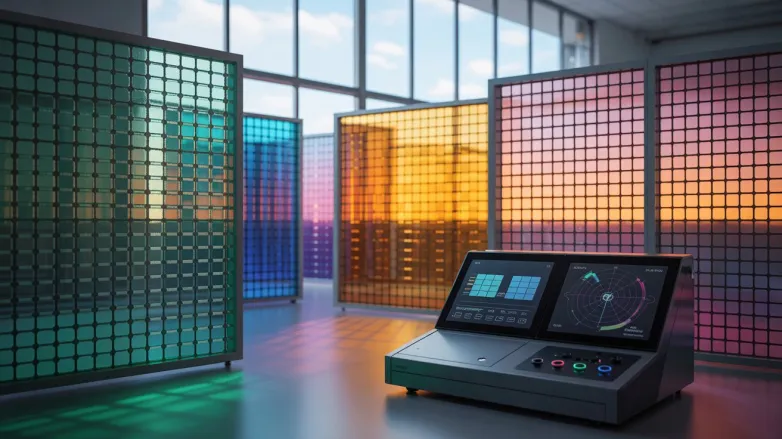
Researchers at Kyung Hee University and Hyundai Motor Group used AI inverse design to add all‑dielectric ZnS/MgF2 multilayer coatings to semitransparent perovskite cells, delivering user‑defined colors with minimal optical loss. A factorization‑machine surrogate and QUBO optimization chose layer sequences, achieving six target hues across varying absorber thicknesses.
A cyan device with 110 nm MAPbI3 absorber reached 10.4% transmittance and 6.5% AVT on glass, raising PCE 20.9%; on PET it lifted PCE 10.4%. Coatings were thermally evaporated on cells or laminated from pre‑coated PET, and framework extends to thin films; higher‑bit encoding could sharpen hues for solar windows and vehicle glazing.
What scalability, durability, and color-uniformity hurdles remain for AI-designed perovskite coatings?
Scalability – manufacturing and cost
- Tight thickness control over multi‑layer dielectric stacks across square‑meter rolls; managing web tension, edge effects, and run‑to‑run drift in roll‑to‑roll lines.
- Throughput limits of vacuum deposition versus demand for high‑area, multi‑color product families; tool uptime, target utilization, and cycle time.
- Yield loss from pinholes/particulates in 10–100 nm films; need for inline, high‑speed ellipsometry/colorimetry and closed‑loop feedback.
- Registration of coatings to cell layouts and busbars on curved or flexible substrates; patterning without damaging perovskites.
- Supply chain and cost of high‑purity dielectrics; scalability of AI workflows from small design spaces to many SKUs and custom hues.
- Lamination or transfer steps at scale without bubbles, wrinkles, or optical adhesives adding haze or color shift; recyclability and rework.
Durability – field reliability and standards
- Thermo‑mechanical mismatch between brittle dielectrics and soft perovskite/encapsulants causing microcracks under thermal cycling and flex.
- Moisture/oxygen ingress at layer interfaces; adhesion aging and edge‑seal robustness under damp‑heat and freeze–thaw.
- UV exposure leading to polymer yellowing, dielectric densification, and perovskite/transport‑layer degradation; maintaining color and PCE.
- Ion migration and halide segregation shifting the absorber’s spectrum, breaking the color match over time.
- Abrasion and cleaning chemicals in building and automotive use; anti‑soiling topcoats that don’t perturb hue.
- Compliance with IEC/UL PV weathering, automotive glazing (impact, wiper, thermal shock), and fire/smoke standards.
Color uniformity – aesthetics and optical control
- Angle‑dependent interference causing iridescence; achieving low color shift over wide viewing cones for windows and windshields.
- Spatial thickness non‑uniformity across large areas leading to visible hue gradients; substrate roughness and TCO texture imprinting scatter.
- Batch‑to‑batch matching across absorber thickness variations and halide ratios; metamerism under different illuminants (D65 vs warm LED).
- Aging‑induced drift from perovskite or encapsulant changes; maintaining uniformity after bending, lamination, and thermal cycling.
- Edge and busbar regions darkening or hue fringes; seamless tiling between modules without visible seams.
- Quantization limits from discrete layer counts/material sets; need for higher‑bit designs without increasing parasitic absorption.
Also read