ReNew to Build 6.5-GW Solar Ingot-Wafer Plant
- ReNew Energy Global plans a 6.5GW solar ingot-wafer plant in Andhra Pradesh, investing INR 42B. It will boost local supply chains, cut imports, and create 2,100+ jobs.
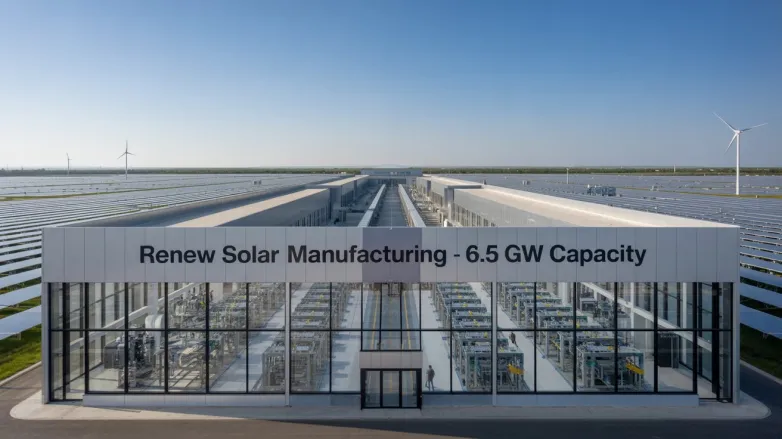
ReNew Energy Global said it will build a 6.5-gigawatt solar ingot-and-wafer manufacturing plant in Anakapalli district, Andhra Pradesh, investing about INR 42 billion (roughly $445.5 million). The company laid a foundation stone for the facility, expecting more than 2,100 construction jobs and operations to begin within 24 months.
ReNew said the plant will help create a more integrated local solar supply chain and reduce India’s reliance on imported equipment. The company currently has 6.5 GW of module production and 2.5 GW of cell capacity, with cells projected to reach 6.5 GW by end-2026. The project also fits ReNew’s broader plan to invest INR 820 billion in Andhra Pradesh to expand clean-energy manufacturing.
ReNew’s 6.5GW Anakapalli solar manufacturing plant: jobs, supply-chain, and investment details?
Project overview
- ReNew’s proposed 6.5GW solar manufacturing facility in Anakapalli (Andhra Pradesh) is designed to produce upstream “ingot-and-wafer” components used in the solar PV value chain.
- The plant is structured to support India’s push toward domestic solar material production, improving supply reliability for downstream module and cell manufacturing.
Jobs (construction and operations)
- Construction phase roles likely to include civil works, structural fabrication, electrical/MEP installation, instrumentation, quality/safety officers, logistics and materials handling, and project management.
- Operations phase roles are likely to include wafer/ingot line operators, process engineers, technicians (vacuum, thermal processing, thin-film/wafer-related operations), maintenance teams, and plant quality/testing staff.
- Safety, environment, and compliance staffing is typically required for high-temperature and chemical-handling process areas (training, EHS officers, environmental monitoring teams).
- Supply-ecosystem job creation can extend to local contractors and vendors (electrical works, transport services, packaging, EHS compliance support, housekeeping, facility security, and maintenance services).
- Skills development is commonly supported through onboarding, operator training, and technical partnerships with local institutes to build semiconductor/solar-process capability in the region.
Supply-chain impact
- Upstream integration: Producing ingots and wafers locally helps reduce dependence on imported intermediate solar components that can constrain pricing and lead times for downstream manufacturers.
- Ecosystem build-out: The plant can catalyze demand for regional suppliers of high-purity inputs, process chemicals, gases, industrial gases logistics, specialty consumables, and precision equipment services.
- Equipment and services: Companies providing crystal/ingot processing, wafer handling/inspection, and materials testing support are likely to see increased local and regional service opportunities (installation, calibration, spares, and technical maintenance).
- Faster procurement cycles: Domestic production can shorten replenishment timelines for wafer feedstock, improving planning certainty for cell and module lines.
- Export/readiness effects: Strengthening upstream capability can improve the ability of Indian solar manufacturers to meet contractual requirements on supply continuity and component availability.
Investment and economic details
- Capital commitment: ReNew has indicated an investment of about INR 42 billion (around $445.5 million) for the Anakapalli ingot-and-wafer facility.
- Funding profile: Such projects typically require capex for process equipment, clean/industrial utilities, material handling systems, quality-control/inspection tooling, warehouses, and plant infrastructure.
- Industrial scale-up: As an upstream plant, part of the investment is usually aimed at achieving stable throughput and yield (which drives operating performance over time).
- Regional manufacturing strategy link: The project aligns with broader clean-energy manufacturing expansion plans in Andhra Pradesh, supporting a multi-stage solar supply chain rather than isolated manufacturing at a single layer of the value chain.
Delivery and timeline considerations
- Start-up planning generally includes commissioning, yield ramp-up, and integration testing for production stability, often extending the period from groundwork to full operational output.
- Workforce ramp-up is typically sequenced so specialized roles and technicians are hired and trained ahead of line commissioning to reduce launch risk.
Also read
- Daqo Cuts Polysilicon Cash Cost to Record $4.23/kg as Q3 Loss Narrows
- EU Ends 12-Year Duties on Chinese Solar Glass With No EU Maker Left
- Tesla Deploys 13.7 GWh of Storage in Q3 as Energy Revenue Falls 16%
- Peak Energy Raises $108 Million as GM Ventures Leads Sodium-Ion Round
- EU Innovation Fund Selects Holosolis 5-GW Solar Factory in €3.4B Round