NLC India Secures €100m KfW Loan for Solar, Storage
Apr 23, 2026 03:47 PM ET
- NLC India secures a €100M KfW loan for solar and battery storage, boosting grid upgrades and faster scale-up. Longer tenors and tighter governance lower risk and capital costs while strengthening stability.
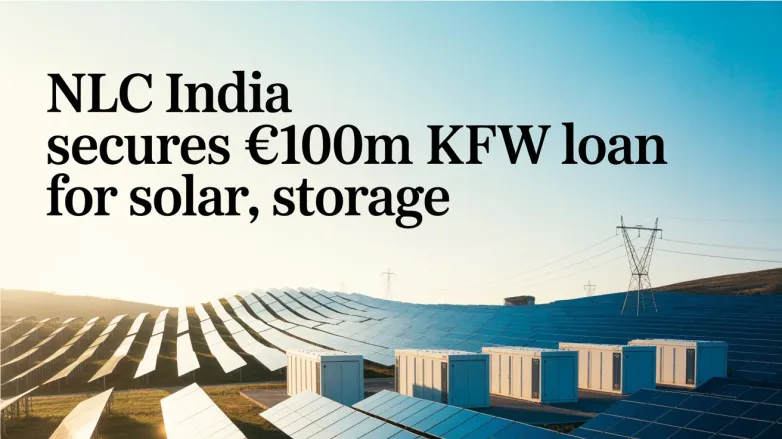
NLC India has secured a EUR 100 million loan from Germany’s KfW to finance solar and battery storage projects, adding institutional-grade funding to its renewables transition away from lignite-heavy generation. The KfW-backed structure is expected to offer longer tenors and stricter governance, helping reduce execution risk and lower the cost of capital.
The funding is intended to support key “gating” steps for scaling capacity, including grid upgrades, equipment procurement, and parallel project development. Storage is positioned as crucial as India’s solar penetration rises, enabling energy shifting from midday to evening and providing grid services that improve stability and may unlock additional revenue.
How will KfW’s €100m loan accelerate NLC India’s solar and battery expansion?
- Provides longer-tenor, lower-cost capital to help NLC India fund solar and battery projects through the full construction-to-commissioning cycle.
- Enables smoother “project gating” by financing interdependent milestones such as grid interconnection studies, approvals, procurement lead times, and site readiness.
- Strengthens governance and monitoring around procurement and contracting, which can reduce delays, cost overruns, and downstream technical risk.
- Improves bankability for equipment purchases by supporting standardized tendering, quality assurance, and performance-testing requirements for solar and storage assets.
- Reduces execution risk by supporting parallel workstreams (design finalization, land/interface readiness, grid works coordination, and battery dispatch planning).
- Helps accelerate grid-side upgrades needed to absorb higher solar output, improving the schedule for commissioning and raising the likelihood of timely evacuation of power.
- Supports earlier procurement of long-lead components (notably battery balance-of-system and inverter-related equipment), shortening critical-path timelines.
- Enhances system integration capability by funding the practical enablement needed for storage dispatch, including controls, monitoring, and grid-service readiness.
- Facilitates scaling by improving the economics of expanding capacity—making it easier to move from smaller pilots to larger, repeatable buildouts.
- Supports a more reliable revenue stack for storage via grid services (e.g., frequency/ancillary services) and improved solar utilization through peak-shaving and energy shifting.
- Strengthens investor confidence as “institutional-grade” financing can improve counterpart and supplier willingness to commit to schedules and performance guarantees.
- Frees internal capital that would otherwise be tied up in higher-cost financing, allowing NLC India to reallocate resources toward additional renewable sites and expansion phases.
Also read
- Cosin Solar Tops Out Two 199-Meter Towers at 350-MW Golmud CSP Plant
- Peak Energy Raises $108 Million as GM Ventures Leads Sodium-Ion Round
- Berkeley Lab Finds US Utility Solar Cost Rose 7% to $61/MWh in 2025
- Tesla Deploys 13.7 GWh of Storage in Q3 as Energy Revenue Falls 16%
- EBRD Arranges $265 Million for Egypt's 1.2-GW Nefer Minya Solar Plant