Italy Energy Community Sells 13.7 MWp Solar Portfolio
- Italy’s energy community flips a 13.7‑MWp PV bundle—bifacial, battery‑ready, bankable—seeding social rooftops and agrivoltaics, while buyers lock diversified cash flows as revised rules turbocharge a maturing market.
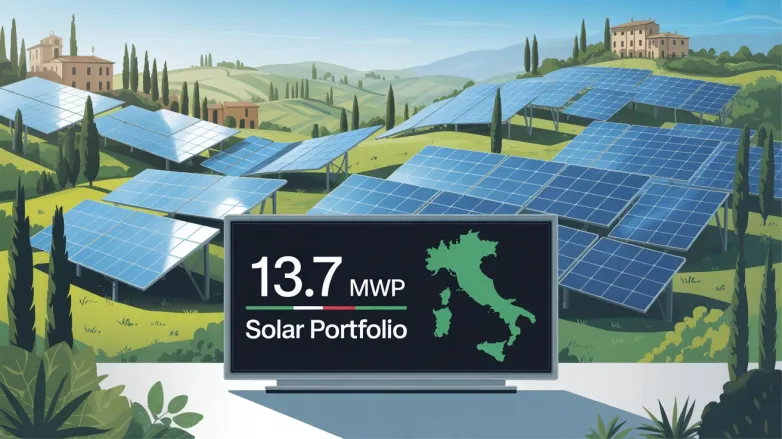
An Italian energy community sold a 13.7‑MWp portfolio of PV projects, mixing shovel‑ready and operating assets with early‑secured grid ties. Sites deploy bifacial modules on trackers or fixed‑tilt, string inverters, and grid‑code‑compliant controllers. Bankability stems from long‑dated offtake, standard EPCs, unified SCADA, robust O&M, and several battery‑ready locations.
Proceeds will seed new community schemes, including social‑housing rooftops and agrivoltaic pilots. Buyers gain diversified cash flows across nodes and technologies, tempering curtailment and price risk. The deal underscores a maturing market as Italy’s revised energy‑community rules attract households, SMEs, and municipalities, proving small projects can be aggregated, financed, traded, and replicated.
How does the sale validate energy community bankability and de-risked PV portfolios in Italy?
- Confirms lenders’ appetite for community-scale PV by delivering a priced, closed transaction with long-tenor cash‑flow visibility and acceptable DSCRs under standard stress cases.
- Establishes secondary‑market liquidity and valuation benchmarks for aggregated small assets, compressing yields and lowering equity IRR hurdles for follow‑on raises.
- Validates that diversified portfolios—spread across nodes, geographies, and offtakers—attenuate correlated risks such as congestion, curtailment, and localized irradiance variance.
- Shows construction and operating risks can be ring‑fenced via EPC wraps, LDs, tier‑1 equipment warranties, and performance guarantees acceptable to project‑finance lenders.
- Demonstrates that early grid‑capacity rights and clear interconnection milestones materially reduce schedule and capex overrun risk, improving credit metrics at financial close.
- Proves bankable offtake structures for communities (self‑consumption plus PPAs or tariffs) can underpin investment‑grade‑like revenue profiles despite partial merchant exposure.
- Confirms O&M standardization, unified monitoring, and data transparency enable portfolio‑level covenants, KPIs, and step‑in rights that banks require.
- Provides price discovery for risk premia (curtailment, balancing, imbalance, cannibalization), sharpening underwriting models and insurer willingness to write performance policies.
- Signals replicability: small rooftops and midsize ground‑mounts can be aggregated into financeable pools, paving the way for warehouse lines, securitizations, or green ABS.
- Evidences that community sponsors can recycle capital through disposals, shortening equity hold periods and improving platform‑level returns—key to scaling local energy schemes.
- Shows counterparty diversification (households, SMEs, municipalities, corporate buyers) reduces credit concentration, supporting longer tenors and lower margins.
- Validates that Italy’s current regulatory framework is sufficiently stable for banks to lend against community revenues, narrowing policy‑change haircuts in sensitivities.
- Highlights operational track record sufficiency: measured PR, availability, and loss factors that align with pro formas, boosting confidence in forward yield estimates.
- Confirms curtailment and price risks can be actively managed through dispatch strategies, node selection, and flexible assets in the pipeline, improving downside protection.
- Creates a comparable set for future deals, shortening due‑diligence cycles and transaction costs, which improves bankability at the sector level.
Also read