GoldenPeaks Seals 10-Year Solar PPA with Hankook
- GoldenPeaks inks 10-year solar PPA with Hankook in Poland, hedging power costs, cutting Scope 2 emissions, unlocking project finance, and showcasing CEE’s storage-ready, bankable shift beyond auctions.
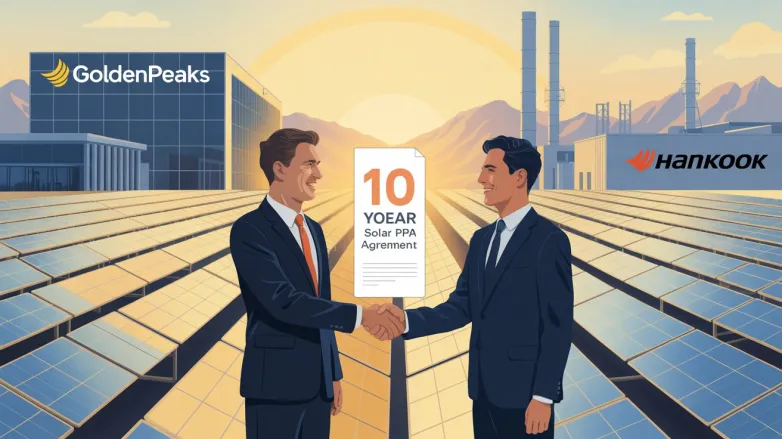
GoldenPeaks, a Central and Eastern Europe-focused developer, signed a 10-year solar power purchase agreement with tyre maker Hankook, securing long-term renewable supply and backing new PV capacity in Poland. For Hankook, the contract hedges rising electricity costs for energy-intensive operations and provides verifiable Scope 2 emissions reductions for corporate reporting.
For GoldenPeaks, the PPA delivers bankable revenue to unlock project finance and speed construction across a diversified, multi-site portfolio. The deal reflects a broader CEE shift: corporate PPAs are propelling renewables beyond auctions and merchant risk, emphasizing deliverability—robust interconnection, standardized EPC—and storage-ready designs to shape output for industry’s peak hours.
How will Hankook–GoldenPeaks PPA influence Poland’s storage deployment and grid interconnections?
- Contextualize policy: compare how IRA, EU Green Deal, and China’s 14th FYP are shaping deployment speed, local content, and supply chains
- Quantify interconnection bottlenecks: size of queues, typical study delays, reforms like first-ready–first-served and cluster studies
- Transmission urgency: highlight permitting timelines, cost allocation debates, and advanced options (HTLS reconductoring, HVDC backbones)
- Grid flexibility: role of storage durations, virtual power plants, demand response, and dynamic line rating to absorb variable renewables
- Hybridization trends: solar-plus-storage and wind-plus-storage co-location economics, shared interconnection benefits, and capacity accreditation
- Supply chain resilience: module and turbine manufacturing shifts, critical minerals exposure, and recycling/second-life pathways
- Workforce needs: retraining programs, union and apprenticeship pipelines, and community college partnerships in clean-tech hubs
- Environmental justice: community benefits agreements, cumulative impact assessments, and equitable siting practices
- Land use solutions: agrivoltaics, dual-use wind on working lands, wildlife-safe siting, and setback best practices
- Offshore wind status: port infrastructure gaps, vessel availability, O&M strategies, and floating wind cost trajectories
- Financing evolution: rise of PPAs, CfDs, merchant risk management, insurance for extreme weather, and tax credit transferability
- Corporate procurement: growth of virtual PPAs, 24/7 carbon-free energy goals, and hourly matching implications
- Emerging demand: data centers, electrified heat, EV fast charging; strategies like co-location, curtailable loads, and green tariffs
- Green hydrogen: prioritizing RFNBO standards, coupling with curtailed renewables, and bankable offtake models for industry
- Resilience planning: microgrids, black-start capable renewables-plus-storage, and wildfire/heatwave hardening
- Measurement and transparency: hourly carbon accounting, grid-marginal emissions signals, and verified claims to avoid greenwashing
Also read