Ambient-Made Perovskite Tandems Hit 31.72% Efficiency
- Ambient-air fabrication breakthrough: ternary GDMA/AG SAMs stabilize perovskite and perovskite/Si tandems, boosting efficiencies up to 31.72% and keeping 92%+ after 600h at 85°C.
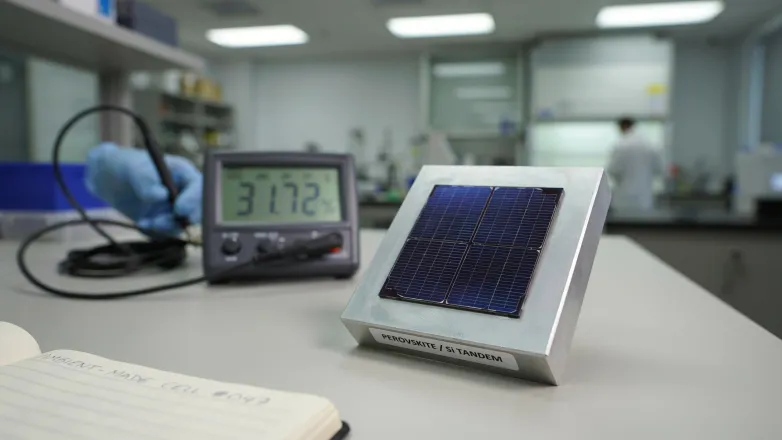
Researchers from UNIST, KAUST, CUHK Shenzhen, and Forschungszentrum Jülich report an interfacial engineering approach that lets perovskite and perovskite/silicon tandem solar cells be fabricated in ambient air. The team targets a key bottleneck: conventional phosphonic-acid self-assembled monolayers (SAMs) used as hole-selective contacts degrade in moisture, causing non-uniform coverage and exposing underlying electrodes during air processing.
They design a ternary SAM combining glycerol dimethacrylate (GDMA) and 1-acetylguanidine (AG). GDMA improves wetting during deposition and, after mild curing, forms a hydrophilic network that anchors the layer and suppresses disruption during perovskite coating, while AG passivates interfacial defects. Wide-bandgap PSCs reached 21.20% efficiency in air, and monolithic tandems achieved 31.72% (certified 31.36%) versus 32.60% under inert conditions. Devices also showed strong durability, retaining over 92% after 600 hours at 85°C in air and over 90% after 1,000 hours of continuous simulated sunlight.
How does a ternary SAM enable perovskite and tandem solar cells to form in air?
- A ternary SAM is a mixed self-assembled monolayer made from three complementary components; in air processing, its role is to create a stable, continuous “interfacial skin” between the device electrode and the perovskite/transport layers.
- The SAM components are chosen to cooperate in three functions that are especially vulnerable in air: (1) wetting/coverage during solution coating, (2) resistance to moisture-driven chemical changes, and (3) chemical/electronic defect passivation at the contact interface.
- During perovskite deposition from solution, the SAM’s surface energy is tuned so precursor droplets spread evenly rather than breaking into islands; improved wetting reduces pinholes and interfacial voids that would otherwise expose the underlying electrode.
- After mild curing/activation, the SAM forms a more robust interfacial network (through polymerizable/anchoring chemistry and physical interlocking), which makes the layer harder for ambient water and solvent exposure to disrupt.
- The design addresses SAM “desorption” and “reorganization” problems common in humid air: instead of relying on a single, moisture-sensitive binding mode, the ternary layer uses multiple interactions so coverage remains uniform even after exposure to oxygen/humidity.
- One component promotes formation of hydrophilic, defect-minimizing pathways at the surface; this can help control how the perovskite nucleates and grows, leading to smoother films and more consistent contact formation.
- Another component provides chemical passivation by neutralizing under-coordinated sites and trap-forming species at the perovskite interface, which lowers non-radiative recombination and improves hole/extraction selectivity.
- Because the ternary SAM reduces interfacial trap density and suppresses moisture-assisted degradation routes, perovskite crystallization and device operation are less sensitive to the “ambient gap” between fabrication steps.
- For perovskite/silicon tandem cells, the same concept applies at each critical interface: the upper perovskite subcell still needs a stable, selective contact in air, and the interfacial skin must remain intact so the perovskite layer forms uniformly without damaging layers beneath.
- Overall, the ternary SAM enables air fabrication by combining (i) moisture-tolerant, coverage-preserving interfacial anchoring, (ii) improved wetting for defect-free perovskite coating, and (iii) interfacial defect passivation that preserves charge transport—together preventing the breakdown mechanisms that occur with conventional moisture-sensitive monolayers in ambient conditions.