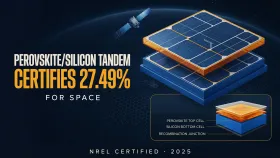
Perovskite/Silicon Tandem Certifies 27.49% for Space
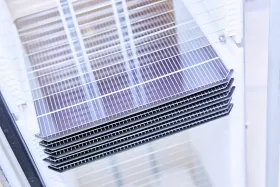
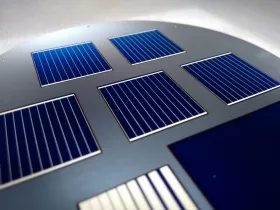
Certified 27.49% AM0 efficiency: a durable monolithic perovskite/silicon space tandem. It withstood radiation, heat, humidity, and high-altitude balloon operation—no monotonic decay.
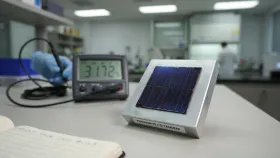
Ambient-air fabrication breakthrough: ternary GDMA/AG SAMs stabilize perovskite and perovskite/Si tandems, boosting efficiencies up to 31.72% and keeping 92%+ after 600h at 85°C.
WattByWatt’s air-processed perovskite ink helps France’s CEA hit 28 % efficiency in a tandem perovskite-silicon cell, edging closer to scalable next-gen solar panels.
Innovative TiOx interconnect boosts perovskite-silicon solar cell efficiency to 26.5%, paving the way for cost-effective, scalable, and sustainable solar energy solutions.
Tongwei Co. pushes ahead with ambitious expansion plans while Chinese solar sector braces for inevitable consolidation and price wars. The 28 billion yuan ($3.9 billion) factory in Inner Mongolia promises 500,000 tons of industrial silicon and 400,000 tons of polysilicon annually.
LONGi's R&D team sets record-breaking 33.9% efficiency in tandem solar cell – and they're confident of pushing that to over 34% soon. Get the details from this expert analysis.
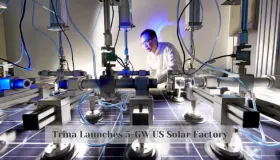
Trina Solar is building the largest single-site silicon solar panel factory in the US, creating 1,500 jobs and investing over $200 million. Producing Vertex modules with 210-mm wafers, the 1 million-sq-ft facility is set to come online in 2024. Be part of the US solar market revolution with Trina Solar's 25+ years of experience and 150 GW of modules shipped worldwide.
CubicPV is now looking to build a 10GW US silicon wafer manufacturing base, and to continue its research into perovskite-silicon tandem technology.
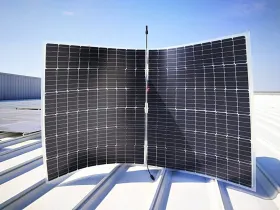
A big group of technologists associated with numerous institutions in China, collaborating with two coworkers from Germany and also an additional two from Saudi Arabia, has located a way to create flexible monocrystalline silicon solar cells.
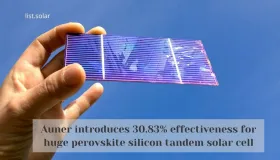
Beijing Yaoneng Technology Co. (Auner), a Chinese programmer of perovskite and also crystalline silicon lamination photovoltaic innovation and supplier of photovoltaic cells as well as components, has actually introduced that its 25cm ² perovskite silicon tandem PV cell has actually attained a secure conversion performance of 30.83% in the laboratory, which has reportedly been confirmed by China's National Institute of Metrology.
TNO, in cooperation with Dutch and German commercial companions, is advancing a perovskite/silicon tandem solar module suitable for very early market introduction.
Nano-textured surface areas are an interesting strategy for maximizing the optical qualities for monolithic perovskite/silicon tandem solar cells. Researchers from Germany's Helmholtz-Zentrum Berlin (HZB) have actually checked out the growth of different textures of silicon surface areas making use of different industrial additives as well as their efficiency in silicon heterojunction (SHJ) and also SHJ-- perovskite tandem solar cells.
Linton Crystal Technologies (LCT) revealed it will produce solar silicon production equipment in the United States and intends to break ground on a united state manufacturing facility in Q2 2023. The Rochester, New York-based firm makes silicon-growing and crystal-processing equipment as well as has formerly dealt with Dalian Linton NC Machine Co. Ltd. in China to make its equipment.
REC Silicon ASA, a Norwegian silicon producer, and Hanwha Solutions, part of Korea's Hanwha Group, have announced progress in finalizing a 10-year supply agreement for solar silicon production from the Moses Lake (Washington state) factory. This agreement is a major step forward for sustainable energy news and photovoltaic technology.
The united state solar market will certainly soon have the ability to make the most of locally produced solar cells. Enel North America, through its affiliate 3Sun USA, revealed its plans to develop a silicon solar cell production center in the USA with an anticipated minimum manufacturing capacity of 3 GW.
Trina Solar has actually started building on a vast new industrial park in the central Chinese province of Qinghai that will cover practically the whole PV manufacturing chain from polysilicon manufacturing completely to modules.
Chinese module manufacturer Jolywood Solar has actually authorized an agreement with the government of Taiyuan City, Shanxi Province to build a high-purity, solar-grade polysilicon manufacturing facility as it tries to balance out rising raw material expenses and also push for greater vertical combination.
Major polysilicon and wafer manufacturer GCL-Poly Energy Holdings verified the completion of its granular silicon facility as well as, in a significant turnaround of its lot of money in 2020, is expecting RMB5.4 billion (US$ 850 million) in net profit for 2021, according to a business statement.
Market association Eurometaux has asked EU policy-makers to enable participant states to support domestic manufacturers of aluminium, zinc and also silicon with state help to make sure products of the metals critical for the transition to reduced carbon energy.
Elkem has been offered NOK16 million (US$ 1.78 million) from the Research Council of Norway to establish a silicon manufacturing procedure that gets rid of all straight CO2 emissions associated with its manufacturing.
The result was certified by Germany's Fraunhofer Institute for Solar Energy Systems' (ISE) CalLab as well as included in the charts of the united state Department of Energy's National Renewable Energy Laboratory.
Chinese energy firm TBEA is intending to spend RMB6 billion (US$ 938 million) to establish a polysilicon manufacturing center with an annual outcome of 400,000 MT in China's Inner Mongolia region.
Silicon steel rises 300% after power aesthetics in Yunnan. Material is utilized to make polysilicon vital to photovoltaic panels.
Lots of nations around the globe are devoted to reducing emissions or getting to net-zero exhausts to meet the United Nations' environment goals of keeping temperature increases listed below 1.5 degrees Celsius by 2050. Renewable energy modern technologies, particularly solar power panels, will play a substantial role in achieving these goals.
A lot of today's solar cells are made from silicon and are heavy, inflexible, and expensive to create. By comparison, organic solar cells hold the assurance of being light-weight, flexible, and also inexpensive to make.
In simulations as well as experiments, researchers demonstrate that introducing small nanoscale texturing on the surfaces of products in perovskite/silicon tandem solar cells can dramatically increase efficiency by decreasing the quantity of light energy that is lost as a result of representation.
Silicon has long been the gold standard for solar cells, however it's starting to reach its limitation. Perovskite is emerging as a promising companion, and now designers have attained a new efficiency record closing in on 30 percent for this sort of tandem solar cell.
HighLine Technology GmbH, a spin-off of Fraunhofer Institute for Solar Energy System ISE, declared that it has actually created a brand-new giving modern technology, which boosts the power yield of silicon solar cells. The firm has strategies to advertise this innovation.
The Institute for Solar Energy Research Hamelin (ISFH), the Karlsruhe Institute of Technology (KIT) as well as the Institute for Materials as well as Components in Electronics at the University of Hannover, in addition to Centrotherm, Singulus, Meyer Burger as well as Von Ardenne are associated with a study project focused on achieving a 27% conversion effectiveness for silicon solar cells based on perovskite.
Scientists in Australia took a close consider the long-term efficiency of passivation layers in silicon solar cells, as well as found a surprising procedure of degradation and regrowth at the office within the product. The outcomes could have ramifications on the procedures used in industrial scale solar cell manufacturing.
Researchers from the United States have utilized new passivated get in touch with styles to show a screen-printed silicon heterojunction solar cell on 40 micron thick standalone wafers.
Norwegian polysilicon manufacturer as well as silicon organisation Elkem is preparing to build a manufacturing facility in Herøya.
Scientists from Fraunhofer IISB, Wacker Chemie and also Alzchem claim undesirable metals go into the silicon mostly with finish of the quartz crucible. The searching for can make it possible for manufacturers to make forecasts concerning the high quality of silicon blocks.
Silicon has actually long been the traditional product of selection for solar cells, which transform power from the sunlight right into power. Nonetheless, due to the fact that light absorption in silicon mishandles, solar cells made from silicon are thick, hefty, and also stiff. Furthermore, their production is pricey as well as complicated. To deal with these concerns, researchers have actually been searching for options to silicon.
The exact same product you'll locate at the idea of a pencil - graphite - has actually long been a vital element in today's lithium-ion batteries. As our dependence on these batteries boosts, nevertheless, graphite-based electrodes schedule for an upgrade. For that, researchers are seeking to the component at the heart of the electronic transformation: silicon
In the last years, perovskites - a varied series of products with a details crystal framework - have actually become appealing choices to silicon solar cells, as they are more affordable and also greener to produce, while attaining an equivalent degree of effectiveness.
Emitting light from silicon has actually been the 'Holy Grail' in the microelectronics market for years. Fixing this problem would certainly change computer, as chips will certainly come to be quicker than ever before. Scientists from Eindhoven University of Technology currently was successful: they have actually established an alloy with silicon that can emit light. The outcomes have actually been released in the journal Nature. The group will certainly currently begin developing a silicon laser to be incorporated right into existing chips.
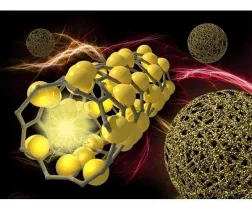
Researchers in the United States have actually established a carbon nanotube approach of producing a lithium-ion battery with a silicon anode. The gadget apparently showed far better than 87% capability retention after 1,500 cycles. The designers claim their exploration gets over a number of the challenges to using silicon as an anode as well as might open making use of various other products for electrodes in lithium-ion gadgets
Researchers at Australian National University have actually attained a 27.7% performance price for mechanically piled perovskite-silicon tandem cells.
The tool displayed a little efficiency loss after a 400-hour thermal security examination at 85 levels Celsius as well as after the very same duration under optimal power factor monitoring at 40 levels Celsius, according to its developer. The cell was made by integrating solution-processed, micrometer-thick perovskite leading cells with fully-textured silicon heterojunction base cells.
Graphene Flagship scientists at the University of Rome Tor Vergata, the Italian Institute of Technology (IIT) as well as its spin-off, Graphene Flagship Associate Member BeDimensional, together with ENEA have actually efficiently integrated graphene with tandem perovskite-silicon solar cells to attain performances of approximately 26.3%.
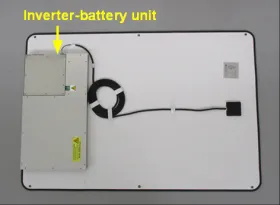
Japanese scientists have actually examined the performance of SiC gadgets in sub-kilowatt applications. A 790g tool was examined in a small PV generator system that included a battery as well as optimum power factor tracker circuit in the very same real estate. Contrasted to typical mini inverters the SiC tool revealed 3% greater performance
Scientists from Switzerland's École Polytechnique Fédérale de Lausanne have actually utilized molybdenum oxide as the hole-selective call in an heterojuction silicon cell. The researchers declare the substance can take on conventional get in touches with in spite of a reduced degree of optimization.
Researchers at Rice University in the U.S. have actually carried out explores lithium-ion batteries utilizing silicon as an anode product and made an unexpected discovery relating to an aluminum oxide passivation layer at the cathode. The finding might open up a new path toward much better performing lithium-ion batteries.
Lower prices for polycrystalline silicon have turned interest from poly-Si consumption minimization. However, the latest study shows that, with account to modern technologies, slimming wafers can be crucial for cost reduction and is worth attention again.
An unknown material, made from disulfide flakes has helped to boost the power of organic solar cells.
A scientific group from two U.S.-based universities has discovered how to transfer the energy between the molecules of silicon and organic material. So far, this phenomenon was only theoretical. The discovery has vast prospects for medical, solar power, and quantum computing applications.
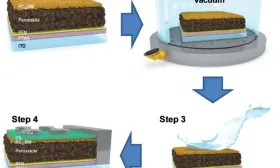
Researchers from the Ulsan Institute of Science and Technology have demonstrated a new method of fabricating perovskite-on-silicon tandem devices, using a transparent conductive adhesive to combine the two cells. The scientists have developed devices with demonstrated efficiencies of 19.4%, and propose strategies to bring that above 24% using existing technology.
The solar industry must work together to agree on standardised larger wafer sizes, according to monocrystalline solar manufacturer LONGi Group.
Chinese thin film producer Hanergy has set a new record of 24.85% module efficiency for silicon heterojunction technology. The record was achieved at the company’s research & development center in Chengdu, China, and has been confirmed by the Institute for Solar Energy Research in Hamelin, Germany.