Perovskite/Silicon Tandem Certifies 27.49% for Space
- Certified 27.49% AM0 efficiency: a durable monolithic perovskite/silicon space tandem. It withstood radiation, heat, humidity, and high-altitude balloon operation—no monotonic decay.
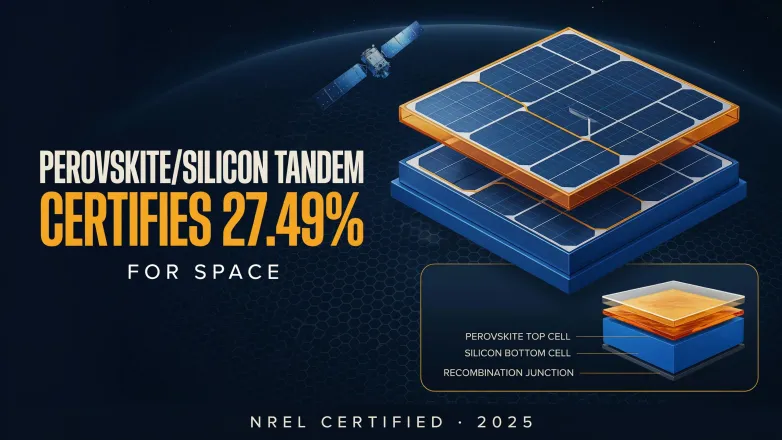
Researchers at several Chinese institutions say they built a monolithic perovskite/silicon tandem solar cell for space power that achieved a certified 27.49% power conversion efficiency under AM0 (zero air mass) light, the highest certified AM0 result for this tandem type reported so far. The large-area device maintained strong performance while demonstrating resistance to radiation and environmental stress, including real operation during a high-altitude balloon flight to about 29.7 km.
The team attributes durability to using a thicker p-type silicon bottom cell (n-type degraded severely under 1 MeV electrons), tuning the perovskite top-cell bandgap to 1.72 eV to preserve current matching as silicon ages, and adding a multifunctional ionic liquid to stabilize perovskite films. The tandem retained ~96.8% after thermal shocks, ~93% after proton irradiation, and ~95% after 550 hours under humidity/heat, and delivered stable balloon-flight power without monotonic decay.
How did a Chinese monolithic perovskite/silicon space tandem achieve certified AM0 durability?
- Monolithic 2‑terminal perovskite/silicon stack used a radiation-aware cell architecture: a deliberately selected p‑type silicon bottom cell that is less vulnerable to the dominant electron-driven damage pathways than n‑type designs, helping preserve carrier lifetime and junction performance under space particle exposure.
- Bandgap and current-matching were engineered to remain “thermally and electrically compatible” as the silicon degrades in orbit: the perovskite top-cell composition was tuned (around the ~1.7 eV range) so that—after silicon performance loss—its generated photocurrent still tracks the bottom cell closely, reducing the tendency for power to fall via mismatch rather than only via absolute efficiency loss.
- Space-stability chemistry was built into the perovskite layer using an ionic-liquid–assisted strategy: the additive acts to suppress ion migration and passivate detrimental interfacial defects, limiting halide loss and structural relaxation that can otherwise accelerate efficiency decay under heat cycles and prolonged bias.
- Interface and transport layers were chosen/processed to remain robust under humidity and temperature: stronger adhesion and improved barrier behavior at the perovskite/transport interfaces reduce decomposition triggers (moisture ingress, interlayer delamination) that commonly cause gradual AM0-to-flight underperformance.
- Encapsulation and device stack integrity were treated as part of “durability certification,” not an afterthought: protective layers were optimized to slow moisture and oxygen penetration and to buffer thermal-expansion stress, which helps explain why the device maintained output without a steady monotonic efficiency drop during real environmental cycling.
- Radiation durability was demonstrated through damage-resilient design plus post-irradiation performance checks: the combination of more radiation-tolerant silicon polarity, defect passivation in the perovskite, and stable interfaces mitigated the typical two-stage failure pattern (fast initial loss plus slower recovery/continued degradation), yielding a comparatively flat response curve after exposure.
- Thermal shock resistance was achieved by managing mechanical stress in the monolithic interconnection: controlling film thicknesses and interlayer adhesion reduces crack propagation and interfacial strain, preserving electrical continuity and suppressing formation of shunt pathways during repeated temperature swings.
- The AM0 certification durability link came from maintaining electrical match and structural stability under test-standard equivalent stressors while preserving full-device operation: the team’s approach ensured the cell remained in a high-performance operating regime (current match + low leakage) rather than relying on short-term performance snapshots.
- High-altitude balloon operation served as a practical validation of the “certified durability” premise: the tandem produced stable power output under near-space environmental conditions and maintained functionality without progressive collapse, supporting that the lab durability tests translated to operational reliability beyond ground-only characterization.
Also read
- Optivolt Raises $32 Million for Power Electronics Built Into Panels
- UNSW Catalyst Lifts Hydrogen Output 10-Fold From Biodiesel Glycerol
- Sparc Hydrogen Owners Commit A$1.3 Million to Solar Water Splitting
- SunPower Origin Launches in Europe With 505 W, 40-Year Warranty
- JinkoSolar Reports 28% Peak Efficiency for Back-Contact TAC Cell