LONGi and Soochow Tandem Cell Reaches 35.1% Certified Efficiency
- A perovskite-silicon tandem cell from Soochow University and LONGi reached 35.1% certified stabilized efficiency, Nature reported on Nov. 4.
- A twisted self-assembled molecule lifted the fill factor to 85%; the cell kept over 94% of output after 1,500 hours.
- The 1-cm² lab cell sits below LONGi's 35.5% ESTI-certified record, announced in July.
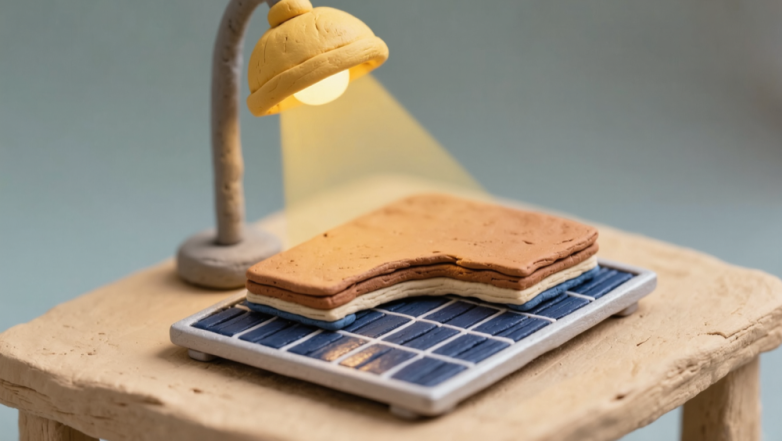
A perovskite-silicon tandem solar cell made by Soochow University and LONGi Green Energy Technology reached a certified stabilized efficiency of 35.1%, according to a paper published in Nature on Nov. 4.
The gain comes from a new self-assembled molecule that pulls holes out of the perovskite top cell. Such molecules tend to clump on the pyramid texture of a silicon wafer and leave gaps. The team added a twist to the molecule's structure, which stopped the clumping without cutting its conductivity. The best of three new designs, called TC2, lifted the fill factor to 85%.
The CPVT test lab certified a 1.007-cm² cell. It measured 35.25% on a forward scan and 35.16% on a reverse scan. The stabilized value was 35.13%, which the paper rounds to 35.1%. The 35.31% figure in the supplementary data is the team's own best measurement, not a certified one.
The result is not a record. The efficiency chart of the National Laboratory of the Rockies, formerly NREL, lists a 35.2% LONGi cell as the best two-terminal perovskite-silicon device. On July 28 LONGi said an ESTI-certified cell had reached 35.5%.
The cell in numbers
- 35.13% certified stabilized efficiency on a 1.007-cm² aperture, measured by CPVT.
- 1.997 V open-circuit voltage and 20.78 mA/cm² current density in the certified reverse scan.
- More than 94% of initial output kept after 1,500 hours of light soaking under the ISOS-L-1 protocol.
- 24.34% average efficiency across 10 cells with the reference 4PACz molecule, against 35.11% with TC2.
- 7.0 percentage points above the 28.1% best single-junction crystalline silicon cell on the same chart (list.solar calculation).
- 0.4 percentage points below LONGi's 35.5% ESTI-certified cell (list.solar calculation).
Soochow University made the perovskite top cell entirely in its own laboratory, the supplementary information says. LONGi researchers at its central R&D institute in Xi'an made the silicon bottom cells, and five of the 27 authors work for the company. KAUST, the Chinese University of Hong Kong and five other institutions also took part. The same partners reported a 34.6% certified cell with a different molecule in a 2025 Nature paper, LONGi said at the time.
The tested cells cover about one square centimeter. LONGi said in July that it has also shown strong results on larger tandem cells and modules, but that statement gave no figures.
Also read
- Wood Mackenzie Sees Sodium-Ion Cells Matching LFP Costs by End-2026
- Eos Energy Lifts Q3 Revenue 171% to $82.7 Million on Zinc Batteries
- Osaka Robot Platform Guides Perovskite Cell to 24.4% Efficiency
- ARRAY and Shoals Agree All-Stock Merger, Shoals Holders to Own 65%
- DGIST Cuts Solar Hydrogen Electrode Coating Voltage to 4 V From 200 V