How Advanced PV Encapsulation Materials Are Shaping the Next Generation of Solar Modules
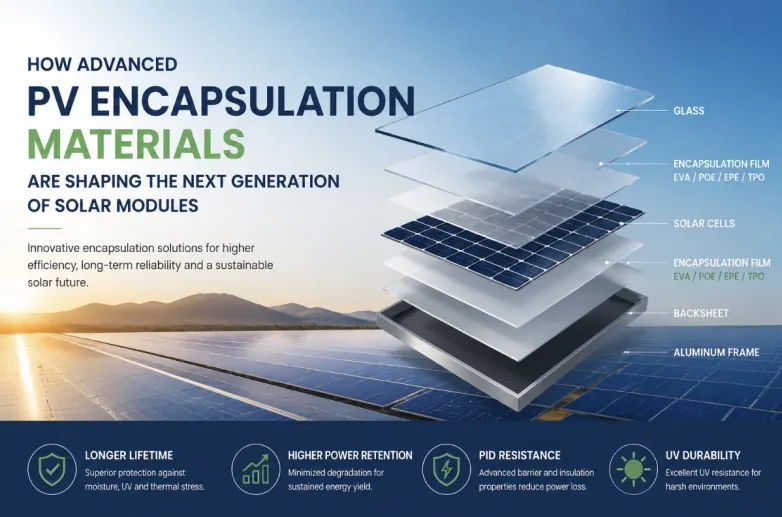
Over the past decade, photovoltaic (PV) technology has experienced remarkable progress. Solar cell efficiency has continued to increase, manufacturing costs have declined, and advanced technologies such as TOPCon, BC (Back Contact), HJT, and perovskite tandem cells are accelerating the next phase of solar innovation.
However, improving solar cell efficiency alone is no longer enough.
As PV modules become more powerful and are deployed in increasingly challenging environments, the materials surrounding the cells have become equally critical. Encapsulation materials, although often invisible to end users, play a fundamental role in protecting solar cells, maintaining long-term power output, and ensuring module reliability throughout a 25–30 year operating life.
The Material Challenges Behind Higher Solar Module Efficiency
Modern solar modules are becoming increasingly efficient, but higher performance brings new reliability challenges.
Traditional PV modules were designed around conventional silicon cells with moderate efficiency levels. Today, advanced cell technologies introduce more sensitive structures and require stricter material compatibility.
For example:
-
TOPCon cells rely on advanced passivation layers to achieve higher conversion efficiency.
-
BC cells eliminate front-side metal grids to maximize light absorption but require improved mechanical protection.
-
HJT cells combine crystalline silicon with thin-film technologies, making them more sensitive to moisture and thermal stress.
-
Perovskite tandem cells introduce new materials that require extremely stable encapsulation environments.
As cell structures become more sophisticated, PV module encapsulation materials must provide more than basic protection. They must simultaneously deliver:
-
Higher transparency for improved light utilization
-
Strong adhesion to prevent delamination
-
Lower moisture transmission
-
Better resistance to UV radiation
-
Improved thermal stability
-
Enhanced electrical insulation performance
In other words, encapsulation materials have become a key factor in determining whether laboratory-level efficiency can be successfully translated into decades of real-world energy generation.
The Evolution of PV Encapsulation Materials: From EVA to POE, EPE, and TPO
EVA Encapsulation Film
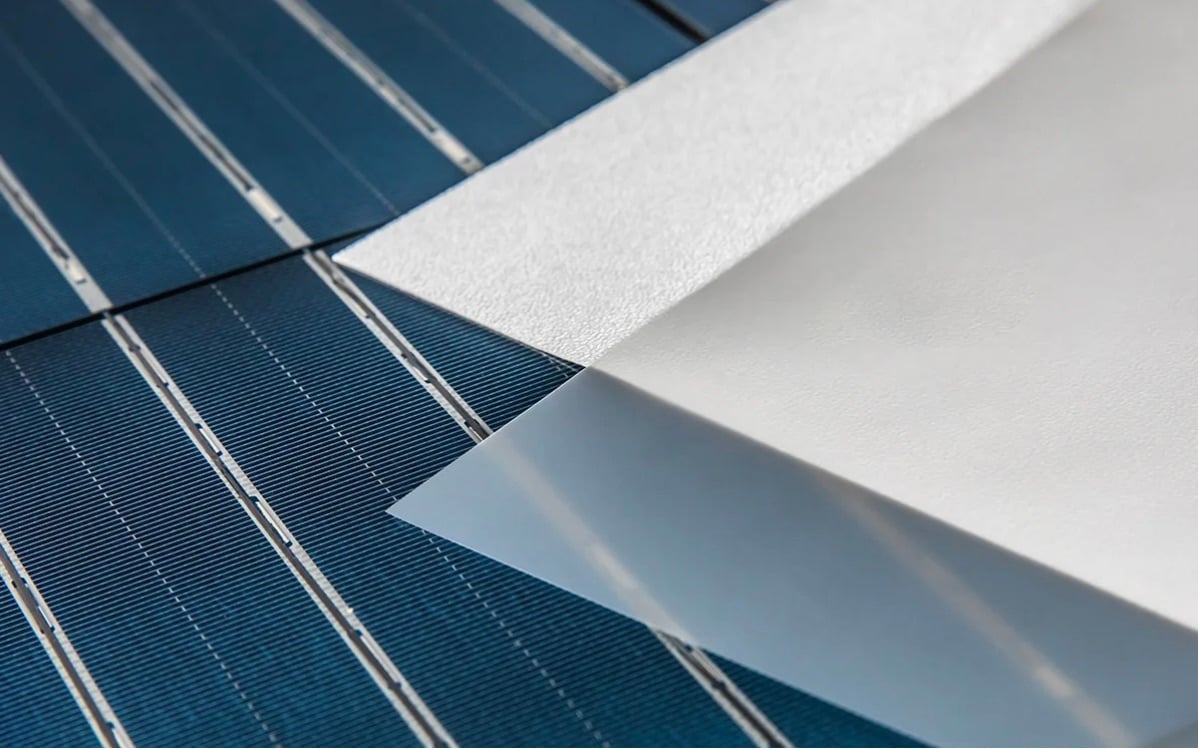
Ethylene Vinyl Acetate (EVA) has been the dominant encapsulation material in the PV industry for decades due to its excellent balance of cost, process compatibility, and optical performance.
The advantages of EVA include:
-
High transparency
-
Strong bonding performance
-
Mature manufacturing technology
-
Cost competitiveness
For conventional crystalline silicon modules, EVA solar film has provided reliable protection for millions of installations worldwide.
However, as module technologies advance, several limitations have become increasingly important:
-
Moisture penetration risks
-
Acetic acid generation during aging
-
Potential-induced degradation (PID) concerns
-
Reduced performance under extreme environments
These challenges have driven the development of more advanced encapsulation technologies.
POE Encapsulation Film
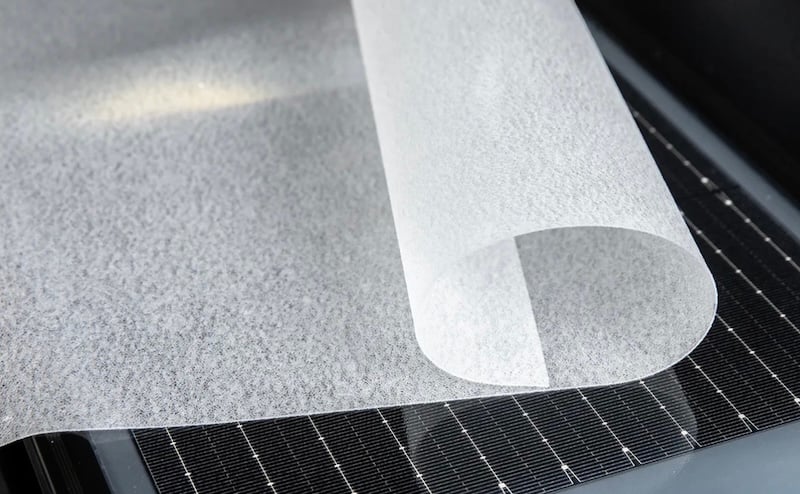
Polyolefin Elastomer (POE) encapsulation film has emerged as a preferred solution for high-performance solar modules.
Unlike EVA, POE solar film does not generate acetic acid during degradation, significantly reducing corrosion risks inside the module.
Key advantages include:
Superior Moisture Resistance
POE provides a much lower water vapor transmission rate (WVTR), making it highly suitable for:
-
Coastal environments
-
Humid regions
-
Floating PV systems
-
Long-life utility-scale projects
Improved PID Resistance
Potential-induced degradation is one of the major causes of power loss in PV modules.
POE's excellent electrical insulation properties help reduce ion migration and improve module stability under high-voltage conditions.
As module power increases and system voltages rise, POE is becoming increasingly important for maintaining long-term energy yield.
EPE Encapsulation Film
EPE encapsulation film integrates the advantages of EVA and POE through a multilayer structure.
Typically consisting of:
EVA / POE / EVA
or similar configurations, EPE provides a balanced solution between reliability and cost.
Advantages include:
-
Improved moisture resistance compared with traditional EVA
-
Better cost-performance ratio compared with pure POE
-
Strong adhesion
-
Excellent optical properties
EPE has become increasingly attractive for applications such as:
-
TOPCon modules
-
High-power bifacial modules
-
Large-scale solar installations
By combining different polymer characteristics, EPE enables manufacturers to achieve higher reliability without significantly increasing module costs.
TPO Encapsulation Film
Thermoplastic Polyolefin (TPO) encapsulation represents another important direction in PV material innovation.
TPO offers:
-
Excellent chemical stability
-
High moisture resistance
-
Low-temperature processing capability
-
Strong compatibility with emerging solar technologies
As perovskite tandem cells and other next-generation PV technologies move toward commercialization, encapsulation materials with improved chemical stability and low-temperature processing characteristics will become increasingly valuable.
New Requirements from Advanced Solar Cell Technologies
TOPCon Modules
TOPCon has rapidly become one of the leading next-generation silicon technologies.
However, its advanced passivation structures require stronger protection against:
-
UV exposure
-
Moisture intrusion
-
Ion migration
Advanced encapsulation films help maintain passivation integrity and reduce long-term efficiency losses.
BC (Back Contact) Modules
BC technology maximizes front-side light absorption by removing traditional front metal grids.
However, this structure increases requirements for:
-
Mechanical stress management
-
Adhesion reliability
-
Thermal cycling resistance
High-performance encapsulation materials help protect delicate cell structures during manufacturing and operation.
HJT Modules
HJT technology combines crystalline silicon with thin-film layers, creating excellent efficiency potential.
However, HJT modules are particularly sensitive to:
-
High temperature
-
Moisture
-
Material compatibility issues
Encapsulation films with superior barrier properties are essential for maintaining long-term stability.
Perovskite Tandem Modules
Perovskite tandem technology represents one of the most promising future PV directions.
However, perovskite materials are highly sensitive to:
-
Water vapor
-
Oxygen
-
Thermal stress
-
Chemical interaction
Future encapsulation solutions must provide ultra-high barrier performance while maintaining optical transparency.
How Advanced Encapsulation Materials Improve Solar Module Reliability?
1. Extending Module Lifetime
A solar module's lifetime depends not only on the cell but also on how effectively the encapsulation system protects internal components.
Advanced encapsulation materials help prevent:
-
Cell corrosion
-
Delamination
-
Moisture damage
-
Material aging
By maintaining structural integrity, they support reliable operation beyond the traditional 25-year lifespan.
2. Improving Power Retention
Module degradation directly affects lifetime energy production.
Encapsulation materials influence degradation through:
-
UV stability
-
Thermal resistance
-
Adhesion durability
-
Chemical stability
A module with better encapsulation performance can maintain higher power output throughout its operational life, improving project economics.
3. Enhancing PID Resistance
PID remains a major concern for high-power PV systems.
Advanced encapsulation films reduce PID risks through:
-
Higher electrical resistance
-
Reduced ion migration
-
Better moisture protection
This is especially important for large-scale solar farms operating at high system voltages.
4. Increasing UV Durability
Solar modules are exposed to intense UV radiation throughout their lifetime.
Extreme environments such as deserts can experience significantly higher UV exposure than standard climates.
Advanced encapsulation materials incorporate technologies such as:
-
UV-resistant polymer structures
-
Optical stabilizers
-
Improved molecular cross-linking
These technologies help protect cells and maintain module performance under harsh conditions.
Final Words
The future of photovoltaic technology is not determined by solar cells alone. As efficiency levels continue to rise, encapsulation materials will play an increasingly important role in enabling reliable, long-lasting, and high-performance solar modules.
The transition from EVA to advanced solutions such as POE, EPE, and TPO reflects a broader industry shift toward higher reliability and application-specific material engineering.
For next-generation PV technologies including TOPCon, BC, HJT, and perovskite tandem modules, advanced encapsulation materials are no longer simply protective layers—they are strategic components that determine module lifetime, energy yield, and long-term return on investment.
As the global solar industry moves toward higher efficiency and more demanding applications, innovative PV encapsulation materials will continue to shape the future of clean energy.
Also read
- How Can You Plan Solar Powered Lighting for a Garden Shed Without Overbuying?
- How Can You Make a Solar Installation Proposal Easier for Homeowners to Understand?
- What Should You Ask About Electrical Connections Before Buying a Home Solar System?
- How Can You Plan Portable Solar Power for a Weekend Away?
- Solar PV and Pool Heat Pumps in Australia: How to Reduce Heating Costs Without Oversizing Your System