Solar PV and Pool Heat Pumps in Australia: How to Reduce Heating Costs Without Oversizing Your System
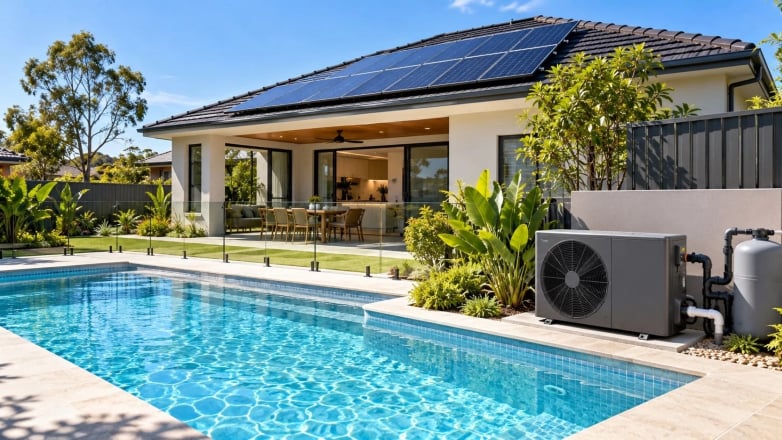
Rooftop solar can reduce the running costs of an electric pool heat pump by supplying electricity during daylight hours. The largest potential savings usually come when the heat pump uses electricity that would otherwise be exported to the grid at a relatively low feed-in tariff.
The challenge is matching three things: the electricity available from the solar system, the heat required by the pool and the heat pump's performance under local weather conditions.
A larger heat pump is not necessarily more economical. Nor does a household need to replace a working heater simply because solar panels have been installed.
For Australian pool owners, a useful starting point is to examine actual solar exports, estimate the pool's heating demand and compare equipment under realistic operating conditions.
How Much Solar Electricity Is Available for Pool Heating?
A rooftop solar system supplies electricity to household appliances before any surplus is exported to the grid, assuming a typical grid-connected installation without battery discharge or other special controls.
The electricity available for pool heating is therefore not the same as the total solar output.
Consider a Melbourne household on a sunny afternoon:
|
Electricity use |
Power |
|---|---|
|
Rooftop solar generation |
4.0 kW |
|
Other household appliances |
1.5 kW |
|
Surplus before pool heating |
2.5 kW |
|
Pool heat pump electrical input |
2.0 kW |
|
Remaining solar surplus |
0.5 kW |
In this example, the heat pump could operate without additional grid imports while those conditions remain unchanged.
If clouds reduce solar generation to 2.5 kW while other household appliances continue using 1.5 kW, only 1 kW remains available. A heat pump drawing 2 kW would then require approximately 1 kW from the grid.
This is why the size of the rooftop solar array alone tells homeowners relatively little about the electricity available for heating.
A 6.6 kW solar system, for example, does not produce 6.6 kW continuously. Output changes with sunlight, panel orientation, shading, temperature and season.
Households with solar monitoring should examine their actual export patterns over several weeks. Midday export readings provide a more useful starting point for heating schedules than the system's advertised capacity.
How an Electric Pool Heat Pump Uses Solar Power
An electric pool heat pump transfers heat from outdoor air into the pool water through a refrigeration cycle.
Unlike a conventional resistance heater, it does not convert electricity directly into an equivalent quantity of heat. Its electrical input runs the compressor, fan and other components needed to move heat.
This allows a heat pump to deliver several units of thermal energy for each unit of electrical energy consumed.
The relationship is expressed as the coefficient of performance, or COP.
What does COP 5 actually mean?
A COP of 5 means that, under the stated operating conditions, the heat pump delivers five units of heating energy for every unit of electrical energy consumed.
For example:
-
Electrical input: 2 kW
-
Heating output: 10 kW
-
Operating time: 4 hours
-
Electricity consumed: 8 kWh
-
Thermal energy delivered: approximately 40 kWh
These figures assume stable performance during the example period.
Actual COP changes with outdoor temperature, humidity, pool-water temperature and operating conditions.
A unit achieving COP 5 during a warm afternoon may be less efficient during a cold Melbourne morning.
Manufacturer specifications should therefore be compared using the same air temperature, humidity, water temperature and operating mode.
A headline COP measured under favourable test conditions should not be compared directly with another manufacturer's figure obtained under different conditions.
For households planning to heat during cooler months, performance at lower outdoor temperatures is particularly important.
Solar Thermal Pool Heating or a PV-Powered Heat Pump?
Solar pool heating and rooftop solar PV use sunlight in different ways.
Solar thermal systems circulate pool water through roof-mounted collectors, allowing sunlight to warm the water directly.
A PV-powered heat pump uses electricity from solar panels to operate an air-source heating system.
Both approaches can reduce purchased energy, but their suitability depends on the swimming season, existing equipment and available installation space.
|
Factor |
Solar thermal heating |
Solar PV with heat pump |
|---|---|---|
|
Primary energy source |
Sunlight heating pool water directly |
Electricity operating an air-source heat pump |
|
Heating during cloudy weather |
Output generally falls |
Can continue using available solar or grid electricity |
|
Heating after sunset |
No direct solar heat collection |
Possible using grid electricity or another available supply |
|
Installation requirements |
Roof collectors, plumbing and controls |
Electrical supply, ventilation, drainage and water connections |
|
Main operating limitation |
Available solar heat |
Ambient conditions, electricity costs and equipment capacity |
|
Suitable applications |
Swimming seasons with sufficient sunshine |
More controlled heating across suitable operating conditions |
Solar thermal heating can be attractive for households that mainly swim during warmer, sunnier months.
An electric heat pump may suit owners seeking more predictable heating or a longer swimming season, provided the selected unit has adequate capacity.
Where a household already has an effective solar thermal system, keeping it may be more economical than installing a new heat pump.
The comparison should account for the useful life and condition of existing equipment, not just the operating characteristics of a new system.
What Does Solar-Assisted Pool Heating Actually Cost?
Electricity savings are best assessed by comparing grid purchases and foregone solar export revenue.
Suppose a pool heat pump consumes 10 kWh during its daily heating period.
For this example, assume:
-
Grid electricity costs $0.30 per kWh.
-
Solar exports earn $0.05 per kWh.
-
The household has 7 kWh of surplus solar electricity available while the heat pump operates.
-
The remaining 3 kWh comes from the grid.
Without solar electricity, running the heat pump would cost:
10 kWh × $0.30 = $3.00 per day
With 7 kWh supplied by surplus solar, grid electricity purchases fall to:
3 kWh × $0.30 = $0.90
However, the household also gives up the export revenue it would have earned from the 7 kWh:
7 kWh × $0.05 = $0.35
The total effective daily energy cost is therefore:
$0.90 + $0.35 = $1.25
|
Scenario |
Effective daily cost |
|---|---|
|
All electricity purchased from grid |
$3.00 |
|
7 kWh surplus solar + 3 kWh grid |
$1.25 |
|
Daily saving |
$1.75 |
At the same operating pattern for 150 days, the illustrative saving would be $262.50.
This is a comparison of electricity sourcing for an existing heat pump. It is not the payback period for buying solar panels or replacing heating equipment.
The example uses assumed tariffs and a constant electricity requirement. Real costs depend on the retailer's pricing, export arrangements, weather, household consumption and actual heating demand.
A time-of-use tariff can also change the calculation. Daytime grid electricity may be cheaper or more expensive than electricity purchased during other periods, depending on the plan.
Getting the Heating Schedule Right
For many solar-equipped households, the most promising heating window falls between late morning and mid-afternoon.
That is when rooftop generation often exceeds household demand, particularly on clear days.
But moving the heat pump to a daytime schedule requires more than changing its timer.
The circulation pump must be running whenever the heat pump requires water flow. The system must also supply enough flow to satisfy the heater's operating requirements.
Some chlorinators and cleaning systems share the same circulation equipment, so changes to the pump schedule may also affect sanitisation and cleaning.
A practical setup may involve running a variable-speed circulation pump at a suitable lower speed during normal filtration and increasing speed when connected equipment requires additional flow.
The correct settings depend on the manufacturer's flow specifications and the pool's hydraulic arrangement.
Fixed timers or solar-aware controls?
A fixed timer is relatively simple. It operates the heat pump during nominated hours, regardless of actual solar output.
Solar-aware controls can potentially respond to available surplus generation, where compatible equipment and suitable monitoring are installed.
Neither approach guarantees that enough heat will be delivered.
On a cloudy day, a heat pump restricted to a short solar-only window may not maintain the desired water temperature. During cooler weather, the unit may also deliver less heat for the electricity consumed.
Homeowners should first establish the pool's required heating period, then identify how much of that operation can reasonably be shifted into daylight hours.
Why a Pool Cover Changes the Heating Calculation
An outdoor pool loses heat continuously, particularly through evaporation.
Wind increases evaporation by removing moist air from the water surface. The resulting heat loss can be substantial when warm pool water is exposed during cool nights.
This matters in Melbourne, where an afternoon suitable for swimming can be followed by much cooler overnight conditions.
A pool cover reduces evaporation and helps preserve heat added during the day.
Consider a simplified heating-demand example.
A pool requires 60 kWh of thermal energy over a particular period to replace heat losses while uncovered.
If a suitable cover reduces those losses by an assumed 50%, the replacement heating requirement falls to approximately 30 kWh.
With a heat pump operating at an average COP of 5:
|
Condition |
Thermal energy required |
Heat pump electricity |
|---|---|---|
|
Pool uncovered |
60 kWh |
12 kWh |
|
Pool covered, assuming 50% lower heat loss |
30 kWh |
6 kWh |
The figures illustrate the relationship between heat loss and electricity consumption. They are not measured results or a prediction for a particular pool.
Actual cover performance depends on fit, construction, use, weather and the proportion of heat loss attributable to evaporation.
Nevertheless, the principle is important: reducing heat loss lowers the amount of heating energy the equipment must supply.
It can also improve the usefulness of daytime solar generation by retaining more of the heat after the sun has set.
For some households, improving heat retention is a more sensible first investment than purchasing a higher-capacity heater.
When Is Replacing an Existing Pool Heater Worthwhile?
Imagine a homeowner with an ageing gas pool heater and an existing rooftop solar system.
The heater still works, but gas consumption has become expensive, and the family now wants to swim regularly through spring and autumn.
An electric heat pump might be attractive because some of its electricity demand could be supplied by rooftop solar.
However, the decision requires a comparison of total annual costs.
The existing gas heater's efficiency, actual gas consumption and the household's swimming schedule matter. So do the replacement heat pump's installed cost, electricity consumption and likely performance during cooler months.
For homeowners considering pool heat pump upgrades, an assessment should also establish whether the existing circulation system can support the replacement unit.
A new heat pump may require changes to valves, bypass plumbing, electrical supply or equipment positioning. A poorly ventilated installation can reduce performance, while inadequate water flow may cause operating faults.
These costs belong in the replacement comparison.
How to calculate simple payback
Suppose the proposed heat pump installation costs $6,000, including the necessary equipment and installation work.
The homeowner expects the new arrangement to reduce annual heating expenses by $900 compared with retaining the existing system.
Assuming those savings are net of relevant differences in routine operating and maintenance costs, the simplified calculation is:
$6,000 ÷ $900 = approximately 6.7 years
This is the simple payback period.
It does not account for financing, the time value of money, future tariff changes, major repairs or differences in equipment life.
Where the existing heater would soon require replacement anyway, the more useful calculation may compare the additional cost of choosing the heat pump over another replacement option.
For example, if one viable replacement costs $4,000 and the heat pump installation costs $6,000, the incremental investment is $2,000 rather than the full $6,000.
Payback is only one measure. Reliability, temperature control and the length of the swimming season may also influence the decision.
Choosing the Right Heat Pump Size
Heat pump sizing should start with the pool's heating requirement, not the highest output figure in a product brochure.
Pool volume determines how much energy is needed to raise the water temperature.
As a useful approximation, raising 1,000 litres of water by 1°C requires about 1.16 kWh of thermal energy, before allowing for heat loss.
For a 40,000-litre pool, increasing the temperature by 1°C requires approximately:
40 × 1.16 = 46.4 kWh of heat
A 3°C increase would require approximately 139 kWh before accounting for losses during heating.
If a heat pump could continuously deliver 12 kW of thermal output under the actual operating conditions, that 3°C increase would theoretically require around 11.6 hours without heat losses.
In real outdoor conditions, the heating period would generally be longer because the pool continues to lose heat while warming.
This demonstrates why a heat pump cannot be sized from pool volume alone.
The installer also needs to consider the desired warm-up period, expected weather, heating season, water temperature and cover use.
Comparing two heat pumps
Consider two hypothetical models tested under identical conditions:
|
Specification |
Model A |
Model B |
|---|---|---|
|
Heating output |
12 kW |
18 kW |
|
COP |
5 |
5 |
|
Electrical input |
2.4 kW |
3.6 kW |
Model B delivers more heat while operating, but it also draws more electricity.
If the household usually has approximately 2.5 kW of surplus solar available, Model A may align more closely with that surplus at the stated operating point.
That does not establish which model will cost less across a season.
Model B could require fewer heating hours, while a variable-capacity unit may operate at different output and efficiency levels depending on demand.
The comparison must include actual part-load performance and heating requirements under the same operating assumptions.
Oversizing can increase purchase costs without providing worthwhile additional benefits. Undersizing can leave the heater running for excessive periods or failing to maintain the desired temperature.
Before Ordering a New Heat Pump
A useful equipment assessment starts with information homeowners can collect themselves.
Check the pool and heating requirements. Record approximate water volume, preferred temperature, swimming months and whether a cover is regularly used.
Review solar monitoring. Examine actual daytime exports and how they change between clear and cloudy days.
Identify existing equipment. Photograph model labels for the pump, filter, chlorinator and heater. Note any error messages or recurring operating problems.
Inspect the proposed installation area. Heat pumps require manufacturer-specified airflow clearances, suitable drainage and access for servicing.
Confirm the installation scope. Plumbing, electrical connections and other regulated work may involve separate trades. In Victoria, electrical installation work must be undertaken through the appropriate licensed arrangements, while regulated gasfitting and refrigerant-handling activities require suitably authorised personnel.
These checks can reveal potential costs before the replacement equipment is purchased.
They also reduce the risk of choosing a unit that performs well on paper but is poorly suited to the existing pool.
Making Solar Pool Heating Work in Practice
For a household that already has rooftop solar, the first useful measurement is the amount of electricity regularly exported during the proposed heating hours.
Next, establish how much heat the pool needs. Pool volume, desired temperature, outdoor conditions and cover use all affect that requirement.
Only then does it make sense to compare heat pump models and operating schedules.
A homeowner with substantial midday exports and a well-covered pool may be able to move much of the heating electricity demand into solar-producing hours. Another household with limited exports, significant overnight heat loss or high shoulder-season heating demand may need a different operating strategy.
Before committing to a replacement, compare the existing heater's costs with a properly sized alternative using realistic performance data and a complete installation quote.
Those figures provide a stronger basis for an equipment decision than either advertised COP or rooftop solar capacity alone.
Also read
- World Sustainability Forum Continues Global Impact with WSF-13 and Sustainability Awards in 2027
- How Long Do Solar Panels Actually Last? What BC Homeowners Should Know
- Home Solar Plus Battery Storage on Vancouver Island: What Payback Looks Like in 2026
- Why most AI agent pilots on solar sites never reach production
- How Industrial Air Cleaning Improves Workplace Safety and Productivity