Best Portable Solar Generators (2026): 13 Kits Compared on Real Solar Output and Price
Updated: November 2026 · Data: kit prices and specifications from brand US stores checked 7 November 2026, solar yield from NLR PVWatts and EU PVGIS, CPSC and EIA reports · Primary sources listed at the end
Key figures
- 13 of 13: solar generator kits in this guide whose power station accepts more solar power than the panels in the box can supply; the panels cover 11–50% of the station's solar input
- 1.69 vs 0.96 kWh: what 400 W of panels deliver per day in New York in June and in December (PVWatts); in Kyiv the December figure is 0.34 kWh, 18% of June
- 2.1 days: how long a 200 W panel takes to fill a 1 kWh station in a New York December, against "around 6.6h" in Jackery's charging FAQ (list.solar calculation)
- 83–91%: share of their rated output that the better folding panels delivered in a two-hour side-by-side test (OutdoorGearLab, July 2026)
- 93: Americans killed in 2022 by carbon monoxide from portable generators, the latest year in the CPSC's count; battery-based solar generators emit none
- $0.68–1.08: fuel cost per kWh from a small gasoline inverter generator at November 2026 pump prices (list.solar calculation from Honda specifications and EIA data)
EcoFlow sells its DELTA 3 Plus power station with a 220 W folding solar panel for $919. The station can take 1,000 W of solar through two inputs. The panel in the box supplies 22% of that, and in New York in December it needs about two days of sun to fill the 1 kWh battery once. That gap between what a "solar generator" can absorb and what its own panels deliver runs through every kit we looked at.
A solar generator is not a new kind of machine. It is a portable power station, a lithium battery with an inverter and a solar charge controller, sold together with one or more folding panels. This guide compares 13 such kits on sale in the brands' own US stores on 7 November 2026, from a 288 Wh camping kit at $489.99 to a 5 kWh home-backup kit at $3,499.99. For each one we calculated how long its panels take to fill its battery in June and December, using irradiance models from the National Laboratory of the Rockies (NLR, formerly NREL) and the EU's Joint Research Centre. We also checked the panels themselves, the gap between label and measured output, and how the kits compare with a gasoline generator. There are no affiliate links on this page. The stations alone, with runtime tables and safety recalls, are covered in our companion guide to the best portable power stations of 2026.
Best Solar Generators of 2026 at a Glance
The table picks one kit per need. Prices are the brand's own US store price on 7 November 2026, when early Black Friday discounts were running at EcoFlow, Anker SOLIX and BLUETTI.
| Need | Kit | Why (key number) |
|---|---|---|
| Camping, phones and laptops | BLUETTI Elite 30 V2 + 100W | $489.99; the 100 W panel refills the 288 Wh battery in 0.7 days in a New York June and 1.2 in December, the fastest of any kit |
| Cheapest 1 kWh solar generator | BLUETTI Elite 100 V2 + 200W | $699 for 1,024 Wh and 200 W of panels; the station takes up to 1,000 W of solar for later expansion |
| Best 1 kWh panel in the box | EcoFlow DELTA 3 Plus + 220W | $919; the 220 W bifacial panel averaged 193 W in an independent test, the best result among folding panels |
| Lightest panel per watt | Anker SOLIX C1000 Gen 2 + PS200 | The 200 W PS200 Bifacial weighs 4.8 kg, or 41.6 W per kg |
| 2 kWh with the most solar | Anker SOLIX C2000 Gen 2 + PS400 | 400 W in one panel, enough to refill 2 kWh in about 1.2 summer days |
| Biggest bundle saving | EcoFlow DELTA 3800 Gen4 + 4×160W | $2,599 early-bird price, $576 below the station and four panels bought separately |
| Fastest solar refill, home size | BLUETTI Apex 300 + 2×350W | 700 W of panels for 2.8 kWh: 0.9 days in a New York June, 1.6 in December |
| 240 V home backup | Anker SOLIX S5000 + 2×400W | 5,024 Wh, 120/240 V, 10,000 cycles to 60%, up to 3,000 W of solar |
Sources: EcoFlow, Anker SOLIX, Jackery, BLUETTI and Goal Zero US online stores, 7 November 2026; OutdoorGearLab panel test (July 2026). Fill times are list.solar calculations explained under the infographic below.
How Much Solar Do the Kits Really Collect?
Brands quote solar charging in hours: "approx. 5.8 hours" for EcoFlow's DELTA 3 Classic with a 220 W panel, "around 6.6h" for Jackery's HomePower 1000 v2 with one SolarSaga 200W. Those figures assume the panel works at close to its full rating for the whole time, which happens only around midday in clear weather. The useful question is how much energy a panel collects over a whole day, and that depends on where and when.
We ran 400 W of panels, tilted at 35° to the south with 14% system losses, through PVWatts v8 for six US cities and through the EU's PVGIS 5.3 for four European ones. In June, 400 W delivered 1.5–2.1 kWh a day in every city. In December the results split. Phoenix kept 85% of its June output and Madrid 64%. New York fell to 57%, Seattle to 30% and Kyiv to 18%.
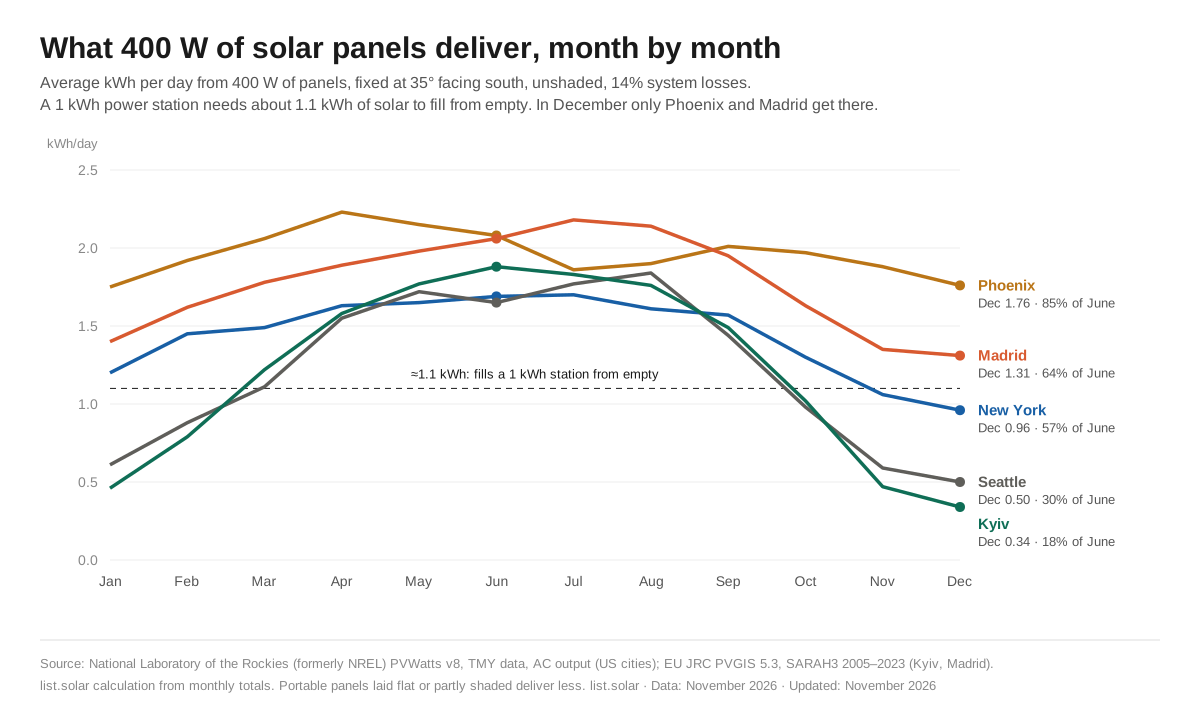
| City | June, kWh/day | December, kWh/day | December as % of June | Year, kWh |
|---|---|---|---|---|
| Phoenix | 2.08 | 1.76 | 85% | 717 |
| Denver | 1.96 | 1.49 | 76% | 661 |
| Miami | 1.47 | 1.56 | 106% | 611 |
| Chicago | 1.79 | 0.88 | 49% | 534 |
| New York | 1.69 | 0.96 | 57% | 526 |
| Seattle | 1.65 | 0.50 | 30% | 447 |
| Madrid | 2.06 | 1.31 | 64% | 648 |
| Kyiv | 1.88 | 0.34 | 18% | 445 |
| Berlin | 1.77 | 0.35 | 20% | 420 |
| London | 1.63 | 0.47 | 29% | 408 |
Output of 400 W (DC) of panels at 35° tilt facing south, unshaded, 14% system losses. US cities: NLR PVWatts v8, typical meteorological year (NSRDB TMY-2020), AC output. European cities: EU JRC PVGIS 5.3, SARAH3 satellite data 2005–2023. Per-day figures are monthly totals divided by days in the month, list.solar calculation. Miami's sunniest months are winter and spring; summer storms cut its June output.
Applied to the kits, the numbers are sobering. We divided each kit's rated battery capacity by the daily output of the panels in its box. A typical 1 kWh kit with one 200–220 W panel fills in 1.1–1.2 days in a New York June and in about two days in December. In Kyiv in December it takes about six days. The brands' hour figures are not wrong, but they describe a perfect noon, not a day.
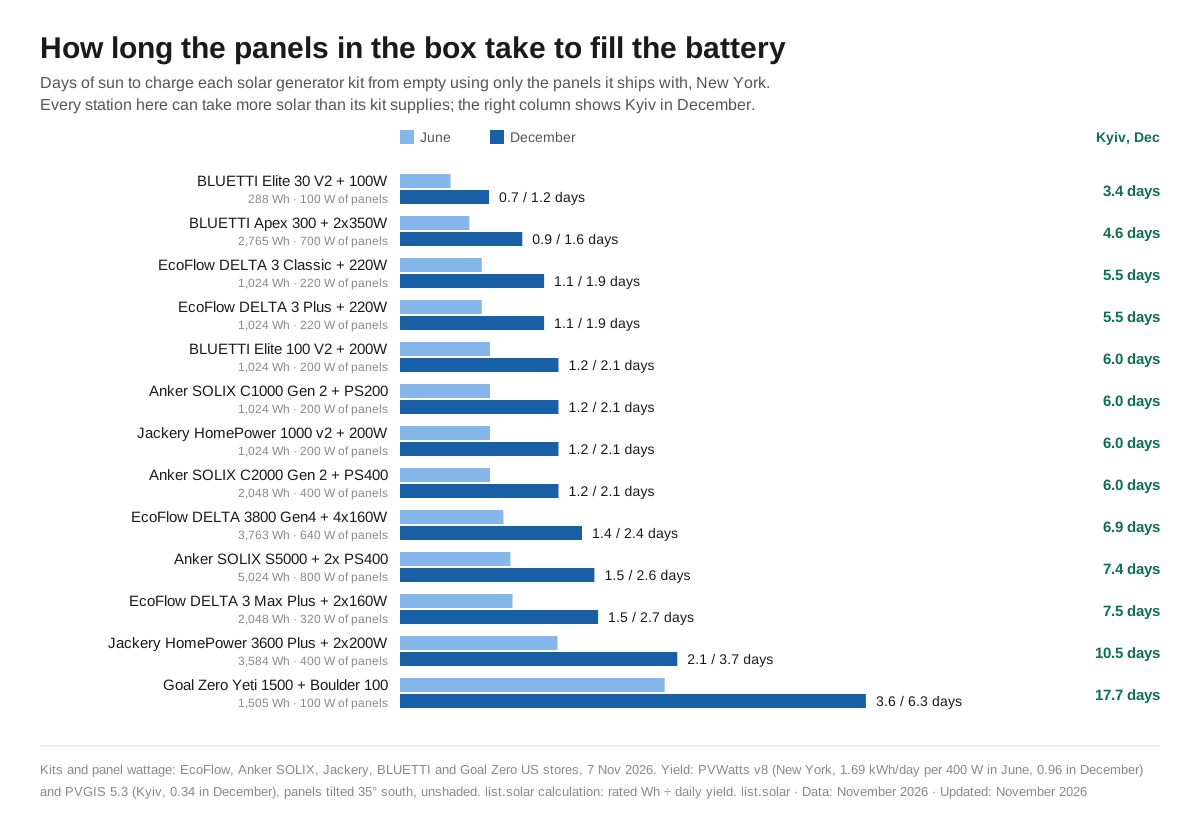
Two practical rules follow. First, size the panels to the season you care about. For a camping kit used from May to September, the panels in the box are often enough. For winter blackouts in the northern US or Europe, plan on two to four times the kit's panel wattage, or accept that the battery will be charged mostly from the grid or a generator. Second, the station is rarely the bottleneck. Every station in this guide accepts more solar than its kit supplies, so adding panels later is usually just a matter of buying them and checking the voltage window.
Small Solar Generators (Under 500 Wh): Camping and Laptops
At this size the panel-to-battery ratio is at its best: 100 W of panels for 288 Wh. That is enough for a weekend of phones, lights, a laptop and a small 12 V cooler, and the battery refills during the day.
1. BLUETTI Elite 30 V2 + 100W: the camping kit that keeps up
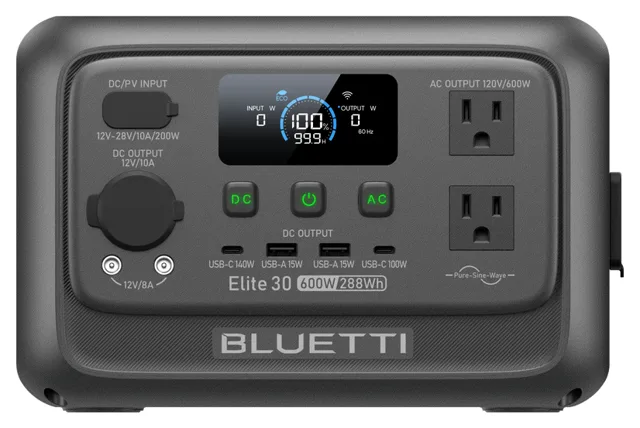
BLUETTI Elite 30 V2; the kit adds a 100 W folding panel. Image: BLUETTI
BLUETTI sells the Elite 30 V2 with a 100 W folding panel for $489.99, $49 less than the station ($289.99) and BLUETTI's 100 W panel ($249) bought separately. The kit page does not name the panel model. The station holds 288 Wh of lithium iron phosphate (LFP) cells, rated for 3,000 cycles to 80%, behind a 600 W inverter, and weighs 4.3 kg. Its solar input takes up to 200 W at 12–28 V, so the kit's panel uses half of it. In our calculation the 100 W panel refills the battery in 0.7 days in a New York June and 1.2 days in December, the shortest times in this guide. BLUETTI says the station charges in 2.2 hours from 200 W of solar, which would need a second panel. Kits were shipping from early December.
The alternatives are weaker. Anker's SOLIX C300 kit ($499.99) ships with a 60 W panel that Anker does not name or sell separately, for a station rated at 300 W continuous. Jackery's Solar Generator 300 v2 ($419) comes with a 40 W panel that Jackery itself says needs about 9.5 hours of ideal sun to fill the battery, and on 7 November the same page said the Explorer 300 v2 station was sold out.
1 kWh Solar Generators: The Blackout Basics
The 1 kWh class has the most kits and the lowest prices. Five of them pair a 1,024 Wh LFP station with a single 200–220 W panel, for $699 to $939. With one panel each, they fill in about 1.1–1.2 days in a New York June. The real differences are in the panel, the station's room for more panels, and the price.
2. EcoFlow DELTA 3 Classic + 220W: a budget kit with a good panel
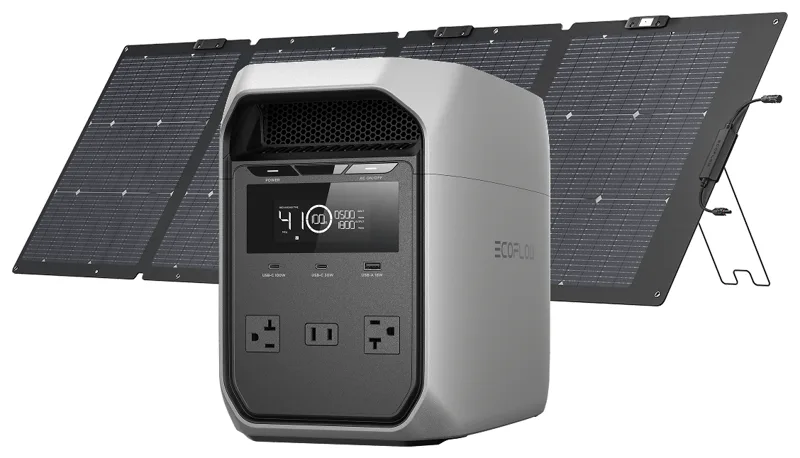
EcoFlow DELTA 3 Classic with the 220 W panel. Image: EcoFlow
The DELTA 3 Classic, launched on 16 March 2026, is the cheapest way to get EcoFlow's 220 W bifacial panel: $729 for the kit against $899 regular, or $199 less than the $479 station and $449 panel bought separately. The station has 1,024 Wh and an 1,800 W inverter, but only 500 W of solar input, half the DELTA 3 Plus figure. EcoFlow quotes "approx. 5.8 hours" of solar charging with the 220 W panel; our calculation gives 1.1 days in a New York June and 1.9 in December. EcoFlow does not publish the solar voltage window on its US pages, so check the manual before wiring two panels in series. The same station is also sold with EcoFlow's Smart Generator 3000 dual-fuel generator for $1,209, which is the honest answer for winter: sun when it shines, fuel when it does not.
3. BLUETTI Elite 100 V2 + 200W: the cheapest 1 kWh solar generator
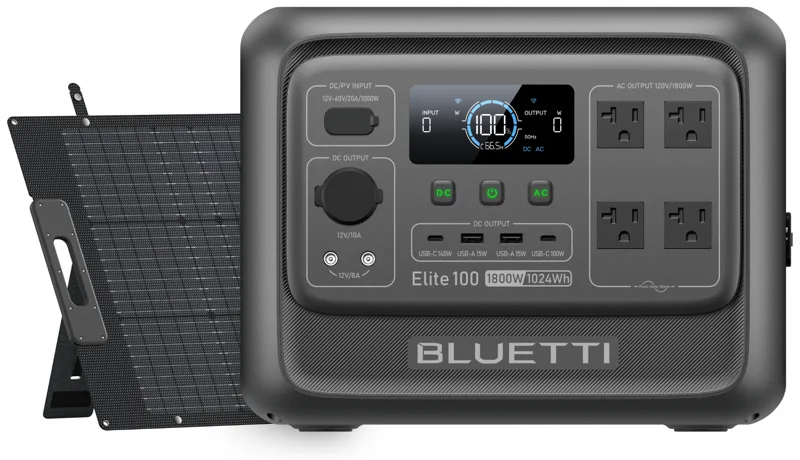
BLUETTI Elite 100 V2 with the 200 W panel. Image: BLUETTI
At $699, the Elite 100 V2 with a 200 W panel was the lowest-priced 1 kWh kit we found, $199 below the station ($499) and the 200 W panel ($399) bought separately. The kit photo shows BLUETTI's SP200L panel: 24.6 V open-circuit voltage (Voc), 8.14 kg, IP67. The station is the strongest in its class on solar: 1,000 W at 12–60 V through one input. The input takes up to 20 A, which leaves room for 800 W more of panels, and BLUETTI says 1,000 W fills the battery in 70 minutes. The inverter delivers 1,800 W, the cells are rated for 4,000 cycles to 80%, and the warranty is five years. BLUETTI also sells the station with its 350 W panel for $1,099, but that kit saves only $49. Buying the $699 kit and adding panels later is better value. Kits were shipping from 12 November.
4. EcoFlow DELTA 3 Plus + 220W: the best panel in a 1 kWh box
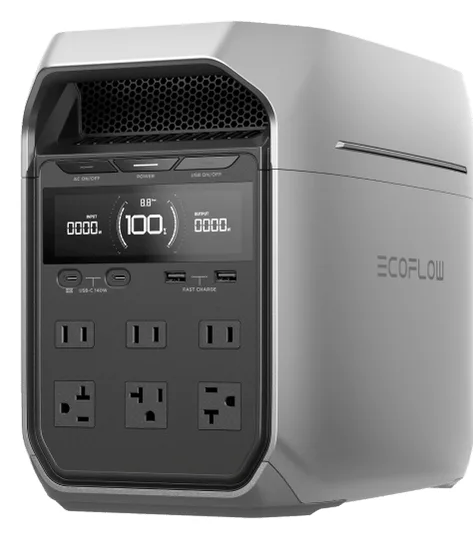
EcoFlow DELTA 3 Plus; the kit adds the 220 W bifacial panel. Image: EcoFlow
The DELTA 3 Plus kit costs $919, against $1,099 regular and $249 less than its parts bought separately. It comes with the same 220 W panel as the Classic, which is the best-measured folding panel we found: in OutdoorGearLab's two-hour side-by-side test it averaged 193 W, 88% of its rating. The panel uses N-type TOPCon cells on both faces, has 21.5 V Voc, weighs 7.0 kg and carries an IP68 rating, but only a 12-month warranty. The station adds what the Classic lacks: two separate 500 W solar inputs (11–60 V), a 4,000-cycle rating and an extra-battery port that takes it to 5 kWh. With 220 W out of 1,000 W of input used, this kit has the most headroom for more panels. Kits were on pre-order, shipping in late November.
5. Anker SOLIX C1000 Gen 2 + PS200: the lightest panel per watt
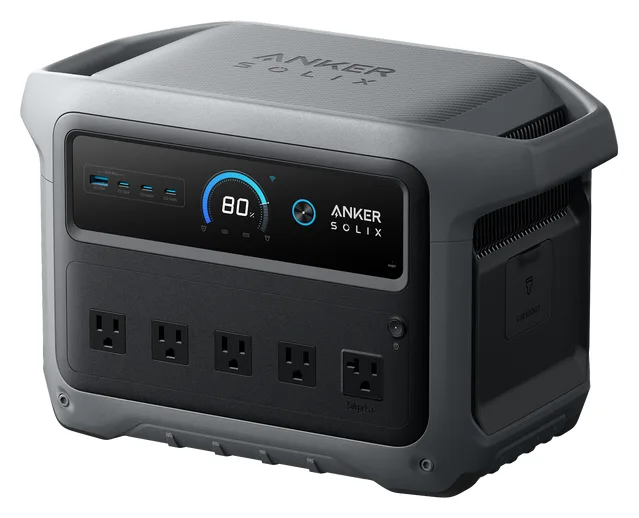
Anker SOLIX C1000 Gen 2; the kit adds the PS200 Bifacial panel. Image: Anker
Anker's kit pairs the C1000 Gen 2, the fastest-recharging 1 kWh station from the wall (49 minutes at 1,600 W), with its PS200 Bifacial panel. The panel is the lightest here for its output: 200 W from 4.8 kg, or 41.6 W per kg, against 31.4 for EcoFlow's 220 W panel. Across its whole unfolded area it converts 18.3% of the sunlight that hits it, the highest figure we calculated. Anker claims only "up to 10% more power" from the rear side, the most modest bifacial claim among the brands, and the panel carries a five-year warranty. The kit's price depends on the page you order from: $849.99 on the bundle page and $799.99 as an option on the C1000 Gen 2 page, both against a $1,199.99 list price. The station takes up to 600 W of solar at 11–28 V (8.2 A) or 29–60 V (14.5 A), and cannot add a battery. Anker says three 200 W panels fill it in 1.8 hours. The kit was on backorder with no date.
6. Jackery HomePower 1000 v2 + SolarSaga 200W: the long-life pick
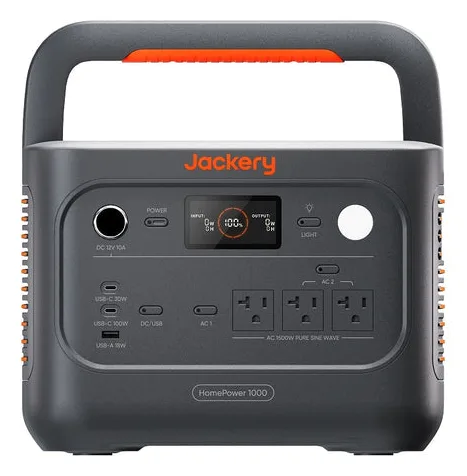
Jackery HomePower 1000 v2; the kit adds the SolarSaga 200W panel. Image: Jackery
Jackery calls this kit the Solar Generator HomePower 1000 v2 and sells it for $939 with no discount, $49 less than the station on sale ($559) and the panel ($429). The station is the reason to choose it: 6,000 cycles to 70%, the highest rating among the 1 kWh kits, at 10.6 kg. The current SolarSaga 200W is a bifacial TOPCon panel with 22 V Voc at 6.5 kg. Jackery's bifacial SolarSaga 200W won the German caravanning magazine promobil's 2026 flat-panel test with 1,250 Wh on a sunny early-May day, 625 Wh per 100 W of rating. Two caveats. The station's solar input stops at 400 W (16–60 V, 12 A per port, two ports), the lowest among the 1 kWh kits. And Jackery's FAQ advises keeping the "IP68" panel out of heavy rain. Jackery quotes "around 6.6h" with one panel and 3.3 hours with two; a kit with two 100 W Air panels costs $989. The kit was in stock.
7. Goal Zero Yeti 1500 + Boulder 100: rugged, but short of panels
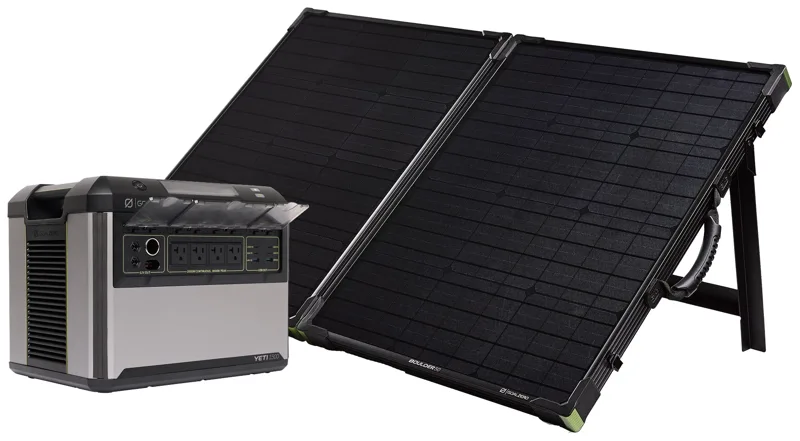
Goal Zero Yeti 1500 with the Boulder 100 Briefcase. Image: Goal Zero
Goal Zero's 2026 Yeti 1500 holds 1,505 Wh of LFP cells and takes up to 900 W of solar: 600 W at 12.3–60 V on its high-power port and 300 W at 13.2–30 V on an 8 mm port. The kit with a Boulder 100 Briefcase costs $1,709.95, $189.95 less than the parts. Goal Zero's Boulder briefcases are rigid panels with tempered glass in an aluminium frame, sturdier than fabric folding panels but much heavier, but 100 W is the weakest panel-to-battery ratio in this guide. Goal Zero's own table gives 17.2 hours of full sun; our calculation gives 3.6 days in a New York June and 6.3 in December. Buy it for the build and the stock (it was in stock when most rivals were on pre-order), and budget for more panels: Goal Zero says 400 W cuts the time to 4.3 hours.
2 kWh Solar Generators: A Day of Fridge and Freezer
About 2 kWh carries a refrigerator, router, lights and a CPAP through a day and a night. Kits in this class include 320–400 W of panels, which in a New York June refill the battery in 1.2–1.5 days. Jackery's HomePower 2000 Plus v2 kit with two 200 W panels ($1,839) was sold out on 7 November, which leaves two picks.
8. EcoFlow DELTA 3 Max Plus + 2×160W: the biggest discount at 2 kWh
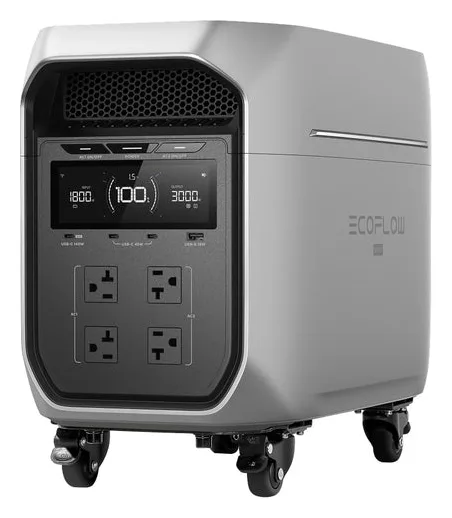
EcoFlow DELTA 3 Max Plus, shown on optional wheels; the kit adds two 160 W panels. Image: EcoFlow
On 7 November this kit sold for $1,599 against a $2,099 list price, $288 below the station ($1,149 on sale) and two NextGen 160W panels ($369 each). The station has the strongest inverter of the 2 kWh kits, 3,000 W continuous, and grows to 10 kWh with extra batteries. Its spec page gives 1,000 W of solar input, although one EcoFlow kit page says "400W solar input"; we use the spec page. The two 160 W panels weigh 5.6 kg each (21.3 V Voc, IP68) and supply 32% of the input. They fill the 2,048 Wh battery in 1.5 days in June and 2.7 in December in New York. The kit was shipping within a week.
9. Anker SOLIX C2000 Gen 2 + PS400: the most panel for 2 kWh
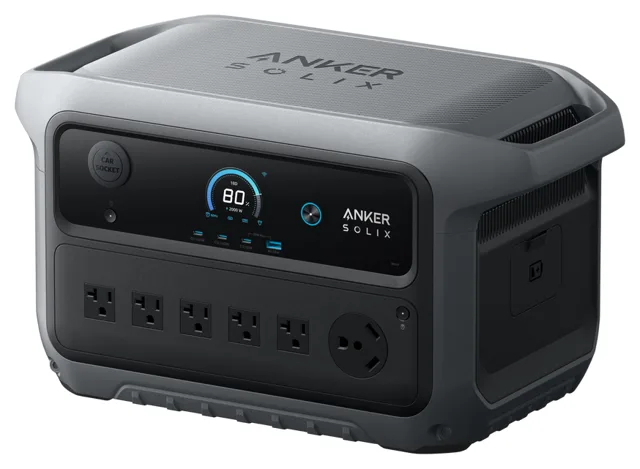
Anker SOLIX C2000 Gen 2; the kit adds the PS400 panel. Image: Anker
Anker's 2 kWh kit comes with a single 400 W PS400 panel, the largest panel in any 2 kWh kit here, for $1,599.99 against a $1,999.99 list price. The PS400 is a monofacial panel rated at 23% cell efficiency and IP67. It was sold out on its own, at a listed $699.99. Against that and the $999.99 station, the kit saves about $100, and its list price is above the two list prices combined. The station delivers 2,400 W, is rated for 4,000 cycles to 80%, and takes 800 W of solar at 11–60 V, so the kit's panel fills half of it. In our calculation the PS400 refills the battery in 1.2 days in a New York June and 2.1 in December, the same as the 1 kWh kits with one 200 W panel. Kits ordered from 2 November ship in early December. A version with the 200 W bifacial panel costs $1,299.99.
Home Backup Solar Generators (2.7–5 kWh)
The large kits are home batteries on wheels with panels added. Their stations take 1,000–3,000 W of solar, while the kits ship with 400–800 W. Goal Zero's four Yeti PRO 4000 solar kits, including the one with four Boulder 200 panels ($6,169.65), were all sold out on 7 November, which leaves four picks.
| Kit | Battery | Panels in box | Station solar max | 240 V | Kit price (list) | Fill days, NY Jun / Dec |
|---|---|---|---|---|---|---|
| EcoFlow DELTA 3800 Gen4 + 4×160W | 3,763 Wh | 640 W | 2,000 W | No | $2,599 ($3,299) | 1.4 / 2.4 |
| BLUETTI Apex 300 + 2×350W | 2,765 Wh | 700 W | 2,400 W | Yes | $2,599 ($2,899) | 0.9 / 1.6 |
| Jackery HomePower 3600 Plus + 2×200W | 3,584 Wh | 400 W | 1,000 W | No (two units) | $2,549 (no discount) | 2.1 / 3.7 |
| Anker SOLIX S5000 + 2×400W | 5,024 Wh | 800 W | 3,000 W | Yes | $3,499.99 ($5,199.99) | 1.5 / 2.6 |
Source: brand US stores and spec pages, 7 November 2026. Fill days: list.solar calculation, rated Wh ÷ daily yield of the kit's panels in New York (PVWatts v8).
10. EcoFlow DELTA 3800 Gen4 + 4×160W: the largest saving
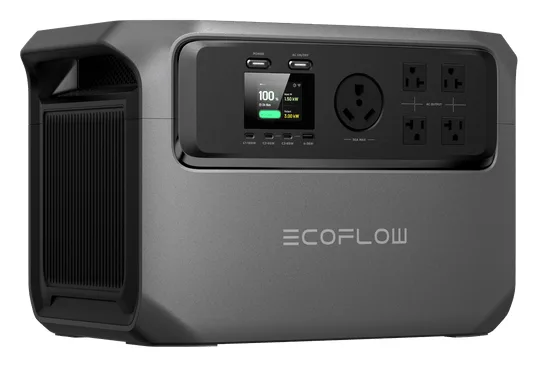
EcoFlow DELTA 3800 Gen4; the kit adds four 160 W panels. Image: EcoFlow
EcoFlow put the DELTA 3800 Gen4 on pre-order on 4 November. With four 160 W panels it costs $2,599 at the web-only early-bird price that runs to 7 December, against a $3,299 list price. That is $576 less than the station ($1,699 early-bird) and four panels ($1,476), the largest bundle saving we found. The station packs 3,763 Wh into 30.6 kg and is rated for 6,000 cycles to 70%. It takes 2,000 W of solar over two 1,000 W inputs. EcoFlow quotes "~7.5 hrs with 640W panel", which in our calculation becomes 1.4 days in a New York June and 2.4 in December. Four panels at 21.3 V Voc each can run as two strings of two, about 43 V per string at 25 °C. EcoFlow does not publish the input voltage window on its US page, so confirm it in the manual first. First kits ship in late November. The station is too new for any independent test.
11. BLUETTI Apex 300 + 2×350W: the fastest solar refill at home size
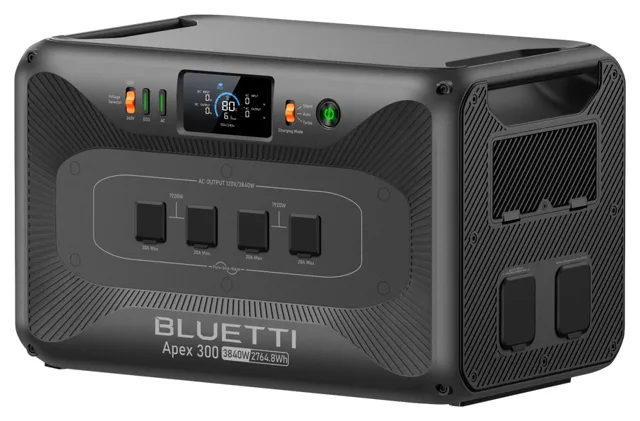
BLUETTI Apex 300; the kit adds two 350 W panels. Image: BLUETTI
The Apex 300 is the cheapest station here with 120/240 V output, and with two 350 W panels it has the best panel-to-battery ratio among the large kits: 700 W for 2,765 Wh. The kit costs $2,599 against $2,899 list, $198 less than the station ($1,499) and two panels ($649 each). BLUETTI also sells it with one 350 W panel for $2,069. Each of the station's two solar inputs takes 1,200 W at 12–60 V Voc and 20 A, according to the manual. The 350 W panel has 44 V Voc, so two in series (88 V) would exceed the limit: run one panel per input. In our calculation the two panels fill the battery in 0.9 days in a New York June and 1.6 in December. The panels are heavy, 14.7 kg each, and BLUETTI's page lists both IP65 and IP67 for them. The cells are rated for 6,000 cycles to 80%. Kits were shipping from early December.
12. Jackery HomePower 3600 Plus + 2×200W: lowest price per kWh, thin on panels
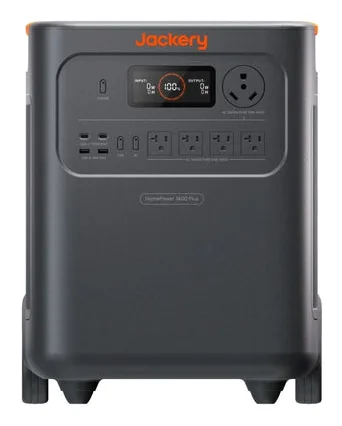
Jackery HomePower 3600 Plus, cropped from a kit photo; the kit adds two SolarSaga 200W panels. Image: Jackery
Jackery's large kit costs $2,549 with no discount, or $711 per kWh of battery, one of the lowest prices per kWh of any kit here. The station alone was sold out on 7 November at $1,899, which makes the kit $208 cheaper than its parts at list prices. The weak point is solar. Two 200 W panels supply 400 W to a station that accepts 1,000 W, and they need 2.1 days in a New York June and 3.7 in December to fill 3,584 Wh. Jackery's FAQ gives no charge time for this pairing, only for its 500 W panel: about 12 hours with one and six with two. Two SolarSaga 200W in series reach about 44 V Voc, inside the station's 16–60 V window. The station is rated for 6,000 cycles to 70% and outputs 120 V only; 240 V needs a second unit. Kits were on pre-order, shipping by 20 November.
13. Anker SOLIX S5000 + 2×400W: whole-home backup with high-voltage solar
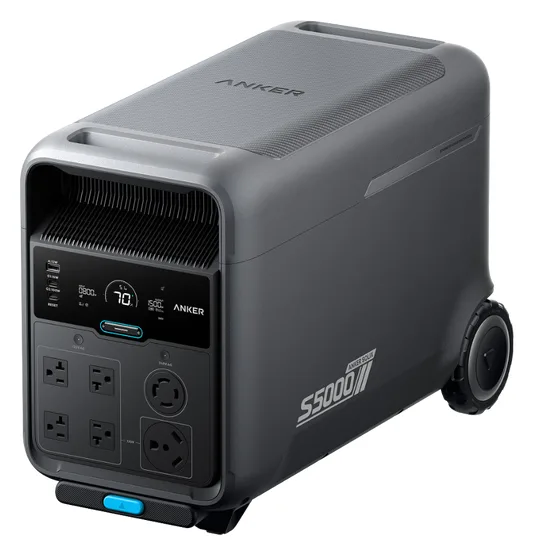
Anker SOLIX S5000; the kit adds two 400 W bifacial panels. Image: Anker
The S5000 went on sale on 27 October. It holds 5,024 Wh, delivers 4,500 W at 120 and 240 V, and Anker rates its cells for 10,000 cycles to 60%. It is also the only station here whose spec page cites UL 9540, the listing US fire codes require for batteries wired into a home. With two 400 W panels the kit cost $3,499.99 on 7 November, with a code valid to 10 November, against $5,199.99 list. Anker's page does not name the panel, but the product images show the PS400 Bifacial. The station's solar side is the most capable here: 1,000 W at 11–60 V plus 2,000 W at 16–165 V. That high-voltage input can take panels in long series strings: two PS400s at about 48 V operating voltage each fit on it in series. The two panels fill the battery in 1.5 days in a New York June and 2.6 in December, and they use only 27% of the station's solar capacity. Orders were shipping in seven to eight weeks.
All 13 Solar Generator Kits Compared
| Kit | Battery, Wh | Panels in box, W | Station solar max, W | Panels / max | Kit price 7 Nov | List price | Saving vs parts | Kit $/kWh | NY kWh/day, Jun / Dec |
|---|---|---|---|---|---|---|---|---|---|
| BLUETTI Elite 30 V2 + 100W | 288 | 100 | 200 | 50% | $489.99 | — | $49 | 1,701 | 0.42 / 0.24 |
| EcoFlow DELTA 3 Classic + 220W | 1,024 | 220 | 500 | 44% | $729 | $899 | $199 | 712 | 0.93 / 0.53 |
| BLUETTI Elite 100 V2 + 200W | 1,024 | 200 | 1,000 | 20% | $699 | — | $199 | 683 | 0.84 / 0.48 |
| EcoFlow DELTA 3 Plus + 220W | 1,024 | 220 | 1,000 | 22% | $919 | $1,099 | $249 | 897 | 0.93 / 0.53 |
| Anker SOLIX C1000 Gen 2 + PS200 | 1,024 | 200 | 600 | 33% | $849.99* | $1,199.99 | $200* | 830 | 0.84 / 0.48 |
| Jackery HomePower 1000 v2 + SolarSaga 200W | 1,024 | 200 | 400 | 50% | $939 | — | $49 | 917 | 0.84 / 0.48 |
| Goal Zero Yeti 1500 + Boulder 100 | 1,505 | 100 | 900 | 11% | $1,709.95 | $1,899.90 | $190 | 1,136 | 0.42 / 0.24 |
| EcoFlow DELTA 3 Max Plus + 2×160W | 2,048 | 320 | 1,000 | 32% | $1,599 | $2,099 | $288 | 781 | 1.35 / 0.77 |
| Anker SOLIX C2000 Gen 2 + PS400 | 2,048 | 400 | 800 | 50% | $1,599.99 | $1,999.99 | ~$100 | 781 | 1.69 / 0.96 |
| EcoFlow DELTA 3800 Gen4 + 4×160W | 3,763 | 640 | 2,000 | 32% | $2,599 | $3,299 | $576 | 691 | 2.70 / 1.54 |
| BLUETTI Apex 300 + 2×350W | 2,765 | 700 | 2,400 | 29% | $2,599 | $2,899 | $198 | 940 | 2.96 / 1.68 |
| Jackery HomePower 3600 Plus + 2×200W | 3,584 | 400 | 1,000 | 40% | $2,549 | — | $208 | 711 | 1.69 / 0.96 |
| Anker SOLIX S5000 + 2×400W | 5,024 | 800 | 3,000 | 27% | $3,499.99 | $5,199.99 | $200–600* | 697 | 3.38 / 1.92 |
Source: EcoFlow, Anker SOLIX, Jackery, BLUETTI and Goal Zero US stores, 7 November 2026. "—" = no list or strike-through price shown. Saving = station price + panel prices − kit price on the same day, list.solar calculation; the Jackery 3600 Plus saving uses list prices because the station alone was sold out. * Anker lists the same kit or panel at different prices on different pages ($799.99–849.99 for the C1000 Gen 2 kit; $599.99–799.99 for the PS400 Bifacial). Kit $/kWh = kit price ÷ battery Wh × 1,000. NY kWh/day = daily output of the kit's panels in New York (PVWatts v8), list.solar calculation.
The comparison shows how kits are priced. Bundle savings range from $49 to $576, so a kit is almost always cheaper than its parts, but not always by much: Jackery's 1 kWh kit and BLUETTI's 30 V2 kit save $49. Price per kWh falls with size, from $1,701 for the small BLUETTI kit to $683–712 for the five cheapest kits of 1 kWh and up. And the panel share of the station's input never exceeds 50%. Brands fill the box with the panel that keeps the kit price attractive, not with the panel that makes the most of the station.
Portable Solar Panels Compared
The panel decides how much a solar generator actually generates, yet it gets a fraction of the attention the battery gets. We collected official specifications for 11 folding and briefcase panels sold by the same brands.
| Panel | Rated W | Cells | Voc, V | Weight, kg | W per kg | Whole-panel efficiency | IP rating | Warranty | US price | $/W |
|---|---|---|---|---|---|---|---|---|---|---|
| EcoFlow NextGen 220W Bifacial | 220 | TOPCon, bifacial | 21.5 | 7.0 | 31.4 | 16.6% | IP68 | 1 yr | $449 | 2.04 |
| EcoFlow NextGen 160W | 160 | TOPCon | 21.3 | 5.6 | 28.6 | 16.6% | IP68 | 1 yr | $369 | 2.31 |
| Jackery SolarSaga 200W | 200 | TOPCon, bifacial | 22 | 6.5 | 30.8 | 14.7% | IP68** | 3+2 yr | $429 | 2.15 |
| Jackery SolarSaga 500 X | 500 | TOPCon, bifacial | n/p | 10.5 | 47.6 | n/a | IP68 | 5 yr | $999 | 2.00 |
| Anker SOLIX PS200 Bifacial | 200 | N-type, bifacial | n/p | 4.8 | 41.6 | 18.3% | IP68 | 5 yr | $499.99 | 2.50 |
| Anker SOLIX PS400 Bifacial | 400 | N-type, bifacial | n/p | 9.9 | 40.3 | 17.8% | IP68 | 5 yr | $799.99 | 2.00 |
| BLUETTI SORA 500 | 500 | N-type mono | 49.1 | 12.9 | 38.8 | 17.2% | IP67 | 1 yr | $849 | 1.70 |
| BLUETTI 350W (PV350) | 350 | Mono | 44 | 14.7 | 23.8 | 15.9% | IP65/IP67** | 1 yr | $649 | 1.85 |
| BLUETTI 200W (SP200L) | 200 | Mono | 24.6 | 8.1 | 24.6 | 15.6% | IP67 | 1 yr | $399 | 2.00 |
| Goal Zero Boulder 200 Briefcase | 200 | Mono, glass | 21.8 | 19.0 | 10.5 | 14.1% | n/p | 2 yr | $599.95 | 3.00 |
| Renogy 400W Portable Suitcase | 400 | Mono | 47.2 | 13.7 | 29.2 | 16.5% | ≥IP67 | 3+2 yr | $495.99 | 1.24 |
Source: manufacturer product pages and manuals, prices from brand US stores on 7 November 2026 (regular price; Renogy was $399.99 on sale). n/p = not published. W per kg and whole-panel efficiency (rated W ÷ unfolded area × 1,000 W/m²) are list.solar calculations; the 500 X is excluded because Jackery publishes only the footprint of its stand. ** Jackery's FAQ tells owners to keep its IP68 panels out of heavy rain; BLUETTI's 350 W page states both IP65 and IP67.
Three things stand out. The "25%" efficiency in panel marketing is the efficiency of the cells. Across the whole unfolded panel, with gaps, hinges and frame, the figure is 14–18%, which is why a 200 W folding panel is about 2.2–2.3 m long. Weight varies fourfold for the same output: 10.5 W per kg for Goal Zero's glass briefcase against 41.6 for Anker's PS200. And warranties run from one year (EcoFlow, BLUETTI) to five (Anker, Jackery's 500 X), which matters more for a panel that is folded, carried and dropped than for one bolted to a roof.
Myth: A 200 W Panel Gives You 200 Watts
The watt rating on a panel is measured under Standard Test Conditions: 1,000 W of sunlight per square metre hitting the panel square-on, with the cells at 25 °C. Outdoors, those conditions rarely occur together. Sunlight reaching the ground is usually below 1,000 W/m², and a black panel in the sun runs far hotter than 25 °C. EcoFlow's manual for its 400 W panel puts it plainly: on a clear day with the sun square-on, the panel "usually generates 320W–350W", or 80–88% of its rating, and summer heat near 60 °C costs about 13%.
Independent tests agree. In OutdoorGearLab's July 2026 test, each panel charged an identical power station for two hours, side by side, on a clear day at 6,300 feet with air at 55–65 °F. Cool air and altitude both favour output, so this was close to a best case. The better panels averaged 83–91% of their rating at the station's input. Weak panels managed 67–70%.
| Panel | Rated | Measured average | Share of rating |
|---|---|---|---|
| EcoFlow NextGen 220W Bifacial | 220 W | 193 W | 88% |
| Renogy 200W Portable | 200 W | 177 W | 88% |
| Jackery SolarSaga 200 | 200 W | 171 W | 86% |
| Anker SOLIX PS200, Goal Zero Boulder 200 | 200 W | ~166 W | ~83% |
| FlexSolar 100W | 100 W | 70 W | 70% |
Source: OutdoorGearLab, Best Portable Solar Panels (updated 13 July 2026): two-hour charge of the same Jackery station, input logged every 30 minutes. Shares and the Anker/Goal Zero wattage (derived from a 31% charge of a 1,070 Wh battery in two hours) are list.solar calculations.
Over a whole day the spread widens. The German magazine promobil laid ten folding panels flat, as campers often do, on the same unshaded site in early May, each with its own Victron charge controller. On the best day the winner, Jackery's SolarSaga 200W, collected 625 Wh per 100 W of rating and the weakest panel 431 Wh, a 1.45-fold spread between nominally similar panels. Lying flat cost them output, since a panel angled at the sun collects more.
Bifacial panels, which collect light on their back face too, are now standard in the big brands' line-ups, and the claims vary. EcoFlow's 220 W page says both "up to 25%" and "up to 28% more energy". Anker claims "up to 10%". Jackery publishes a standardised bifacial rating of 225 W for its 200 W panel, 12.5% more. A 2018 study in Applied Energy by researchers from Purdue University and NREL found that with typical ground reflectivity the bifacial gain of ground-mounted panels is "less than 10% worldwide", and that 30% needs a bright surface and panels raised a metre off the ground. A folding panel on its kickstand sits much lower. Count on the front-side rating, and treat any rear-side gain over snow, sand or a white tarp as a bonus.
Wiring Panels to a Solar Generator
Adding panels is how most owners close the gap between kit and station. Two limits decide how many panels fit and how they are connected.
Voltage. Panels in series add their voltages. Most mid-size stations accept 11–60 V per input, EcoFlow's DELTA 3 Plus and BLUETTI's Elite 100 V2 among them. A 200–220 W folding panel has 21–25 V Voc, so two in series (44–49 V) fit and three do not. Panel voltage also rises in the cold. The formula is Voc at temperature = Voc × [1 + coefficient × (T − 25 °C)], with the coefficient from the datasheet. For EcoFlow's 400 W panel (48 V Voc, −0.33%/K), Voc rises to 53.5 V at −10 °C, which is why one 400 W panel fits a 60 V input and two in series need a high-voltage input such as the Anker S5000's (16–165 V). Even brand advice can be wrong here. BLUETTI's panel page suggests up to three panels in series on a 60 V input, using an example 19 V panel. With BLUETTI's own 200 W panel (24.6 V Voc), three in series reach 73.8 V at 25 °C (list.solar calculation), well over the limit.
Current. Panels in parallel add their currents, and each input has a current limit: 14.5 A on the high-voltage side of Anker's C1000 Gen 2, 20 A per input on BLUETTI's Apex 300. Exceeding the current limit does not usually damage the station; it simply caps the power. EcoFlow's manual calls this the "1+1=1 scenario". Mixing panel sizes in series is worse, because the string runs at the current of the weakest panel.
The practical rule: match panels to the voltage window first, use separate inputs where the station has them, and stay at least 10% below the maximum voltage to allow for cold mornings.
Solar Generator vs Gas Generator
A solar generator is quiet, needs no fuel and can run indoors. A gasoline generator delivers far more energy per day and does not care about the weather. The numbers explain who should own which.
| Measure | 1 kWh solar generator kit (220 W panel) | Honda EU2200i gasoline inverter generator |
|---|---|---|
| Price | $699–939 | $1,199 MSRP |
| Continuous output | 1,500–2,000 W (station inverter) | 1,800 W rated |
| Energy per day | ~0.9 kWh from the panel in a New York June, ~0.5 in December | 5.8 kWh per 0.95-gallon tank at rated load (3.2 hours); refuel as needed |
| Fuel cost per kWh | $0 | $0.68 at rated load, $1.08 at quarter load |
| Noise | Cooling fan only | 48 dB(A) at quarter load, 57 at rated load |
| Indoor use | Yes | Never: outdoors, at least 20 feet from the house (CPSC) |
| California | Allowed | "Not for sale in California" (Honda) |
Sources: Honda Power Equipment EU2200i specifications; EIA US regular gasoline price, $4.153 per gallon in the week of 2 November 2026; CPSC; kit data from brand stores. Fuel cost per kWh: list.solar calculation, gallons per kWh from Honda's run times × EIA price; oil and maintenance excluded.
Carbon monoxide is the main reason the comparison is not only about money. The US Consumer Product Safety Commission estimates that portable generators caused 93 deaths from carbon monoxide poisoning in 2022, the latest year in its May 2026 report, and 892 since 2012, or 41% of all consumer-product CO deaths in that period. In 2026 releases the agency puts the average at "nearly 100" a year. Across all consumer products, 59% of CO deaths in 2022 happened from November to February and 64% at home, typically when a generator runs in a garage or near a window. A federal rule requiring generators to cut CO emissions and shut off automatically was proposed in April 2023 and was still not final in November 2026. CPSC staff found in 2022 that generators meeting the voluntary UL 2201 standard would avert nearly all such deaths, and those meeting PGMA G300 nearly 87%. Battery-based solar generators produce no exhaust at all. Their own fire risk is covered in the recall section of our power station guide.
Regulation is pushing in the same direction. California's small off-road engine rules require new portable generators sold there to meet zero-emission standards from model year 2028. The US EPA authorised the rules on 6 January 2025. Two resolutions in Congress to overturn that authorisation, S.J.Res.205 and H.J.Res.214, were introduced in August 2026 and had not moved beyond committee by 7 November. A CARB review of whether the 2028 date is feasible for generators was due in 2025–2026 and had not been published. If the rule stands, a battery is the only new portable option for California buyers from 2028.
Outages decide how often either one is used. The average US electricity customer was without power for 269 minutes in 2025, including major storms, according to the EIA. That was down from 663 minutes in 2024, the worst year in the EIA's 2015–2025 series. Routine outages, without major events, have stayed at about two hours a year.
| Year | Minutes without power per customer, all events | Change y/y | Minutes, excluding major event days | Interruptions per customer |
|---|---|---|---|---|
| 2021 | 475.8 | — | 125.7 | 1.44 |
| 2022 | 333.0 | ▼ 30.0% | 131.1 | 1.43 |
| 2023 | 366.6 | ▲ 10.1% | 123.9 | 1.35 |
| 2024 | 662.6 | ▲ 80.7% | 131.6 | 1.53 |
| 2025 | 269.2 | ▼ 59.4% | 125.3 | 1.34 |
Source: US EIA, Electric Power Annual, Table 11.1 (SAIDI and SAIFI, IEEE method). Change y/y: list.solar calculation.
For a few hours a year, a 1 kWh kit covers the essentials without fuel, noise or fumes. For multi-day outages in winter, especially in the north, its panels cannot keep up, and a generator or a much larger battery is the realistic backup. Many owners combine them: the station runs the house quietly and safely, and a generator outside tops it up for an hour or two a day. EcoFlow sells exactly that pairing. Over a year the fuel saved can also add up for frequent users: a 220 W panel in New York yields about 289 kWh a year, worth $197–312 of gasoline at generator efficiency (list.solar calculation), but only if all of it is used.
Ukraine and Northern Europe: Why Winter Panels Disappoint
Few countries rely on power stations as heavily as Ukraine, where Russian strikes have caused blackouts every winter since 2022, in the darkest months of the year. PVGIS data for Kyiv show what that means for solar. A 400 W panel set facing south at 35° yields 1.88 kWh a day in June but 1.02 in October, 0.47 in November, 0.34 in December and 0.46 in January. From November to January, 400 W of panels delivers about a third of a 1 kWh station's capacity a day. That is enough to keep a router, LED lights and phones going, not to refill the battery.
Berlin (0.35 kWh a day in December) and London (0.47) are no better. In northern Europe a solar generator kit is a spring-to-autumn tool for balconies, gardens, dachas and camping. In winter the station's value comes from charging it from the grid during the hours the power is on. In Ukraine, solar panels and lithium-ion batteries have been exempt from import duty and VAT since July 2024, and the exemption now runs to 1 January 2029; the import data and retail prices are in our power station guide.
What Happened to the 2024 List
The May 2024 edition of this page named seven models. On 7 November 2026 only one, the original EcoFlow DELTA Pro, was still sold new in its maker's US store, and two of the brands no longer sell power stations through their own stores.
| 2024 pick | Status on 7 Nov 2026 | Closest kit in this guide |
|---|---|---|
| BLUETTI AC200P | Not sold new; BLUETTI lists it among discontinued models | BLUETTI Apex 300 + 2×350W |
| Jackery Explorer 1000 Pro | Not sold new; a refurbished listing was sold out | Jackery HomePower 1000 v2 + SolarSaga 200W |
| ITEHIL 500W portable power station | The ITEHIL store now sells camping and water gear and no power stations; the old product page returns 404 | BLUETTI Elite 30 V2 + 100W |
| Anker 555 Solar Generator | Discontinued; the 555 page is sold out and the bundle page returns 404 | Anker SOLIX C1000 Gen 2 + PS200 |
| Renogy Lycan 5000 Power Box | No buyable US listing, only a spec page | Anker SOLIX S5000 + 2×400W |
| EcoFlow DELTA Pro | Still sold new: $1,799 on sale ($2,399 list); with two 220 W panels $2,499 | EcoFlow DELTA 3800 Gen4 + 4×160W |
| TACKLIFE P50 500Wh | No working brand store (tacklife.com returned an error) | BLUETTI Elite 30 V2 + 100W |
Source: BLUETTI, Jackery, ITEHIL, Anker SOLIX, Renogy, EcoFlow and TACKLIFE websites, checked 7 November 2026.
Every 1 kWh station in this guide now uses LFP cells rated for 4,000–6,000 cycles. The 2024 edition said lithium-ion batteries last "100–500 cycles" and that an average home uses "30KW per day". Both were wrong then, and this edition replaces them.
From a Solar Generator to a Home Solar System
A solar generator is the smallest solar power system you can own: no permit, no installer, no roof. Its limits are the same ones this guide keeps running into: a few hundred watts of panels that have to be set out and packed away, and a battery of 1–5 kWh. A household that wants solar every day, not just in emergencies, will get more energy per dollar from fixed panels on a roof and a home battery. For the panels themselves, see our comparison of the best solar panels of 2026; for the stations without kits, our guide to the best portable power stations.
Methodology and Data Sources
Selection. We started from the solar-kit and power-station collections of the EcoFlow, Anker SOLIX, Jackery, BLUETTI, Goal Zero, DJI and Renogy US online stores on 7 November 2026. We kept kits that combine a current power station with portable panels and were in stock or on dated pre-order, one or two per station. All four Goal Zero Yeti PRO 4000 kits and the Jackery HomePower 2000 Plus v2 kit with two 200 W panels were sold out. EcoFlow's RIVER 3 series was no longer listed in its US store, and DJI's US store sold no station-and-panel kits.
Prices are the brands' own US store prices on 7 November 2026, during early Black Friday sales, before any sign-up or membership codes. Anker shows a listed price and an automatically applied code; we use the price after the code. "Saving vs parts" compares the kit with the station and panels bought separately on the same day. Where a brand lists the same item at different prices on different pages, we say so.
Solar yield comes from NLR PVWatts v8 (US cities; typical meteorological year from the NSRDB, standard module, open rack, 35° tilt, 180° azimuth, 14% losses, AC output) and EU JRC PVGIS 5.3 (European cities; SARAH3 data 2005–2023, 35° tilt, south-facing, 14% losses). Both model a fixed, unshaded panel at a good angle. Panels laid flat, shaded or left at a poor angle deliver less; panels turned to follow the sun by hand can deliver more. Fill days are rated battery capacity divided by the daily output of the kit's panels. That is slightly optimistic, because charging losses add about 5–10%, and slightly pessimistic, because usable capacity is below rated capacity. We used the AC output of PVWatts, which already includes a 4% conversion loss, as a proxy for what reaches the battery.
Specifications come from manufacturer product pages, spec FAQs and manuals. Panel efficiencies and weights per watt are list.solar calculations from published dimensions and weights. Gas generator fuel costs are list.solar calculations from Honda's published run times and the EIA's weekly US average price. We did not test any kit ourselves; measured panel outputs are from the OutdoorGearLab and promobil tests named in the text.
Updates. This page replaces the May 2024 edition. We plan to recheck stock and prices after the November 2026 sales and update the kits in the first quarter of 2027.
FAQ
Does a 200 W solar panel really produce 200 watts?
Only in lab conditions. The rating assumes 1,000 W/m² of sunlight square-on and cells at 25 °C. Outdoors, good folding panels deliver about 83–91% of their rating at best (OutdoorGearLab, 2026), and EcoFlow's own manual says its 400 W panel usually gives 320–350 W in clear sun. Over a whole day, a 200 W panel in New York yields about 0.84 kWh in June and 0.48 kWh in December.
What is the best solar generator in 2026?
For 1 kWh, the BLUETTI Elite 100 V2 with a 200 W panel ($699) is the cheapest kit and takes up to 1,000 W of solar later, while the EcoFlow DELTA 3 Plus with its 220 W bifacial panel ($919) has the best-measured panel. For home backup, the BLUETTI Apex 300 with two 350 W panels refills fastest from solar, and the Anker SOLIX S5000 kit offers 5 kWh, 240 V and 3,000 W of solar input.
How long does it take to charge a solar generator with solar panels?
Divide the battery capacity by the panels' daily output. In New York, 200 W of panels collects about 0.84 kWh a day in June and 0.48 kWh in December, so a 1 kWh station takes about 1.2 days in summer and 2.1 in winter. Brand figures of five to seven hours assume full midday sun for the whole time.
How many solar panels do I need for a solar generator?
For a 1 kWh station to refill in one June day in New York, Chicago or Seattle, about 250–300 W. In December it takes about 430 W in New York, 820 W in Seattle and 1,200 W in Kyiv (list.solar calculation from PVWatts and PVGIS). The station's solar input sets the ceiling, from 200 W on small units to 3,000 W on the Anker S5000, and the input's voltage window decides how many panels can go in series.
Is a solar generator better than a gas generator?
For short outages, indoor use and quiet, yes: it has no fuel cost, no exhaust and can run in the house. A gas generator delivers far more energy per day: the Honda EU2200i produces about 5.8 kWh per tank at rated load, but its fuel costs $0.68–1.08 per kWh at November 2026 prices, and portable generators killed 93 Americans through carbon monoxide poisoning in 2022 (CPSC). Many households use both.
Can a solar generator run a whole house?
Not for long. An average US home uses about 29.6 kWh a day, while the largest kit here holds 5 kWh and its panels add 1.9–3.4 kWh a day in New York. A solar generator keeps essentials running: refrigerator, router, lights, medical devices and a furnace fan. Our power station guide has runtime tables for common loads.
Related on List.Solar
Sources
- EcoFlow US store: DELTA 3 Classic, DELTA 3 Plus, DELTA 3 Max Plus, DELTA 3800 Gen4, DELTA Pro, NextGen 220W, NextGen 160W; 400W Solar Panel user manual (accessed 7 Nov 2026)
- Anker SOLIX: C1000 Gen 2 + 200W, C2000 Gen 2 + 400W, S5000 + 2×400W, C300, PS200 Bifacial, PS400 Bifacial (accessed 7 Nov 2026)
- Jackery: Solar Generator HomePower 1000 v2, HomePower 3600 Plus, SolarSaga 200W, SolarSaga 500 X; HomePower 1000 v2 FAQ (accessed 7 Nov 2026)
- BLUETTI: Elite 30 V2, Elite 100 V2 + 200W, Apex 300, SORA 500, 350W panel, 200W panel, solar panel collection, discontinued models (accessed 7 Nov 2026)
- Goal Zero: Yeti 1500, Yeti 1500 + Boulder 100, Boulder 200 Briefcase, Yeti PRO 4000 (accessed 7 Nov 2026); Renogy, 400W Portable Solar Suitcase
- National Laboratory of the Rockies (formerly NREL), PVWatts v8 API; European Commission JRC, PVGIS 5.3 (both queried 7 Nov 2026)
- OutdoorGearLab, Best Portable Solar Panels (13 Jul 2026); promobil, Solartaschen im Test (2026)
- Sun, Khan, Deline, Alam, Optimization and performance of bifacial solar modules: a global perspective, Applied Energy 212 (2018)
- US Consumer Product Safety Commission: Non-Fire Carbon Monoxide Deaths, 2022 Annual Estimates (May 2026); winter storm warning (19 Feb 2026); proposed portable generator standard (20 Apr 2023); voluntary standards report (23 Feb 2022)
- Honda Power Equipment, EU2200i specifications; US EIA, Gasoline and Diesel Fuel Update (3 Nov 2026) and Electric Power Annual, Table 11.1
- California Air Resources Board, Small Off-Road Engines program; US EPA, authorisation of California SORE regulations (6 Jan 2025); US Congress, S.J.Res.205 and H.J.Res.214
Also read
- Ember Finds Wind Cuts Cost of Near-Firm Solar and Batteries by 18%
- Haier Energy Rolls Out 12-20-kW Hybrid Inverters for Hot Asian Markets
- Enphase to Show 80-kWh Commercial Battery and IQ Battery G5 at RE+
- Kansai Electric Agrees to Buy 49.99% of 600-MWh Virginia Battery
- Flower, dces File Permits for 500-MW, 2-GWh Battery Near Berlin