Top Lithium Producing Countries With The Largest Reserves
Updated: August 2026 · Data year: 2025 · Primary source: USGS Mineral Commodity Summaries 2026
Key figures
World lithium production, 2025: 290,000 t (+31% y/y) · Global reserves: 37 million t · Identified resources: ~150 million t · Top producer: Australia, 92,000 t · Biggest mover: China, now No. 2 · Batteries' share of demand: 88%
The lithium market spent 2024 in a slump and 2025 sprinting. World mine production rose 31% to roughly 290,000 metric tons of lithium content, the largest annual jump on record, even as the average U.S. contract price for battery-grade lithium carbonate fell to $9,000 per ton — down 86% from the 2022 peak of $63,700. Producers, in other words, responded to a price collapse by digging faster.
The top lithium producing countries also reshuffled for the first time in a decade. China overtook Chile to become the world's second-largest miner. Zimbabwe pushed past Argentina into fourth place with just 1.4% of global reserves. Mali, absent from the rankings two years ago, now out-produces Canada. This article breaks down who mines lithium, who holds it in the ground, and why those are two very different lists — using the latest USGS and IEA data, published in February and May 2026.
Top Lithium Producing Countries in 2026
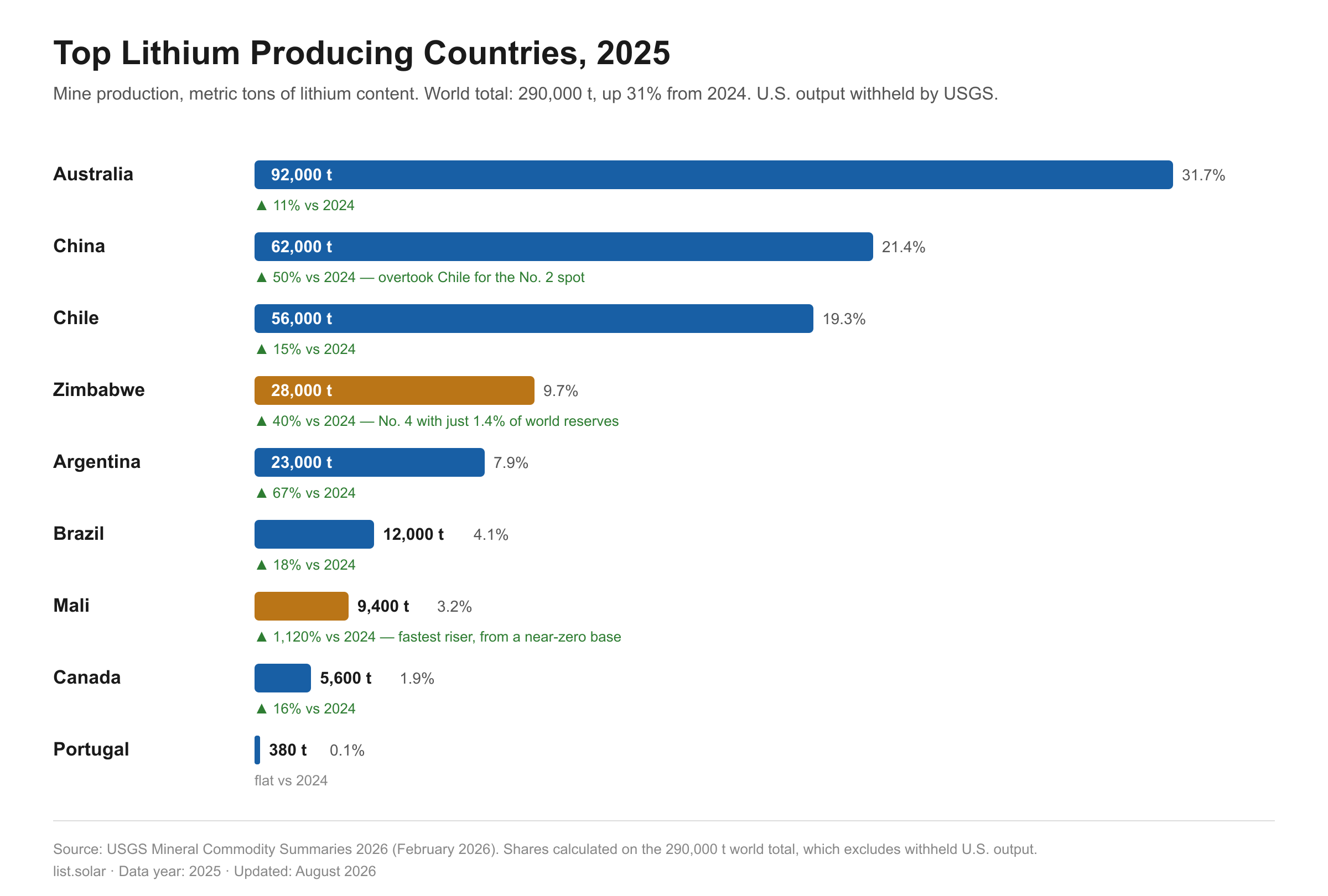
Nine countries account for essentially all recorded lithium output. The U.S. is a tenth, but the U.S. Geological Survey withholds its production figure to protect company data — output comes from a single brine operation in Nevada. The table below uses the latest revised figures; the USGS routinely restates prior years as company reports come in, which is why the numbers here may differ from what other sites copied from earlier editions.
| Country | 2023 (t) | 2024 (t) | 2025 (t) | Share 2025 | Change y/y |
|---|---|---|---|---|---|
| Australia | 91,700 | 82,700 | 92,000 | 31.7% | +11% |
| China | 35,700 | 41,400 | 62,000 | 21.4% | +50% |
| Chile | 41,400 | 48,900 | 56,000 | 19.3% | +15% |
| Zimbabwe | 14,900 | 20,000 | 28,000 | 9.7% | +40% |
| Argentina | 8,630 | 13,800 | 23,000 | 7.9% | +67% |
| Brazil | 5,260 | 10,200 | 12,000 | 4.1% | +18% |
| Mali | — | 770 | 9,400 | 3.2% | +1,120% |
| Canada | 3,240 | 4,820 | 5,600 | 1.9% | +16% |
| Portugal | 380 | 380 | 380 | 0.1% | 0% |
| United States | W | W | W | n/a | n/a |
| World total | 204,000 | 222,000 | 290,000 | 100% | +31% |
Metric tons of lithium content. W = withheld. 2023 figures from USGS MCS 2025; 2024–2025 from USGS MCS 2026 (revised). World totals exclude U.S. output.
Australia: still first, after a scare
Australia produced 92,000 tons in 2025 from seven hard-rock spodumene operations, recovering the ground it lost in 2024 when output dropped to 82,700 tons amid mine curtailments. The centerpiece is Greenbushes in Western Australia, the world's largest hard-rock lithium mine, with capacity of 1.5 million tons of spodumene concentrate a year — jointly held by China's Tianqi, Australia's IGO and U.S.-based Albemarle. Australian spodumene prices climbed from about $800 to $970 per ton over the course of 2025, enough to bring idled capacity back.
China: the new number two
China's output jumped 50% to 62,000 tons — the single biggest tonnage gain of any country — from nine mineral and six brine operations. The strategic picture matters more than the mining one: China already refines most of the world's battery-grade lithium chemicals, and in October 2025 it announced export controls on cathode materials, precursors and battery manufacturing equipment. Moving up the mining table reduces the one dependency China still had — imported feedstock.
Chile: slipping to third
Chile lifted production 15% to 56,000 tons from two brine operations in the Salar de Atacama, run by SQM and Albemarle. That was not enough to hold second place. Chile's real advantage sits underground: it still controls a quarter of global reserves, the largest share of any country, and its brines remain among the cheapest lithium sources on Earth. The constraint is political — output quotas and the state's expanding role through Codelco cap how fast the salar can grow.
Zimbabwe: the overachiever
Zimbabwe mined 28,000 tons across five operations, mostly Chinese-owned, making it Africa's largest producer and the world's fourth. It did this with reserves of just 500,000 tons — 1.4% of the global total. In February 2026 the government moved to restrict raw lithium exports to force processing onshore, a policy the IEA flagged as part of a broader wave of resource nationalism reshaping mineral trade.
Argentina: the fastest of the big producers
Argentina grew 67% to 23,000 tons from four brine operations, with more in construction. The country holds 4.4 million tons of reserves and, at 28 million tons, the largest identified resources of any country after the United States. Rio Tinto's $6.7 billion acquisition of Arcadium Lithium in 2025 put one of the world's biggest miners behind Argentina's expansion.
Brazil, Mali, Canada: the second tier
Brazil reached 12,000 tons from hard-rock operations in Minas Gerais's "Lithium Valley." Mali is the shock entry: two new mines took it from 770 tons in 2024 to 9,400 tons in 2025, a twelvefold increase and the fastest ramp-up in the industry. Canada produced 5,600 tons from two operations in Quebec, with a project pipeline that its 1.6 million tons of reserves can comfortably feed.
United States: big reserves, one mine
The U.S. holds 4.4 million tons of reserves — tied with Argentina for fourth place — and 30 million tons of identified resources, more than any other country. Its entire recorded production comes from Albemarle's Silver Peak brine operation in Nevada. That gap between endowment and output is the widest in the industry, and closing it is the explicit goal of federal funding programs and the Thacker Pass and Kings Mountain projects now in development.
Top Lithium Reserves by Country
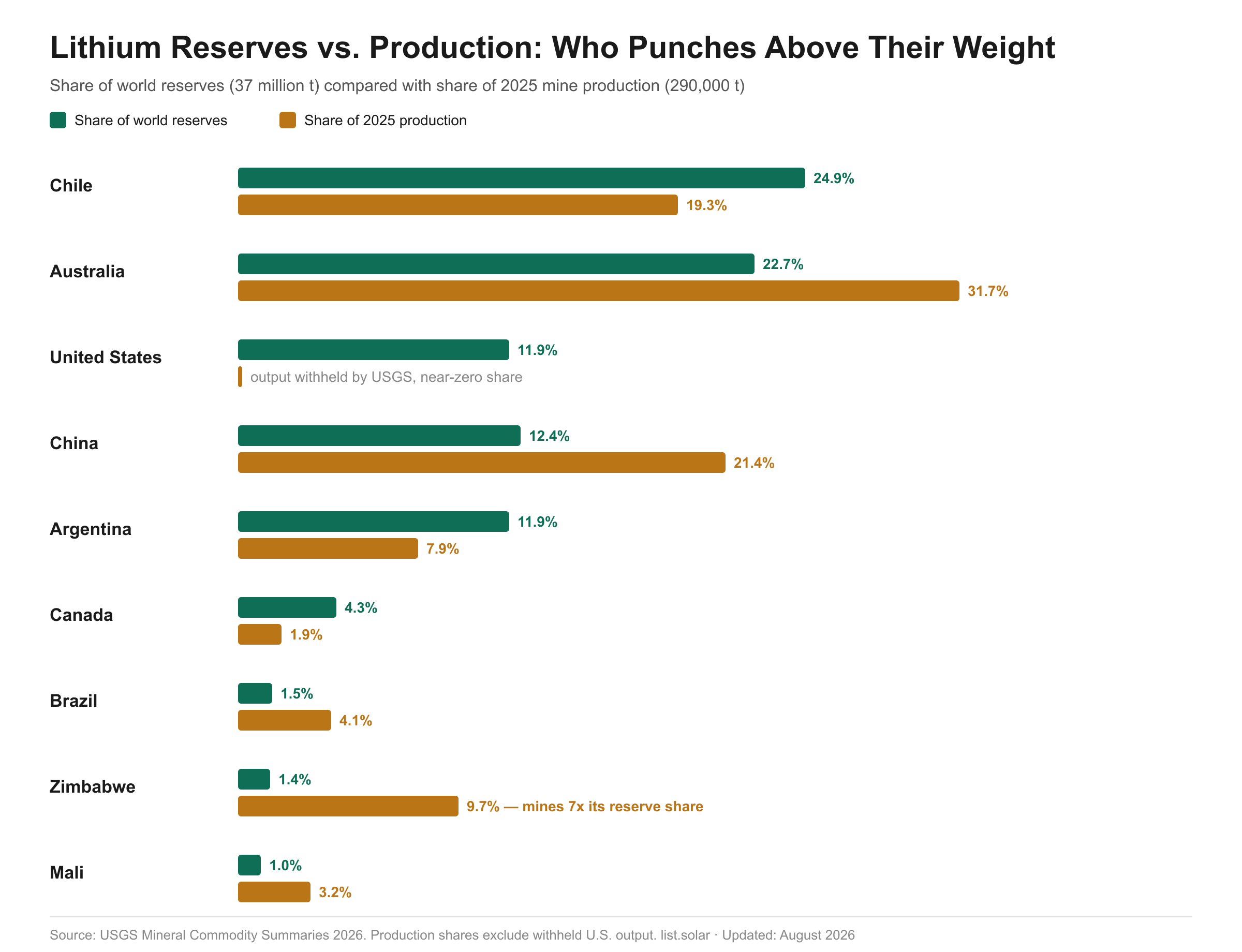
Reserves answer a different question than production: not "who is digging" but "who could keep digging profitably at today's prices." The global total stands at 37 million tons — up from 30 million a year earlier, a 23% increase driven not by discovery but by reclassification, as new company reports moved known deposits into the economic column.
| Country | Reserves (t) | Share of world |
|---|---|---|
| Chile | 9,200,000 | 24.9% |
| Australia | 8,400,000 | 22.7% |
| China | 4,600,000 | 12.4% |
| Argentina | 4,400,000 | 11.9% |
| United States | 4,400,000 | 11.9% |
| Canada | 1,600,000 | 4.3% |
| Brazil | 540,000 | 1.5% |
| Zimbabwe | 500,000 | 1.4% |
| Mali | 370,000 | 1.0% |
| Portugal | 60,000 | 0.2% |
| Other countries | 2,400,000 | 6.5% |
| World total | 37,000,000 | 100% |
Metric tons of lithium content, USGS MCS 2026. Note: under Australia's stricter JORC reporting standard, its compliant reserves are 5.1 million tons — 40% below the USGS figure. Always check whose definition a reserves number uses.
Reserves vs. Resources: Why Bolivia Isn't the Leader
Most viral claims about lithium — "Bolivia has the world's largest reserves" chief among them — confuse two terms the USGS defines precisely. Resources are geology: lithium known or reasonably estimated to exist. Reserves are economics: the subset that can be extracted profitably at current prices, with current technology, under current law. Resources total roughly 150 million tons worldwide. Reserves total 37 million. The other 113 million tons are real metal that no one can currently mine at a profit.
Bolivia is the textbook case. Its Salar de Uyuni holds 23 million tons of resources — third in the world — yet Bolivia appears nowhere in the USGS reserves table and reports no commercial production. Its brines carry high magnesium levels that make processing expensive, and no operator has yet cracked the economics. Germany (8.9 million tons of resources) is a milder version of the same story: metal confirmed, mines absent.
| Country | Resources (t) | Reserves (t) | 2025 production (t) |
|---|---|---|---|
| United States | 30,000,000 | 4,400,000 | W (withheld) |
| Argentina | 28,000,000 | 4,400,000 | 23,000 |
| Bolivia | 23,000,000 | — | 0 |
| Chile | 13,000,000 | 9,200,000 | 56,000 |
| Australia | 10,000,000 | 8,400,000 | 92,000 |
| China | 10,000,000 | 4,600,000 | 62,000 |
| Germany | 8,900,000 | — | 0 |
| Canada | 8,100,000 | 1,600,000 | 5,600 |
| Mali | 1,200,000 | 370,000 | 9,400 |
| Zimbabwe | 860,000 | 500,000 | 28,000 |
Metric tons of lithium content, USGS MCS 2026. "—" = no reserves reported.
Read the three columns together and the market's imbalances jump out. Zimbabwe mines seven times its share of reserves; at 2025 rates its reported reserves cover under 18 years. The United States and Bolivia together hold a third of the world's known lithium and contribute effectively nothing to supply. Australia, with 6.7% of resources, delivers nearly a third of production. Where lithium sits and where it gets mined are, for now, almost unrelated maps.
Ukraine: Europe's Biggest Untapped Lithium Bet
One country absent from every table above may matter to the next decade of European supply. Ukraine holds roughly a third of Europe's lithium endowment, according to the Ukrainian Geological Survey, concentrated in hard-rock deposits in Kirovohrad Oblast — Polokhivske and Dobra — plus Shevchenkivske in the partly occupied Zaporizhzhia region.
Dobra became the first test of the U.S.–Ukraine minerals agreement signed in April 2025. In January 2026, Kyiv awarded the site to Dobra Lithium Holdings, a venture of U.S.-backed TechMet and The Rock Holdings, under a production sharing agreement requiring at least $179 million in investment: $12 million for exploration and an international reserves audit, then $167 million for mining and processing if commercial reserves are confirmed. S&P Global puts the deposit's preliminary estimate at up to 1.26 million tons of lithium carbonate equivalent in petalite and spodumene ores. Industry specialists caution that first production is realistically 10–15 years out — but in a market where the IEA projects supply deficits persisting through 2035, a European-orbit deposit of this size is strategically priced in long before the first ton ships.
Prices, Investment and the Supply Gap
The lithium price cycle of the past five years is among the most violent any commodity has recorded, and it explains nearly every production decision in the tables above.
| Year | Avg. U.S. price, battery-grade Li₂CO₃ ($/t) | Change |
|---|---|---|
| 2021 | 11,700 | — |
| 2022 | 63,700 | +444% |
| 2023 | 39,000 | −39% |
| 2024 | 11,800 | −70% |
| 2025 | 9,000 | −24% |
Annual average real prices for fixed contracts, USGS MCS 2026 (source: Benchmark Mineral Intelligence). Chinese spot carbonate rose from ~$9,300 to ~$10,300/t during 2025.
The turn came mid-2025, driven by EV sales growth in China and Europe and a surge in grid-scale battery storage. By the IEA's count, lithium prices more than doubled between January 2025 and April 2026. Yet capital moved the opposite way: lithium companies cut investment by around 40% in 2025 and exploration spending fell roughly 45% — the delayed scar of the 2023–24 price collapse. Mines take five to ten years to build. The IEA's Global Critical Minerals Outlook 2026 concludes that, on the current project pipeline, lithium supply deficits persist through 2035. Today's underinvestment is tomorrow's shortage, on a schedule the industry can already read.
Batteries now absorb 88% of all lithium, up from 87% a year earlier, which ties the metal's fate almost entirely to electric vehicles and energy storage. Ceramics and glass take 4%; everything else — greases, air treatment, medicine — splits the remainder.
Top Lithium Mining Companies
Country rankings hide the fact that a handful of companies control most output across borders. Albemarle (U.S.) operates in Chile, Australia and Nevada. SQM dominates the Atacama alongside it. Tianqi and Ganfeng anchor China's position at home and abroad — Tianqi through its stake in Greenbushes. PLS (formerly Pilbara Minerals) runs Pilgangoora in Western Australia. And Rio Tinto's 2025 purchase of Arcadium Lithium for $6.7 billion created a new heavyweight overnight, with brine assets across Argentina. We cover the producers, their assets and their expansion pipelines in a separate ranking of the top lithium mining companies.
Methodology and Data Sources
Production and reserves figures come from the USGS Mineral Commodity Summaries 2026 (published February 2026), the earliest comprehensive source of 2025 world mining data; 2023 figures are from the 2025 edition. All tonnages are metric tons of lithium content, not lithium carbonate equivalent — multiply by 5.32 to convert to LCE. Market shares are our own calculations against the USGS world total, which excludes withheld U.S. output, so true shares are marginally lower. Price, investment and outlook data come from the IEA Global Critical Minerals Outlook 2026 (May 2026). Ukraine project details come from Ukrainian government statements and S&P Global reporting, January 2026. The USGS revises historical figures annually; this page uses the latest revision and is updated when new editions publish.
FAQ
What is the difference between lithium reserves and resources?
Resources are all lithium known or estimated to exist in the ground — a geological measure, about 150 million tons worldwide. Reserves are the smaller portion that can be mined profitably at current prices with current technology and legal access — an economic measure, 37 million tons. Reserves change when prices, technology or laws change, even if no new lithium is found.
Which country produces the most lithium?
Australia, with 92,000 tons of lithium content in 2025 — 31.7% of recorded world output — almost entirely from hard-rock spodumene mines in Western Australia, led by Greenbushes, the world's largest lithium mine.
Which country has the most lithium?
It depends on the measure. Chile holds the largest reserves (9.2 million tons). The United States holds the largest identified resources (30 million tons), followed by Argentina (28 million) and Bolivia (23 million). Bolivia's frequently cited "largest in the world" figure refers to resources, not reserves — it reports no commercial production.
Does Ukraine produce lithium?
Not yet. Ukraine holds an estimated third of Europe's lithium endowment but has no commercial mines. The first project, the Dobra deposit in Kirovohrad Oblast, was awarded to a U.S.-linked consortium in January 2026 with a minimum $179 million investment commitment; production is likely a decade or more away.
Will there be a lithium shortage?
The IEA's 2026 outlook projects supply deficits persisting through 2035 based on the current project pipeline. The mechanism is already visible: prices more than doubled between January 2025 and April 2026, while lithium mining investment fell about 40% and exploration spending about 45% — cuts that will constrain supply years from now, since new mines take five to ten years to build.
Related on List.Solar: Best Lithium Battery ETFs · Top Energy Storage Stocks · Energy Commodities • Top Lithium Mining Companies
Sources
- USGS Mineral Commodity Summaries 2026 — Lithium (February 2026)
- USGS Mineral Commodity Summaries 2025 — Lithium (January 2025)
- IEA Global Critical Minerals Outlook 2026 (May 2026)
- S&P Global: TechMet–Rock Holdings JV wins rights for Dobra lithium deposit (January 2026)
- Mining.com: Ukraine launches tender for major lithium deposit (August 2025)
- Investing News Network: Biggest Lithium-Mining Companies (2026)