HKUST Stitches Perovskite Cell Layers to Reach 27.04% Efficiency
Key points
- HKUST researchers report a perovskite cell at 27.04% efficiency, 26.67% certified, in Nature Photonics.
- With polymer links across the buried interface, 92% of the cells tested stayed stable for over 1,400 hours.
- The certified result is 1.33 points below the 28.0% single-junction perovskite record on NLR's chart.
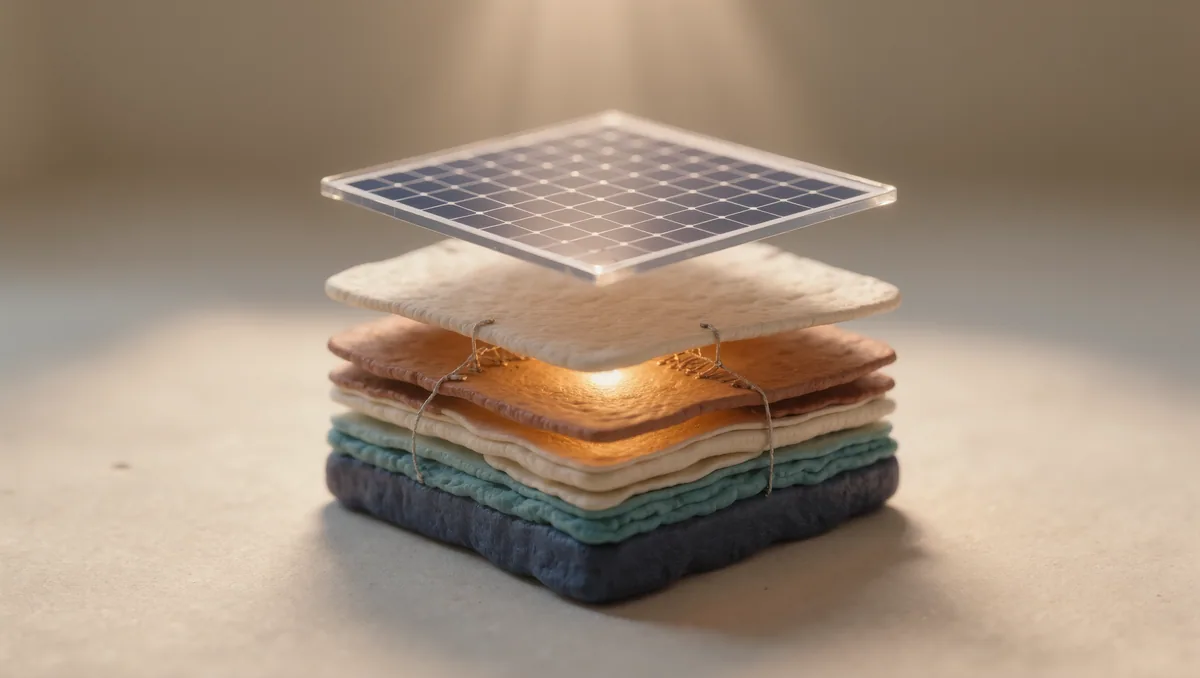
Researchers at the Hong Kong University of Science and Technology have reported a perovskite solar cell with 27.04% efficiency, 26.67% certified, after chemically stitching its absorber to the layer beneath it.
The paper appeared in Nature Photonics online on Sept. 29, nearly two months before HKUST's Nov. 25 release, and is the cover article of the November issue. Prof. Zhou Yuanyuan, acting head of the Department of Materials, led the work as sole corresponding author. Researchers added polymerizable monomers to the perovskite and to the tin oxide electron-transport layer, then heated the stack. Radicals turned them into covalent nano-links that cross the interface. HKUST calls the method trans-interface engineering and says it nearly tripled interfacial toughness. The Tianjin Institute of Metrological Supervision and Testing certified one cell, according to the supplementary data. Neither the release nor the open abstract gives the active area of the cell, and HKUST gave no cost estimate for the process.
| Efficiency (in-house) | 27.04% |
|---|---|
| Certified efficiency | 26.67%, Tianjin Institute of Metrological Supervision and Testing |
| Open-circuit voltage | 1.220 V |
| Operational stability | 92% of more than 50 cells stable for over 1,400 h at maximum power point |
| Other tests | Damp heat at 85°C and 85% relative humidity |
| Cell area | Not disclosed in the release or abstract |
On the efficiency chart of the National Laboratory of the Rockies, formerly NREL, the best certified single-junction perovskite cell is Hainan University's 28.0%. It measured 0.051 cm². A Xi'an Jiaotong-led team reported a 27.96% certified inverted cell in Nature on Nov. 18.
The stitched cell in numbers
- 1.33 percentage points separate the certified 26.67% from the 28.0% perovskite cell on the NLR chart (list.solar calculation).
- 1.29 percentage points below the 27.96% certified Xi'an Jiaotong cell (list.solar calculation).
- 0.37 percentage points between the in-house 27.04% and the certified 26.67% (list.solar calculation).
- About 46 of the 50 treated cells tracked in the supplementary data reached the T80 mark (list.solar calculation).
Control cells without the links lasted anywhere from a few dozen hours to over 1,800 hours, the release says. “TIE is more like stitching the layers together,” Zhou said. Co-first author Yu Wenjian, a PhD student, said the team had tested the method on several perovskite compositions, transport materials and device designs.
HKUST has filed a patent on the technology. China Merchants Group is supporting efforts to commercialize it, according to the university, which gave no timeline for larger cells or panels.