Qcells Adds 372-MW Solar Storage Projects in Arizona
Qcells is building 372 MW of Arizona solar-plus-storage projects, pairing batteries with daytime PV to deliver peak power, strengthen grid reliability, and accelerate clean energy decarbonization.
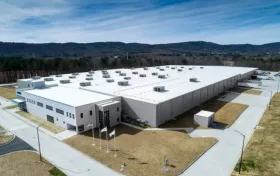
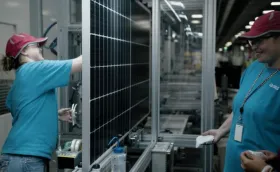
Qcells now produces solar cells in Cartersville, Georgia—boosting U.S. supply security, cutting reliance on imports, and powering domestic module assembly as the plant scales into one of North America’s largest.
Hanwha Qcells’ large-area perovskite-silicon tandem cell secures IEC and UL certifications, clearing a key hurdle toward commercial rollout of next-generation high-efficiency solar modules.
Qcells’ perovskite-silicon tandem modules have passed IEC and UL stress tests, marking a major step toward commercial deployment of high-efficiency tandem solar technology.
Qcells warns global manufacturers of patent infringement, spotlighting the fierce competition and vital role of proprietary tech in boosting solar cell efficiency and market dominance.
Qcells secures $1.45 billion to launch Georgia's first integrated solar manufacturing plant in a decade, revolutionizing the solar supply chain and boosting clean energy production.
Qcells secures $1.45 billion loan guarantee from US Department of Energy for Georgia expansion, creating jobs and boosting solar manufacturing capacity.
Qcells partners with Lumet for cutting-edge solar technology, reducing costs and increasing efficiency with fine-line metallisation. Exciting advancements ahead!
US private equity firm TGC partners with Qcells to advance 450 MW of solar projects, focusing on community, commercial, industrial, and grid-scale solar with American-made panels.
Join Onyx Renewable Partners and Qcells North America in their mission to create a sustainable future with two community solar and battery projects in Massachusetts, providing clean energy to 700 homes and offsetting carbon emissions.
Qcells and SOLARCYCLE join forces to revolutionize the solar industry in the US, creating a circular supply chain that reduces reliance on imports and generates thousands of clean energy jobs.
Microsoft partners with QCells to become one of the world's largest buyers of renewable energy, investing in solar modules and services to achieve its sustainability goals.
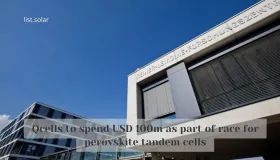
Solar products maker Qcells, a subsidiary of Seoul-based Hanwha Solutions Corp with German roots, today revealed a USD-100-million (EUR 91.9 m) financial investment in a pilot line targeted at speeding up the commercialisation of perovskite-based tandem cells.
Renewables programmer Summit Ridge Energy as well as solar items manufacturer Qcells on Thursday made a statement about what US Vice President Kamala Harris claimed is the biggest community solar order in American background.
The new center by Hanwha will provide clean power company Qcells with encapsulant film. Likewise, Hanwha will certainly be the only company in the USA producing solar encapsulants.
United States tech giant Microsoft Corp (NASDAQ: MSFT) has actually thrown its support behind the efforts of solar product manufacturer Qcells to establish a full solar supply chain in the US, with the companies teaming up on 2.5 GW of solar panel supplies.
The new facility will certainly manufacture 3.3 gigawatts of solar ingots, wafers, cells, and also ended up panels. The factory will certainly be in Georgia that will certainly create 2,500 new jobs in the United States state.
Qcells will certainly present its next-generation domestic power storage space system, Q.HOME CORE, to the united state market following week at the RE+ show.
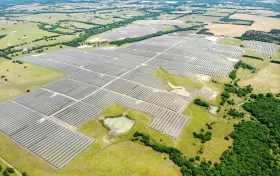
Qcells, a division of South Korea's Hanwha Solutions Corp (KRX:009830), has actually become part of a power acquisition arrangement (PPA) in the US for the electrical power that will certainly be generated by a new 150-MW solar park in the state of Wyoming.
Hanwha Solutions has unveiled plans to spend US$ 320 million in cell and module production capacity developments in the United States and also Korea.