IMR Striped BiVO4 Panel Splits Water With 4 Times the Hydrogen Output
Key points
- A striped bismuth vanadate panel split water into 1.77 mmol of hydrogen per square meter in an hour, about four times its unpatterned control.
- Neither the paper's abstract nor the release gives a solar-to-hydrogen efficiency, lamp intensity or panel size.
- The result is lab scale; the 2021 benchmark is a 100-m2 photocatalytic array that peaked at 0.76% efficiency.
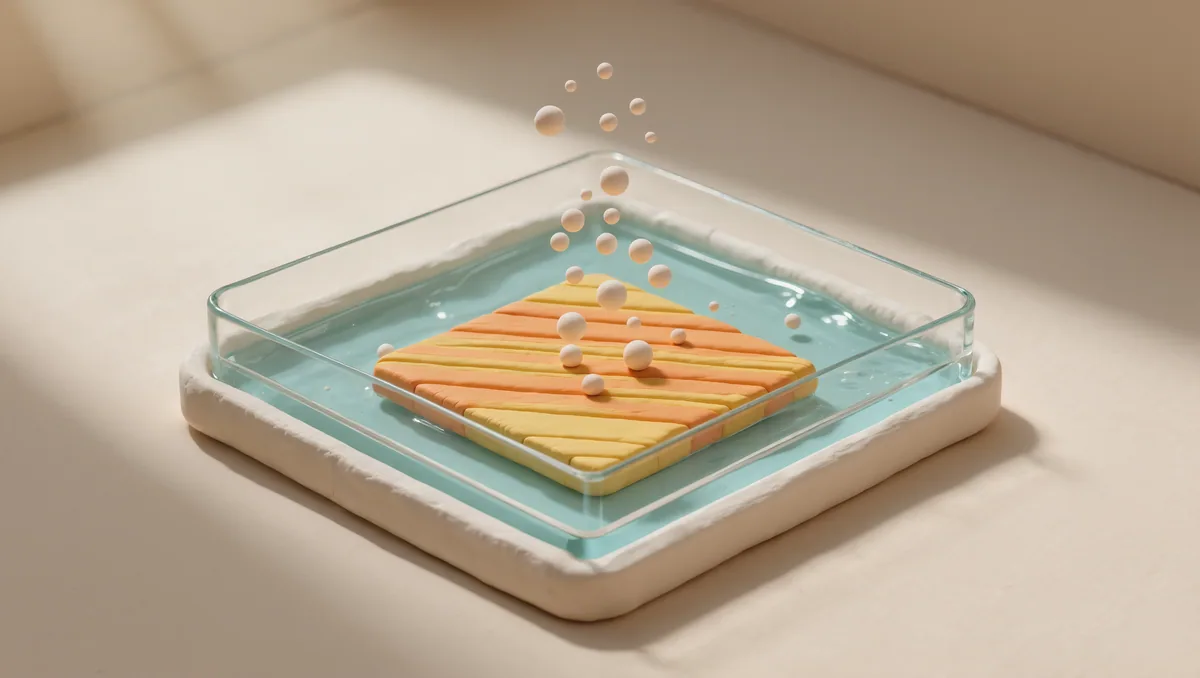
Researchers at the Chinese Academy of Sciences built a panel of alternating bismuth vanadate stripes that splits water into 1.77 mmol of hydrogen per square meter in an hour. That is about four times the output of an unpatterned control panel.
What the numbers show
- 1.77 mmol of hydrogen and 0.84 mmol of oxygen per square meter within one hour, under full-spectrum light.
- About 4 times the output of the unpatterned control panel, the paper's abstract says.
- About 15 μm is the width of the alternating p-type and n-type BiVO4 stripes on conductive glass.
- 2.1 to 1 is the hydrogen-to-oxygen ratio, close to the 2:1 of water (list.solar calculation).
- About 3.6 mg of hydrogen per square meter per hour, at the NIST molar mass of 2.01588 g/mol (list.solar calculation).
- About 280,000 square meters of panel would have to run for an hour to make 1 kg of hydrogen at that rate (list.solar calculation).
- 0.76% was the peak solar-to-hydrogen efficiency of a 100-m2 photocatalytic panel array reported in Nature in 2021.
At the Institute of Metal Research, the team used photolithography to lay p-type tetragonal zircon BiVO4 stripes beside n-type monoclinic scheelite BiVO4 on fluorine-doped tin oxide glass. That oxide layer carries charge between neighboring stripes in a so-called Z-scheme. Electrons gather on the p-type stripes and holes on the n-type ones, which cuts recombination and back reactions. The researchers then photodeposited a Rh@CrOx catalyst for hydrogen on one set of stripes and MnOx for oxygen on the other.
CAS did not disclose a solar-to-hydrogen efficiency, the lamp or its intensity, the panel area or how long the panel stays stable. The paper's abstract in Advanced Energy Materials omits them too. Without the light intensity, the hydrogen rate cannot be turned into an efficiency. Cost was not disclosed either. For scale, the 2021 Nature paper put photocatalytic water splitting at around 1% efficiency, against 30% in the lab for solar cells coupled to electrolysis.
The authors present the striped layout as a way to design scalable photocatalytic panels. EPFL's organic photocatalyst sheet, covered on Nov. 12, takes a different route; more lab work sits on our solar fuels and technology pages.
Yufei Du is first author and Gang Liu last author of the paper, published online on Oct. 1, 2026, in volume 16, issue 43 of Advanced Energy Materials. CAS posted its release on Nov. 16. No next step is named.