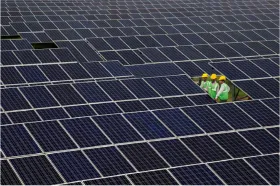
India Slashes Solar GST, Developers Eye Cheaper Tariffs And Restarts
India cut GST on solar and wind hardware to 5%, a move expected to lower project costs, revive stalled bids, and pressure tariffs down.
ABO Energy secures a tariff for a 17-MWp solar project in Poland—its first PV park in the country—amid July 2025 auctions that awarded gigawatts of solar at competitive prices.
India's government has actually agreed on a financing bundle that consists of INR45 billion (US$ 603 million) of financial investment over 5 years to support the domestic growth of high-efficiency PV modules.
SECI's trading margin of Rs.0.07/ kWh has likewise been approved
The incentive scheme awards a 23-year, $0.12/ kWh feed-in tariff to roof arrays with a generation ability of approximately 200 kW. Currently, 141 municipalities have actually applied to set up 116 MW of roof solar ability and also the federal government has actually raised the program's spending plan from $28.5 million to $143 million.
CERC has actually authorized the request submitted by SECI looking for authorization for marketing of 600 MW solar energy to Discoms in Haryana and also Bihar at a toll price of Rs 2.44/ kWh.
Japan has awarded just 39.8MW of PV capacity in its fifth solar auction, despite there being more than 416MW initially on offer.
The Chattisgarh Commission has issued a draft order with the generic levelised tariffs for FY 2019-20 & 2020-21 for renewable energy sources like solar.
The German Energy Agency has drawn up a list of proposed measures which it says could help the world’s biggest solar market accelerate its clean energy plans through the adoption of subsidy-free – private – power purchase agreements.
Expert warnings that India will be falling short of its renewable deployment targets have sparked a strong-worded rebuke from the government, which has slammed them as “ill-founded”
A report by Indian ratings agency CRISIL points to a rising rate of tender failures, an inconsistent policy approach from central and state governments and restrictive solar energy tariff caps and says India could have just 104 GW of renewables capacity by 2022.
India’s Maharashtra state has launched a process to procure a major slice of grid-linked solar power, pushing for low prices in line with earlier tenders this year.
On July 29, the Ninth Circuit Court of Appeals affirmed the lower court’s decision in Winding Creek Solar LLC v. Peterman et al., ruling that California’s feed-in tariff for small qualifying facilities (QFs), the Renewable Market Adjusting Tariff (ReMAT), violates the federal Public Utility Regulatory Policies Act (PURPA) (Ninth Circuit Case No. 17-17531).