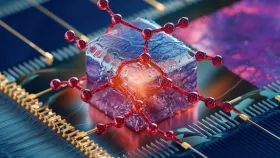
Bridging Molecules Boost Efficiency of Perovskite Solar Cells
Revolutionize solar energy with a groundbreaking bridging molecule, boosting efficiency and stability of perovskite solar cells to new heights.
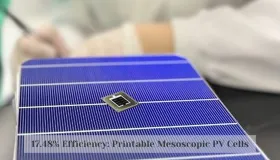
Researchers from East China University of Science and Technology have developed a new manufacturing process for printable mesoscopic carbon perovskite solar cells (p-MPSCs): replacing metals & vapor deposition with carbon & screen printing for cost-effective production & high efficiency.
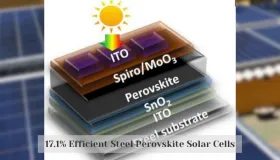
Australian researchers develop record-breaking PSC on steel with 17.1% efficiency, leveraging ITO interlayer, SnO2 ETL, and OABra passivation strategy.
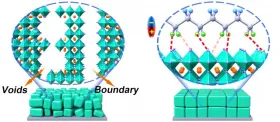
Researchers from Zhengzhou University and Chinese Academy of Sciences have developed a new lead capturing technique for perovskite solar cells to mitigate Pb leakage and shield from external invasion, providing insights into green and sustainable industrial processes.
Researchers from SARI, Southern University of Science and Technology, and City University of Hong Kong have developed a strategy for modulating the buried interface between perovskite and tin dioxide (SnO2). Through incorporating FOA, record power conversion efficiency of 25.05% is achieved with improved stability.
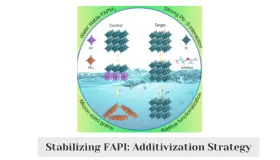
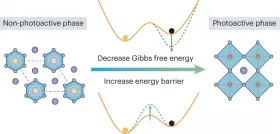
This research breakthrough makes it possible to develop water-stable perovskites for perovskite solar cells. An innovative additivization strategy was used to achieve this, with the lowest formation energy for a 3C phase with exceptional stability against water infiltration, humidity and thermal stresses. A game-changer for solar cells!
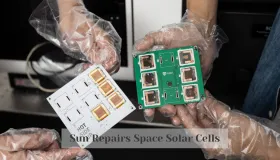
Discover how researchers from the University of Sydney achieved 100% efficiency in perovskite solar cells after being damaged by proton radiation in low Earth orbit. Learn about their innovative combination of hole transport material and dopant, plus the discovery of fluorine diffusion being the cause of cell degradation.
A project from Oklahoma State University was picked to receive a $750,000 grant from NASA.
" Miracle" tandem cells are stated to enhance solar panel effectiveness by 50% with the globe's initial commercialisation of perovskite solar cells
Scientists from the University of Science and Technology of China and also Dongguan University of Technology have discovered a way to boost perovskite solar cells by adding a layer that improves security as well as efficiency at capturing power from sunlight.
Researchers from the Nanjing University of Aeronautics and also Astronautics in China as well as University of Okara in Pakistan have substitute a solar cell based on an absorber making use of a CsSnI3 perovskite product, which is an inorganic perovskite that has low exciton binding energy, a high absorbance coefficient, and an energy bandgap of 1.3 eV.
Perovskite solar cells (PVSCs) are a promising choice to standard silicon-based solar cells because of their high power-conversion performance and low cost. Nevertheless, one of the significant challenges in their growth has actually been achieving long-lasting stability.
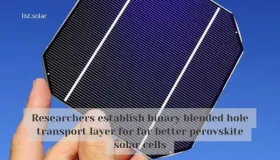
Researchers from China's Chongqing University, the Chinese Academy of Sciences (CAS) as well as JA Solar Holdings Co., along with South Korea's Ulsan National Institute of Science and Technology (UNIST) as well as Germany's CTF Solar as well as have actually made a perovskite solar cell based upon a binary blended hole transport layer (HTL) that apparently supplies much better efficiency than HTLs that depend on commonly used hygroscopic dopants.
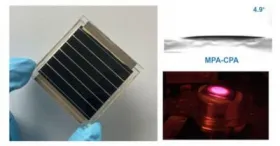
Researchers from East China University of Science and also Technology, Jilin University, Huazhong University of Science and also Technology, ShanghaiTech University, Chinese Academy of Sciences, Shanghai Jiao Tong University and also University of Potsdam have actually located that a new molecular hole-transporter can improve the performance of inverted perovskite solar cells and mini modules.
Mass adoption of perovskite solar cells will certainly never be commercially viable unless the technology gets over several key obstacles, according to scientists from the University of Surrey.
Scientists from the University of Konstanz in Germany, Quaid-i-Azam University and Kohsar University Murree in Pakistan and Huazhong University of Science and Technology in China have actually fabricated an inverted perovskite solar cell with a passivation technique utilizing a mixed solvent vapor annealing technique based on ethylenediamine (EDA).
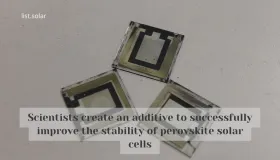
Perovskite semiconductors promise highly efficient and affordable solar cells. Nonetheless, the semi-organic product is very sensitive to temperature differences, which can swiftly cause fatigue damages in typical outdoor usage. Adding a dipolar polymer compound to the precursor perovskite solution assists to neutralize this.
The purpose behind the new research is aimed at creating a future where solar power is more available and also cost effective. The discovery regarding the new production process is done via a paper published in peer-reviewed journal called 'Science.'
Perovskite solar cells have drawn a significant amount of study attention as a promising option to conventional silicon-based solar cells, as a result of their effectiveness in converting sunlight right into electrical power. Perovskite solar cells are a hybrid of organic as well as not natural materials and also contain a light-harvesting layer as well as a charge-transporting layer.
Warwick University has actually been granted ₤ 2.2 million (over USD$ 2,620,000) to investigate metal halide perovskite compounds, for use in transparent and flexible photovoltaic panels, which stay stable precede. A new Nuclear Magnetic Resonance (NMR) spectrometer will be utilized to understand just how to enhance lifespan and durability of these solar cells.
Scientists from China's East China Normal University (ECNU), Shanghai University, Donghua University and Soochow University have actually fabricated an upside down perovskite solar cell with remarkable charge transport.
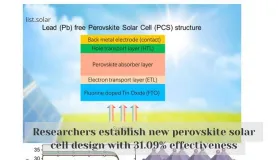
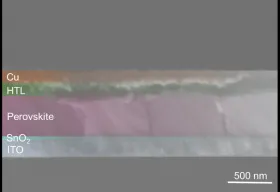
Chinese scientists have actually developed a brand-new solar cell with a planar n-i-p framework and also an indium tin oxide (ITO) substratum. It additionally has a tin( IV) oxide (SnO2) barrier layer, a perovskite layer, a hole transport layer (HTL), and also a layer made of copper. It had the ability to keep around 92% of its preliminary effectiveness after 1,000 hours.
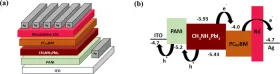
A US-Chinese research group has actually developed a perovskite solar cell with a hole-transporting material (HTM) based upon carrying out polyaniline (PANI) polymer. The tool showed substantially greater performance than a referral solar cell relying on an HTM made from commonly used PEDOT: PSS.