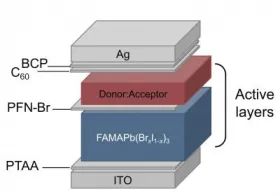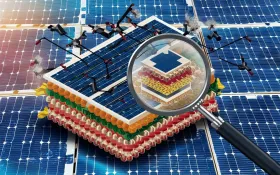
Boosting Perovskite/Organic Solar Cell Efficiency with New Strategy
Revolutionize solar energy with pseudo-halogen thiocyanate ions in perovskite/organic tandem cells, boosting efficiency and stability for long-lasting power.
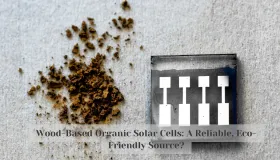
Organic solar cells made of wood pulp? Researchers have developed a way to increase the stability and sustainability of the solar cell using kraft lignin, creating hydrogen bonds for increased performance. Unlock the future of renewable energy with this environmentally friendly technology!
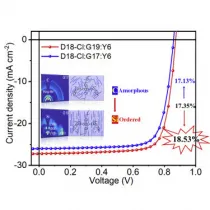
QIBEBT researchers have developed a ternary organic solar cell with power conversion efficiency gains of over 19%, using a third component to improve crystallinity and alignment. Learn more about the mechanisms driving these efficiency gains.
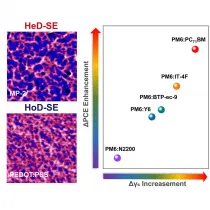
Researchers have identified two design strategies to minimize voltage losses and improve open-circuit voltage in ternary organic solar cells. Yuming Wang from Linköping University leads a team of researchers including those from Hasselt University, IMEC, and other institutes studying the origins of this loss of voltage. Results published in Nature Energy.
Research team at Fraunhofer ISE has developed a layer to boost the efficiency of organic solar cells. This could be a major step towards making renewable energy more accessible and cost effective.
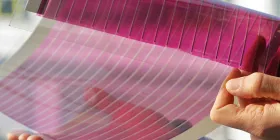
Organic solar cells have a photoactive layer that is made from polymers and tiny molecules. The cells are very slim, can be flexible, as well as are simple to make. Nonetheless, the effectiveness of these cells is still much below that of standard silicon-based ones.
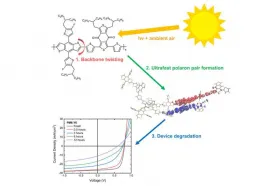
Because of the current improvements in the efficiency with which solar cells made from organic (carbon-based) semiconductors can transform sunlight right into electricity, improving the long-term security of these photovoltaic or pv devices is ending up being a progressively vital subject. Real-world applications of the innovation demand that the efficiency of the photovoltaic or pv device be preserved for several years.
Researchers from Eindhoven University of Technology and also TNO at Holst Centre have actually established a sensor that transforms light into an electric signal at an unbelievable 200% efficiency-- an apparently impossible figure that was accomplished through the exceptional nature of quantum physics.
Scientists at the Gwangju Institute of Science and Technology have actually made a development utilizing water treatment for morphology control in organic solar cells. Morphology control is basically about making and putting really tiny particles in their functioning position. The exploration has actually improved the performance and stability of large-area organic solar cells.
Surface area energy (γs) plays a key function in the development of bulk-heterojunction (BHJ) films in organic solar cells fabricated by solution process. The miscibility of BHJ films can be forecasted by the difference of surface area power in between donor and acceptor.
The power conversion effectiveness (PCE) of organic solar cells (OSCs) are shown to be improved through the microstructure morphology fine-tuning of active layer films. Thanks to the enticing benefits like lightweight, mechanical flexibility and also roll-to-roll processability, OSCs have actually drawn boosting attention. As a promising power source for flexible digital systems, they feature fairly high PCE, which still requires to be enhanced.
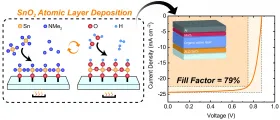
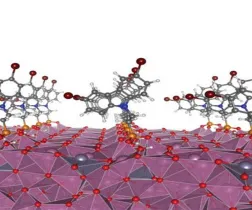
An electrode coating just one molecule thick can substantially enhance the efficiency of an organic photovoltaic cell, KAUST scientists have actually found. The coating outperforms the leading product currently made use of for this job and may lead the way for enhancements in various other tools that rely upon organic molecules, such as light-emitting diodes and also photodetectors.
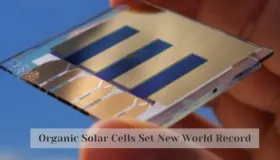
The record was obtained with a 1.1 sq cm tool.
Scientists in China have actually developed an organic module with an area of 18 cm2 based on a non-fullerene acceptor called DTY6. The gadget has a qualified performance of 13.98%, yet when a non-halogen solvent was made use of, it even reached 16.1%.
Last year, a San Francisco-based start-up asserted a world document for performance of a model natural solar cell with a 9.8 percent power conversion performance and also now they want to scale up their modern technology to a mass production level.
A Swedish-Chinese research team has developed an organic cell said to be ideal for wide use in daily life to power internet of things-enabled devices. The cell could be used to power sensors that detect and measure moisture, particle concentrations, temperature and other parameters indoors.