Ember Says Wind-Solar-Battery Hybrids Could Meet 70–90% of Kazakh Load
- Ember modelled 15 Kazakh sites and found wind-solar-battery hybrids could meet 70–90% of a typical demand profile below $60/MWh.
- Coal made 62% of Kazakh power in 2025; the hybrids averaged $56/MWh delivered, against $70–170/MWh for new coal.
- Ember wants a post-2030 wind and solar target and storage rules that let batteries earn from grid services.
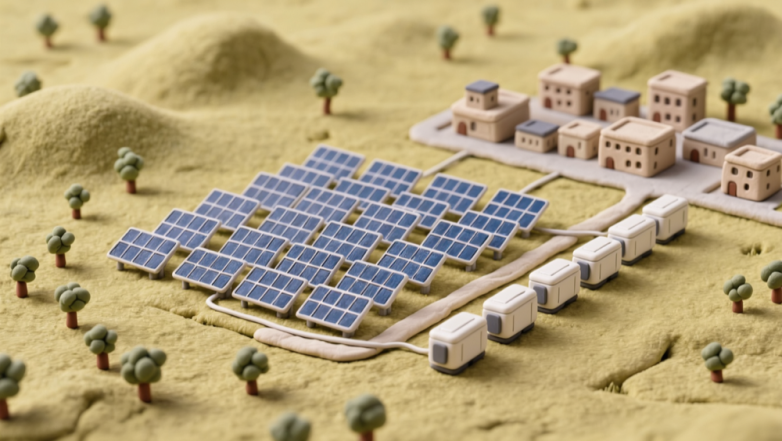
Hybrid plants that pair wind and solar with a small four-hour battery could supply 70–90% of a typical Kazakh demand profile at a delivered cost below $60/MWh, according to a report Ember published on Nov. 3 with Converge-Hybrid.
Ember ran 1,875 hourly simulations on Converge-Hybrid's hybrid plant design software, testing 125 mixes at each of 15 sites near cities and power lines. Demand was scaled to a 100-MW peak. The weakest site, near Kordai in the south, reached 70%. Zhanaozen in the west reached 90%.
The modelled solar plant uses 720-W bifacial modules on single-axis trackers, at $553 per kWac installed. The hybrids meet 78–95% of summer demand and 61–87% in winter. At Kordai, solar supplied 15 percentage points of the 61% met in winter, wind 44 and the battery 2.
The plants are oversized by design, and 23% of output is curtailed on average, mostly in spring and summer when solar peaks. That lifts the average cost from $45/MWh generated to $56/MWh delivered. New coal costs $70–170/MWh, Ember said.
The study in numbers
- 180 MW of wind, 250 MW of solar and 480 MWh of batteries in the largest configuration, which met 91–97% of demand at $87–91/MWh.
- 4.3 times the 100-MW peak in generating capacity in that configuration, 58% of it solar (list.solar calculation).
- 20% below the bottom of Ember's new-coal range: $56/MWh against $70/MWh (list.solar calculation).
- 12–25% of combined wind and solar capacity was the optimal battery size at 14 of the 15 sites.
- 3.5 GW of renewable capacity at 162 facilities made 7% of Kazakhstan's power in 2025, the Ministry of Energy said.
- 21.3% more renewable electricity was generated in January–September 2026 than a year earlier, the Settlement and Financial Center for renewables said.
Since 2025, auction winners must add storage equal to 30% of capacity, with two hours of duration. Ember's optimal batteries were smaller but longer, at four hours. Wind with "some solar and a small battery can reach similar reliability to what solar and more batteries can do in sunny places," said Kostantsa Rangelova, Ember's senior battery analyst.
About 2.4 GWh of batteries are due at four wind-plus-battery projects, and the country's first battery system is expected by 2029. Kazakhstan is considering a law on energy storage. Ember wants it to let batteries earn from grid services, and urged a wind and solar target beyond the 15% renewables goal for 2030.
Also read
- India Approves INR 14,500 Crore to Back 92 GWh of Grid Storage
- TNB, IOI Form JV for 500-MW Solar, 1,000-MWh Battery in Malaysia
- IEA Sees India Reaching 530 GW of Renewables by 2030, Led by Solar
- Sunrun Doubles Puerto Rico Battery Power Plant to 60,000 Customers
- BW ESS Starts Commercial Operation at 1,243-MWh Hams Hall Battery