EU backs bid to take CPV to mass production amid 29% efficiency claims
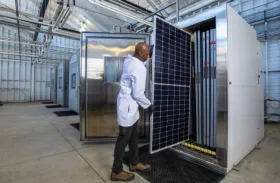
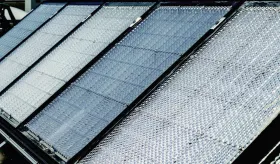
A solar PV technology claiming to have achieved 50% higher output than conventional systems in tests has bagged EU research money to speed up its move to large-scale production.
A solar PV technology claiming to have achieved 50% higher output than conventional systems in tests has bagged EU research money to speed up its move to large-scale production.
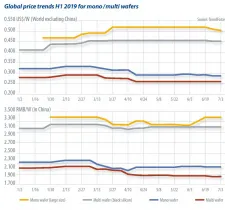
Having stated an intent to hit 65 GW of annual mono wafer production capacity by the end of 2021, the Chinese solar manufacturing giant has now said that landmark will be achieved next year.
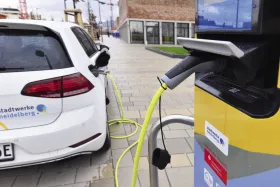
With the 200 hydrogen bikes offered to journalists and world leaders at the G7 summit in Biarritz proving popular, manufacturer Pragma Industries has received an order for 1,000 of them from Chilean president Sebastian Pinera. The company’s founder, Pierre Forté, wants the bike to have a societal impact in developing countries.
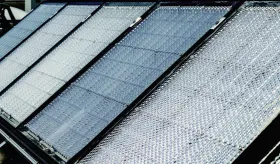
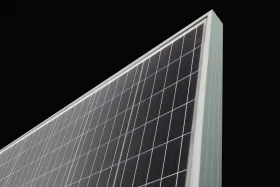
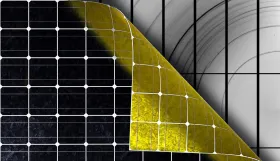
A consortium of European research institutes has received €10.6 million in EU funding to establish pilot production of a high efficiency module concept developed by Swiss startup Insolight. The module combines high efficiency multijunction cells with a solar concentrator lens and has previously demonstrated 29% efficiency.
Two of Germany’s leading research institutes and a CIGS module maker have announced plans to work on the development of perovskite-CIGS tandem cells with a target of producing thin film modules with better than 30% efficiency.
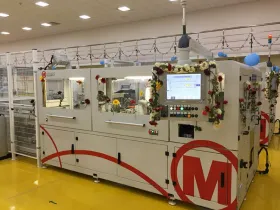
Specialist automation and PV module assembly solutions provider, Mondragon Assembly has struck a deal with Korean equipment supplier, STiN for its ‘continuous stringing’ intellectual property (IP).
Inline solar cell measurement equipment specialist Aurora Solar Technologies (AST) has won its largest single order to date from a major China-based manufacturer of high-efficiency PERC solar cells.
The Hong Kong manufacturer is holding out hope a boom that is expected to start imminently will help it turnaround losses that forced it to issue a profit warning last week. Getting its new production line in Qujing up to speed will help, provided the demand materializes.
The tender produced lower bids than previous rounds but again allocated less generation capacity than planned. The Japanese government initially accepted bids for a combined 589.9 MW but ended up assigning only 195.8 MW of capacity. The final average price for procured solar power was $0.1222/kWh.
The embattled solar manufacturer – which is facing a winding-up petition lodged by Deutsche Bank Hong Kong – says it failed to publish the six-month update by the weekend because of a delay in producing its annual results for last year.
Leading monocrystalline wafer producer and ‘Solar Module Super League’ (SMSL) member LONGi Green Energy Technology (LONGi Group) has reported second quarter 2019 revenue of approximately US$1.17 billion, a new quarterly record, due to monocrystalline wafer shipments increasing by 183% in the first half of 2019, compared to the prior year period.
The SMSL reported second-quarter PV module shipments of 3,386MW, an increase of 11.5% from 3,037MW in the first quarter of 2019 and an increase of 21.2% from 2,794MW in the second quarter of 2018.
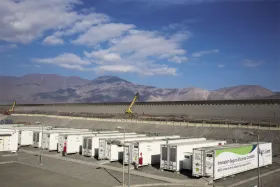
Chile is home to a massive 10.3 million tons of lithium reserves, most of which is found in the Atacama Desert in the northern part of the country. With some of the highest solar irradiation levels on Earth, this region also boasts the perfect conditions for generating solar power. Developments in the photovoltaic market, alongside implementation of more efficient energy storage systems, are positioning Chile as a regional leader in this field. So what does the future hold for battery energy storage systems (BESS) in Chile, and what obstacles lie in their way?
The state-run fossil fuel giant has partnered with an unnamed foreign start-up to produce electric vehicle batteries using raw materials easily available in India.
A spokeswoman from the Chinese manufacturer of the Swan series of double-sided solar panels says monofacial modules will soon be consigned to residential use as the price gap between them and higher-yielding bifacial products rapidly closes.
The Chinese giant has argued its 166mm M6 product should be the new iteration used worldwide, even though larger products have been launched by rivals. Longi says the fact existing cell and module production lines can be adapted for the M6 means rising demand for solar worldwide can be swiftly satisfied.
The solar manufacturer today moved to reassure investors ahead of what promises to be another rocky set of first-half figures in two days’ time. The Hong Kong company says it wants to add another 3.6 GW of mono ingot and wafer capacity by early 2021.
‘Silicon Module Super League’ (SMSL) member, JA Solar has supplied 33.1MW of mono-PERC panels to Ukraine-based project developer, UDP Renewables for the Scythia-Solar-2 PV power plant in the Zaporizhia region of the country.
PV Evolution Labs (PVEL) is including a number of key module reliability tests to its PV Module Product Qualification Program (PQP) that is more responsive to downstream market needs.
India's largest solar panel manufacturer, Waaree Energies said it was closing in on achieving cumulative solar module shipments of 2.5GW as its recent capacity expansions took nameplate production to 1.5GW.
Looking back at the PV market in 2018, micro module technologies started maturing in development and moving on to mass production, writes TrendForce analyst Lions Shih. Modules are no longer limited to a single design as before, but rather continuing on the path toward diversification in 2019. The situation is spreading into other areas, as may be seen in the upstream silicon wafer and cell segments.
With the anti-dumping and countervailing duties imposed in November 2013 set to expire nine months ago, the Canadian International Trade Tribunal has extended them for another five years, ruling their expiry would harm the nation’s only domestic manufacturer.
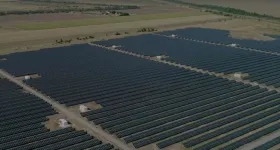
Enel Green Power has reached another development milestone in Latin America, rolling out the first components of what it says is Chile’s largest solar project to enter construction to date.
A binational integrated solar industry project, announced just over a year ago, aims to build a vertically integrated solar manufacturing industry along the border between Brazil and Paraguay. But the project is now on hold pending an update and reassessment by its new managers.
X-ray analysis is said to have solved the mystery of how to preserve optical absorption in perovskite layers. Researchers say the discovery could help stabilize the material and speed up the launch of a new ingredient for PV research.
The performance of the company’s Selectively Coated Ribbons was measured for more than a year in a field test. Heraeus says the yield gains are achieved by the device’s optical properties – said to enable improved reflection – even at low angles of incidence and in low-light conditions.
A maturing PV market does not automatically deliver certainty in terms of technology roadmaps and industry dynamics. Crystalizing trends and anticipating developments is the business of analysts, so pv magazine assembled four of solar’s best to talk about prices, technology and market-defining policy developments.
Chinese string inverter manufacturer Ginlong Solis ranked third among Asian inverter brands in BloombergNEF’s latest industry scorecard.
Meyer Burger’s new chairman has acknowledged that the outlook remains tense for Europe’s largest solar equipment supplier, but he is urging shareholders to support the company’s plan to reposition itself to focus on high-yield technologies and markets beyond China.
Solibro will probably file for insolvency this month, according to German media reports. However, the company has yet to publicly confirm the matter.