Huawei Burns Oil Transformer for 80 Hours Beside LUTERRA Batteries
Key points
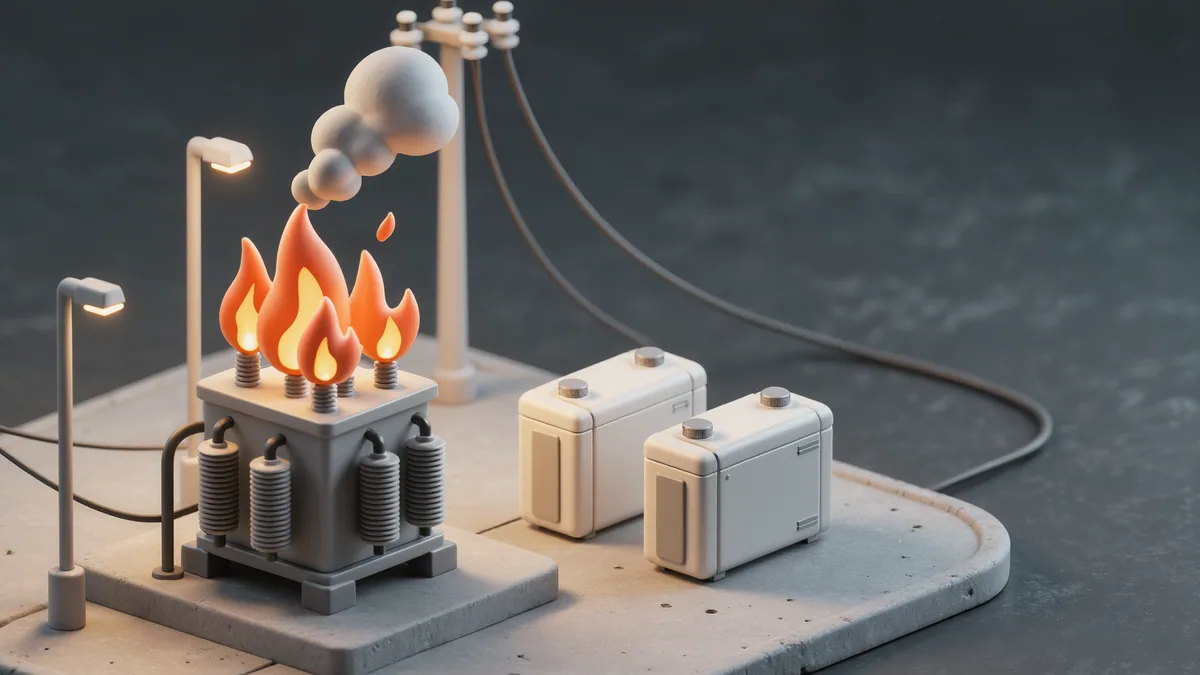
- Huawei set fire to a transformer station holding 5 tons of oil inside a LUTERRA storage sub-array on Oct. 30 and let it burn for 80 hours.
- Cell temperature in the battery containers, spaced 0.6 m apart, stayed below 26°C, Huawei said on Nov. 20.
- SGS ran the test; INERIS checked it against a French storage rule that has not yet been issued.
Huawei Digital Power set fire to an oil-filled transformer station inside a full sub-array of its LUTERRA grid-forming battery system on Oct. 30, 2026, and let it burn for 80 hours. The fire did not spread to the battery containers, which stood 0.6 m apart, the company said in a release dated Nov. 20.
The burn test in figures
- 5 tons of oil were in the transformer station, which was ignited from outside under full-oil condition.
- 0.6 m separated the enclosures, which Huawei calls the minimum installation spacing; through-busbars linked the containers.
- 80 hours of burning, or about 3.3 days, ran without manual intervention (list.solar calculation for days).
- Almost 1,000°C was the peak fire temperature; cells in the sub-array's containers stayed below 26°C throughout.
- Below 28°C was the oil temperature in the adjacent transformer station, according to Huawei.
- About 974°C separated the peak fire temperature from the 26°C ceiling on cell temperature (list.solar calculation).
SGS organised and ran the test. Witnesses included France's INERIS, Bureau Veritas, consultancy BCFI and the Tianjin Fire Research Institute of China's Ministry of Emergency Management. INERIS helped set the abuse conditions to match AMPG 2925-2, a forthcoming French mandatory specification for outdoor stationary storage, and validated the results against it. Huawei calls this the industry's first sub-array-level large-scale fire test that includes a transformer station.
The release does not say where the test took place. It gives no container count, energy rating in MWh or cell chemistry. With no price either, a cost per kWh cannot be worked out. list.solar found no separate report from SGS or INERIS.
In the US, an Aug. 25, 2023 amendment to NFPA 855 keeps storage units 3 ft (914 mm) apart unless fire testing shows less is adequate. That clause sits in the code's chapter for one- and two-family dwellings, and it names UL 9540A or an equivalent test. Utility-scale sites follow other sections. See also list.solar's battery storage section and its largest storage companies.
Most large-scale fire tests so far check whether fire jumps between containers, Huawei said. In its view, storage safety "should not stop at the container-to-container level". The company first showed LUTERRA at Intersolar Europe in June 2026.
The release gives no date for the French specification or for publication of the full SGS test report.