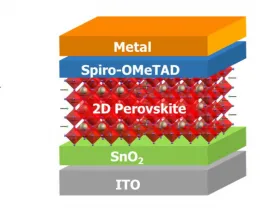
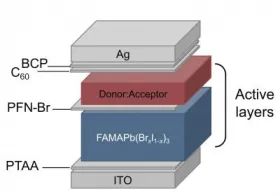
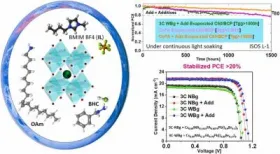
Scientists China's Zhengzhou University, Xi'an Jiaotong University and Chinese Academy of Sciences (CAS) have made a solar cell based on low-dimensional Ruddlesden-Popper (LPDR) perovskite that is said to have improved provider transport residential properties.
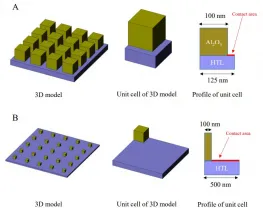
A research team led by Prof. Xu Jixian from the University of Science and also Technology of China (USTC) of the Chinese Academy of Sciences (CAS) developed and fashioned a novel porous insulator contact (PIC) for perovskite solar cells. The PIC alleviated the non-radiative fee recombination result and also the matching solar cell accomplished a performance of up to 25.5%. The research was published in Science.
The human brain can easily process complex sensory information and also gain from experiences, while a computer can not. As well as, the brain does all this by consuming less than half as much energy as a laptop.
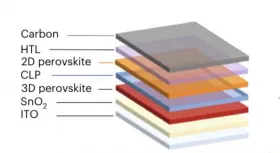
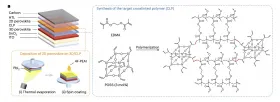
Scientists at Huazhong University of Science and also Technology, Wuhan University of Technology as well as University of Toronto lately introduced a new strategy for producing more stable 3D/2D heterostructures, avoiding their destruction. Their approach is based on the intro of an added layer in between the structures; 3D as well as 2D perovskite layers.
Hybrid perovskite solar cells (PSCs) constructed from organic and also inorganic products are highly promising energy services that can help to decrease carbon emissions worldwide. In the last few years, these cells' power-conversion efficiencies (PCEs) have actually improved substantially, ultimately surpassing 25%.
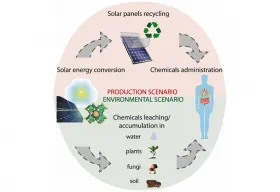
Scientists from Skoltech (Skolkovo Institute of Science and Technology), Research Centre for Medical Genetics, Federal Research Center of Problems of Chemical Physics and also Medicinal Chemistry and also Zhengzhou Research Institute of HIT have examined the toxicity of materials used in perovskite solar cells.
Nano-textured surface areas are an interesting strategy for maximizing the optical qualities for monolithic perovskite/silicon tandem solar cells. Researchers from Germany's Helmholtz-Zentrum Berlin (HZB) have actually checked out the growth of different textures of silicon surface areas making use of different industrial additives as well as their efficiency in silicon heterojunction (SHJ) and also SHJ-- perovskite tandem solar cells.
In the threatening problem of climate change, growing industrial crops on solar farms is a possibly efficient use of farming land that can both increase business food manufacturing and enhance solar panel efficiency as well as longevity, according to new Cornell study.
Scientists at South Korea's Ulsan National Institute of Science and Technology (UNIST), Chonnam National University and also Pohang University of Science and also Technology (POSTECH) have actually created a special perovskite solar cell that utilizes alkylammonium chloride (RACI) to regulate the development of defects in the perovskite layer.
Researchers from North Carolina State University, Pennsylvania State University and University of North Carolina at Chapel Hill have found that channeling ions into defined pathways in perovskite materials improves the stability and operational performance of perovskite solar cells. This breakthrough in sustainable energy news could revolutionize photovoltaic technology.
Scientists from the University of Konstanz in Germany, Quaid-i-Azam University and Kohsar University Murree in Pakistan and Huazhong University of Science and Technology in China have actually fabricated an inverted perovskite solar cell with a passivation technique utilizing a mixed solvent vapor annealing technique based on ethylenediamine (EDA).
Researchers from The Hebrew University of Jerusalem, Israel have developed a new type of flexible, semitransparent solar cell through inkjet printing. This technology advances the use of photovoltaics in existing windows and offers higher efficiency and improved mechanical properties.
Researchers have actually discovered that transporting ions into specified pathways in perovskite products enhances the stability and operational efficiency of perovskite solar cells. The searching for leads the way for a new generation of lighter, more flexible, and much more effective solar cell technologies suitable for practical use.
Penn State scientists use a new process called EM-FAST to create large perovskite devices in minutes, allowing for more efficient and cost-effective fabrication of next-generation solar cells.
A state-of-the-art solar energy laboratory has actually been released today at the University of Mauritius. The laboratory has been established with participation from Huawei Mauritius. The campaign belongs to a project described as the Park of Excellence in Solar Photovoltaic (PESP) at the University of Mauritius.
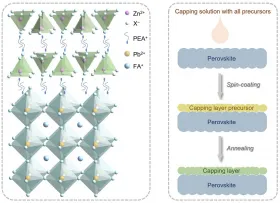
Scientists from Nanyang Technological University, Singapore (NTU Singapore) and the Institute of Materials Research and Engineering (IMRE) have found a way to stabilize perovskite solar cells using non-toxic metal-based capping materials. This paves the way for commercial use of perovskite cells, which, despite superior efficiency and lower production costs, contain lead, posing an environmental threat when decomposed. The researchers used the full precursor (FP) solution method, which allowed them to synthesize the capping layer of solar cells without lead. The zinc-based compound, PEA2ZnX4, was the most effective among the materials tested, and the process was more efficient than the half precursor (HP) method.
Researchers from Eindhoven University of Technology and also TNO at Holst Centre have actually established a sensor that transforms light into an electric signal at an unbelievable 200% efficiency-- an apparently impossible figure that was accomplished through the exceptional nature of quantum physics.
Silicon, the standard semiconducting material used in a host of applications-computer central processing units (CPUs), semiconductor chips, detectors, and solar cells-is an abundant, normally occurring material. However, it is pricey to mine as well as to cleanse.
Researchers from Korea's Institute for Basic Science (IBS), Chinese Academy of Sciences, the University of Rochester in the U.S, and The Australian National University have actually boosted the photoresponsivity of a lead-halide perovskite for solar cell applications by 250%. They developed a perovskite film with a plasmonic substrate made from hyperbolic metamaterial and characterized it with transition dipole orientation.
Researchers from The University of Toledo, University of Washington, Northwestern University, University of Toronto and Empa-- Swiss Federal Laboratories for Products Science and Innovation, have actually attended to a significant difficulty standing in the way of the commercialization of halide perovskite solar cells - their durability - by finding a component that enhances adhesion and mechanical strength.
Making use of green light and a double-layered cell, Ph.D. scientist Riccardo Ollearo has generated a photodiode that has level of sensitivity that several can just imagine.
Scientists from the University of Maryland, Baltimore County are researching ways to make solar panels more efficient by using molecules found in plants, like chlorophyll, to convert sunlight into chemical energy. Learn more about the process and the potential of this sustainable energy source.
Physicists in the U.S. have solved the problem with the durability of perovskite solar cells, bringing the technology one step closer to powering solar panels in the consumer market. This solar energy news is an important breakthrough for the ongoing decarbonization of the world's economy.
QD Solar announces 24% efficiency for spin-coated perovskite cells and 23.2% efficiency for slot-die coated cells. These certified numbers have been developed for large scale manufacturing.
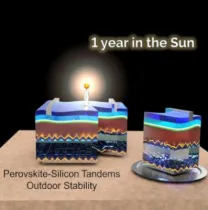
Scientists from Saudi Arabia's King Abdullah University of Science and also Technology (KAUST) have actually reported the results of an one-year outdoor test for a tandem perovskite-silicon solar cell they developed in 2020. They have located that the device retained greater than 80% of its initial performance throughout the testing period between April 2021 as well as April 2022.
New study from US National Renewable Energy Laboratory finds perovskite-based thermochromic windows could lead to massive energy savings and reduce carbon emissions in buildings across all climate zones in the US.
Researchers from Australia and Germany set a new record with a 30.3% efficient perovskite and silicon tandem solar cell, funding by ARENA. Stay up to date with the latest Solar Energy news.
Scientists at University of Rome "Tor Vergata"'s CHOSE (Centre for Hybrid and also Organic Solar Energy), Greatcell Italy, ISM-CNR and also ENEA have actually researched a standard three-way cation perovskite (∼ 1.58 eV) as well as broader bandgap perovskite (∼ 1.63 eV) with intent of discovering a common approach to construct a durable gadget stable gradually independently of the perovskite used.
Halide perovskite solar cells are less stable than thought, but researchers at Georgia Tech have found a path to increased reliability and efficiency, according to new sustainable energy news research.