Encapsulation-Free Hybrid Perovskite Hits 27% Efficiency
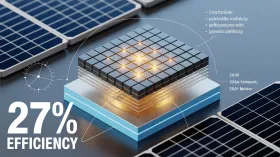
Moisture-proof hybrid perovskite/organic solar cells hit 27.18% efficiency, keeping 95% after 3,000 damp-heat hours—engineered cascade hole transfer reduces recombination.
Moisture-proof hybrid perovskite/organic solar cells hit 27.18% efficiency, keeping 95% after 3,000 damp-heat hours—engineered cascade hole transfer reduces recombination.
Japan launches a first solar-sharing pilot in Chiba: perovskite panels overhead power campus facilities while rice keeps growing—researching electricity, durability, and impacts on yield and quality.
Boost halide perovskite solar cells with BTTM: efficiency jumps to 24.71% (from 22.07%) and UV durability soars—over 90% retention after aging vs ~61% controls.
SHCl enables MA-free all-perovskite tandems with uniform, Cs-rich crystallization—boosting blade-coated films and delivering 24.3% certified efficiency plus strong damp-heat and thermal-cycling stability.
A single perovskite diode turns light into power—and power back into brilliant LEDs—thanks to porous alumina “sponge” islands that slash recombination, boosting solar efficiency and LED brightness.
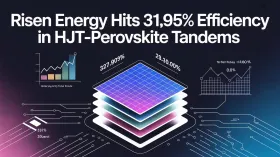
Risen Energy hits 31.95% certified efficiency for its HJT-silicon/perovskite tandem on 1 cm²—1.988V open-circuit. Uniform perovskite layers via water-bath SAM boost transport and cut defects.
Co-assembled SAMs for inverted perovskite solar cells: pair Me4 with new donor–acceptor LYS-H/LYS-F to boost hole extraction, cut recombination, and deliver 25.02% efficiency.
Japan’s Yokohama floating data-center pilot tests modular compute at sea, using seawater cooling to cut heat and ease land scarcity near ports—boosting AI-ready capacity with efficient thermal performance.
Black phosphorene turbocharges MAPbI3 perovskites: dual-interface insertion lifts simulated efficiency to 30%, tuning band alignment, quashing recombination, and speeding extraction—an actionable blueprint for ultra-low-loss PSCs.
AI inverse-designed ZnS/MgF2 coatings paint perovskite solar cells in user-defined colors with minimal loss, boosting PCE on glass and PET—opening sharper-colored solar windows and auto glazing.
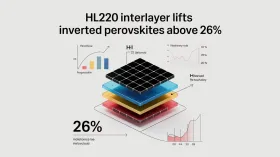
HL220 supercharges inverted perovskite cells: smoother interfaces, faster electrons, 26.44% PCE, 85.2% FF, 22.93% on 15 cm²—94.1% retained after 450 hours. Alcohol-processable, silver-synergistic, scale-ready.
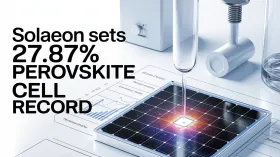
SolaEon hits certified 27.87% perovskite record, nears theoretical limit; tandem tops 31%, and meter-scale modules reach 25%+ stabilized—mass production hurdles next.
Sungrow’s PowerTitan 3.0 hits Europe: containerized, liquid‑cooled battery with grid‑forming control, EMS/SCADA fleet dispatch and lifecycle guarantees for 2–4‑hour FFR, arbitrage and congestion relief.
Tin–lead perovskite hits 24.07% without SnF2: metallic lead + PbF2 boost crystallization and stability, retaining 60% output after 550h at 85°C—tandem-ready durability reported in Nature Communications.
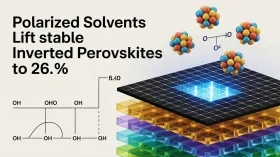
Polarized-solvent tweak sets new 26.4% record for inverted perovskites. Fluorinated polymer tames crystallization, delivers pinhole-free films, 1,000-hour stability, and scalable manufacturing promise.
Longi slumps on fresh loss warning, but a 2026 price rebound beckons. Cost relief and a silver-to-base-metal shift hint at margin repair as China tames overcapacity; Tongwei also bleeds.
Perovs hits TÜV-certified 20.87% efficiency on mass-produced large-area perovskite modules, 150.26 W, as it scales from a 100 MW pilot to a 1 GW plant and GW-level base.
Mellow Energy’s 30×30 cm flexible perovskite hits TÜV NORD–certified 21.13% efficiency, a size-class record, accelerating real-world pilots from gadgets to vehicles, aerospace and satellites toward rapid commercialization.
Jinko Solar and XtalPi unite AI and robotics to accelerate perovskite–silicon tandem cells, targeting mass production in three years with a closed-loop, high-throughput R&D revolution.
Nanocomposite boosts tough perovskites: amorphous–crystalline silicon nitride layer tames defects, lifts efficiency to 26.65%, and keeps large modules humming outdoors for 6+ months—real-world scalability in sight.
Machine-learning tuned, amorphous-passivated flexible perovskites hit 24.52% efficiency and bend-proof longevity, enabling lightweight, roll-to-roll modules for wearables and buildings with record power densities.
Air-stable DMF/NMP perovskite ink enables uniform blade-coated films and record 26.05% inverted efficiency, negligible hysteresis, and enduring high-temp stability—scaling to modules with 23.5% aperture and 96.1% GFF.
BOE smashes perovskite milestones: 27.37% cells, 579 W 2.88 m2 module, flexible hits 21.39%, 433 W pilot — commercial line gears up as BIPV certification signals scale.
Breakthrough vapor-deposited perovskite-silicon tandems hit 30% efficiency on textured wafers, surpass 2,000-hour stability—paving mass-production-ready modules as NUS, A*STAR, Trina Solar move to pilot lines.
FuturaSun and Eni’s Eniverse launch SunXT to commercialize perovskite–silicon tandem bifacial panels, leveraging Solertix IP; pilot line to industrial scale-up targeting homes, businesses, utilities in decarbonization push.
China-led breakthrough: perovskite–silicon tandem hits 32.12% efficiency via steric-complementary passivation, slashing recombination, edging toward 40%, and retaining 80% after 1,000 hours MPP with HJT.
JinkoSolar smashes a new n-type TOPCon record at 27.79%—ISFH verified—pushing power density and project economics, pressuring rivals as 28% looms. Production timing TBD; tech rolling into products.
Japan cools perovskite hype, prioritizing durable, scalable gains as cheap silicon dominates; roadmap shifts to niche wins, cost cuts, and manufacturing know‑how through the 2030s.
JA Solar researchers used a multifunctional ammonium salt to passivate defects and flip the interfacial field in inverted perovskites, hitting 26.7% efficiency with strong thermal stability.