IMR Striped BiVO4 Panel Splits Water With 4 Times the Hydrogen Output
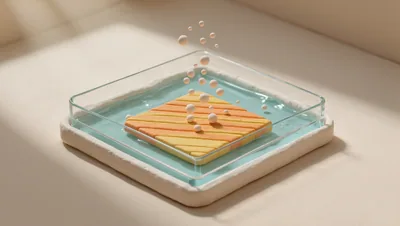
A CAS panel of 15-micrometer p- and n-type BiVO4 stripes made 1.77 mmol of hydrogen per square meter in an hour, about four times its unpatterned control.
Huawei burned an oil-filled transformer inside a LUTERRA battery sub-array for 80 hours on Oct. 30; cells in the 0.6 m-spaced containers stayed below 26°C.
JinkoSolar says its perovskite/TOPCon tandem cell hit 35.24% certified efficiency, up from 34.82% in June. LONGi's 35.5% tandem figure remains higher.
A Xi'an Jiaotong University-led team reports a certified 27.96% inverted perovskite cell in Nature, plus a 34.71% perovskite-silicon tandem cell.
Korea's solar-powered EAV-4 drone flew 170 hours and 5 minutes nonstop in August, more than three times the 53-hour national record, KASA said Nov. 11.
EPFL made a polymer photocatalyst sheet that splits water under simulated sunlight with no bias; it reached about 0.1% solar-to-hydrogen efficiency.
Singulus signed a SpaceX contract for a turnkey heterojunction solar cell line worth over €60 million, with the first line due in the first half of 2027.
Heliene is making Caelux perovskite-silicon modules with up to 27%+ claimed efficiency in Minnesota, under a multi-gigawatt deal, for deliveries in 2027.
A Soochow University and LONGi perovskite-silicon tandem cell reached 35.1% certified stabilized efficiency in Nature, using a new hole-transport molecule.
University of Osaka researchers built a robot and machine-learning platform that tracks perovskite film formation; a cell made with its settings hit 24.4%.
DGIST and Kookmin University coated a solar hydrogen photoanode in water at 4 V, down from 200 V or more, and report about ten times the photocurrent.
UNIST built an all-organic tandem photocathode that splits water at 7.9% solar-to-hydrogen efficiency with no external voltage, a record the team claims.
ARRAY Technologies will use Aeeris hail forecasts to stow Australian solar trackers automatically; SmarTrack starts moving them 30 minutes before hail.
Optivolt raised $32 million led by VXI Capital to expand manufacturing of its Power Balancer, which puts module-level power electronics inside the solar panel.
UNSW-led team lifts hydrogen output from biodiesel glycerol about 10-fold with a nickel-cobalt photocatalyst that also makes chemicals worth up to US$150/kg.
Sparc Hydrogen gets A$1.3 million from Sparc, Fortescue and Adelaide University to take solar water splitting to on-sun pilot tests in early 2027.
SunPower Origin back-contact panel goes on sale in Europe at 505 W with a 40-year warranty. TCL SunPower expects first deliveries before the end of 2026.
JinkoSolar says its new TAC back-contact cell hit 28% peak efficiency without third-party certification; the first TAC module is rated 510 W at 25.52%.
Saft has started making solid-state battery cells in Bordeaux, France, for aviation and space, claiming up to 50% more energy density than lithium-ion.
GameChange Energy commissions its Genius Tracker at Bright Fern’s 23MWp Dannevirke solar farm—engineered for NZ terrain and seismic risk—boosting Oceania’s utility-scale reliability and accelerating a 550MW pipeline.
Certified by TÜV SÜD, Chinese-made large-area perovskite modules hit 24.0% (810 cm²) and 22.0% (meter-scale), boosted by SVP processing and Pb(OA)₂ passivation—95%+ stability.
SunScout’s NZ clean-tech push goes US: after its IPO, it plans Texas manufacturing for faster, cheaper solar-powered robotic mowers—boosting cleaner land management with AI-driven automation.
Sparc Hydrogen teams with SunHydrogen to integrate solar hydrogen modules into its concentrated solar reactor system, starting lab tests and outdoor trials in South Australia for cost-effective feasibility.
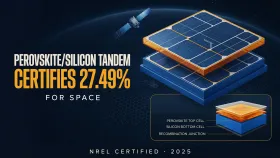
Certified 27.49% AM0 efficiency: a durable monolithic perovskite/silicon space tandem. It withstood radiation, heat, humidity, and high-altitude balloon operation—no monotonic decay.
LONGi claims a world-record 35.5% certified crystalline silicon–perovskite tandem efficiency—topping its prior 34.85% milestone—presented in Shanghai and verified by ESTI, signaling rapid R&D momentum.
Chinese scientists set a new world record: certified 28.04% steady-state efficiency for perovskite–organic tandem cells, boosted by smarter interfaces that boost transport, cut losses, and support stability.
Dual-molecule NiOx/perovskite interface engineering—Me-4PACz plus CzOTf—locks charge extraction, passivates Pb defects, boosts voltage and stability, delivering certified 27.31% and strong 2000h/35-day retention.
CIGSe–perovskite tandem solar cells hit a new 25.5% efficiency record—certified by Fraunhofer ISE—surpassing last year’s 24.6% benchmark through smarter bandgap and interface engineering.
Ambient-air fabrication breakthrough: ternary GDMA/AG SAMs stabilize perovskite and perovskite/Si tandems, boosting efficiencies up to 31.72% and keeping 92%+ after 600h at 85°C.