Swansea Pioneers Roll-to-Roll Printable Solar Cells
- Swansea University pioneers cost-effective, scalable carbon ink for perovskite solar cells, enabling high-speed, low-temperature production with improved efficiency and stability, paving the way for cleaner energy solutions.
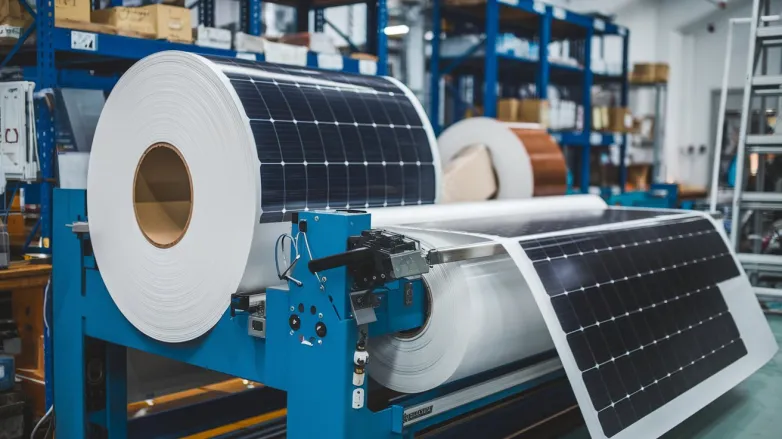
Swansea University has developed a low-cost, scalable carbon ink formulation for perovskite solar cells, advancing their commercialization. Using a roll-to-roll (R2R) process, the team created fully printable perovskite photovoltaics, replacing the expensive gold electrode with a carbon electrode. This innovation, led by Dr. David Beynon, uses a solvent mix that forms a film without dissolving underlying layers, allowing for continuous application at low temperatures and high speeds.
Funded by the European Regional Development Fund and EPSRC, this research promises cleaner energy solutions. Professor Trystan Watson highlighted the potential for high-volume manufacturing, with devices achieving 13-14% power conversion efficiency and improved stability at higher temperatures.
How does Swansea University's carbon ink formulation impact perovskite solar cell commercialization?
- Reduces production costs by eliminating the need for expensive materials like gold.
- Enhances scalability through the roll-to-roll (R2R) process, enabling mass production.
- Increases efficiency in manufacturing by allowing continuous application at low temperatures.
- Improves the environmental footprint of solar cell production by using less toxic materials.
- Boosts the stability and longevity of perovskite solar cells, making them more viable for commercial use.
- Facilitates high-speed production, which can accelerate market entry and adoption.
- Supports the development of flexible and lightweight solar panels, expanding potential applications.
- Aligns with global sustainability goals by promoting cleaner energy technologies.
- Encourages further research and development in perovskite technology due to its commercial potential.
- Attracts investment and interest from industries looking to innovate in renewable energy solutions.
Also read
- Eos Energy Lifts Q3 Revenue 171% to $82.7 Million on Zinc Batteries
- Osaka Robot Platform Guides Perovskite Cell to 24.4% Efficiency
- ARRAY and Shoals Agree All-Stock Merger, Shoals Holders to Own 65%
- DGIST Cuts Solar Hydrogen Electrode Coating Voltage to 4 V From 200 V
- ReNew Q2 Net Profit Rises 37% as Commissioned Capacity Hits 13.7 GW