
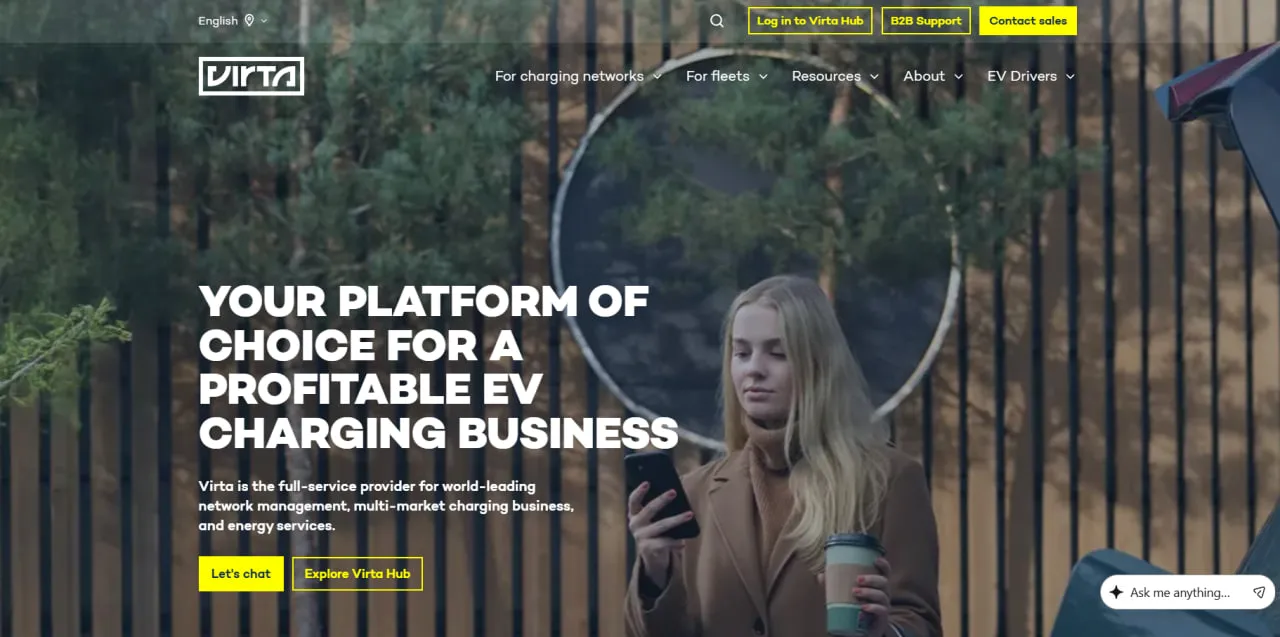
What Is Virta?
Virta is a Software-as-a-Service CPMS from Liikennevirta Oy, a Helsinki company founded in 2013, built for charge point operators (CPOs) and e-mobility service providers (EMPs). It is sold in two forms. Virta Core bundles the Virta Hub back office, the Virta driver app, payments and invoicing, managed roaming, 24/7 driver support and dynamic load management. Virta Modular lets large operators keep their own app, money flow or roaming contracts and run the rest on Virta.
Chargers connect to the Virta Hub, where they are monitored and controlled remotely. In the standard setup, Virta acts as the seller to the driver: it collects the payments and pays the operator through one monthly self-billing invoice. More than 120,000 charge points in 35 countries are connected to the platform, run by over 1,000 private and public organizations, including energy, fuel and retail companies. Virta also cites 34 patent families in energy management and a Technology Innovation Award from Frost & Sullivan.
Virta is a cloud charge point management system (CPMS) for companies that sell EV charging: charge point operators, energy and fuel companies, retailers, property owners and hotel chains. It runs the back office of a charging business, from charger monitoring and remote fixes to tariffs, payments, roaming and a driver app that can carry the operator’s own brand, so a company can open a public or private charging network without building that software itself.
It is not for homeowners with a single home charger, and it is not solar software: it does not design or monitor PV systems. Its solar tie-in is Virta Boost, a paid add-on that sends surplus power from on-site solar, batteries or wind into EV charging instead of exporting it to the grid at low rates. The trade-offs are quote-only pricing, energy features such as Boost, Virta Flex and V2G sold as add-ons, and a weak reputation among drivers over billing and refunds.
Pros and Cons
Pros
- Proven at scale, with more than 120,000 charge points in 35 countries on the platform, and certified to ISO 27001 and SOC 2, which helps when large buyers run security reviews.
- Energy add-ons can add revenue beyond the charging fee: on-site solar surplus goes into cars instead of being exported at low rates, and where Virta Flex runs, pooled charging capacity earns income in reserve and wholesale markets.
- Self-healing is included at no extra cost and clears some charger faults with a remote reboot, saving technician visits.
- Managed roaming spares the operator separate roaming contracts: Virta settles payments with other networks and carries the roaming credit risk.
- An operator can sell charging under its own brand without building or maintaining a driver app.
- Takes compliance work off the operator: as the seller to drivers, Virta handles cross-border VAT, AFIR and German Eichrecht requirements.
Cons
- No public prices, so even a rough budget needs a sales call, and the add-ons most operators will want cost extra on top of the Core fee.
- Core plus a long list of add-ons is a lot of platform to learn for a small site with a few chargers.
- Weak reputation with drivers: Virta scored 1.4/5 on Trustpilot from 44 reviews in November 2026, mostly over billing disputes and slow refunds, and some report app login problems. That matters if your drivers use the Virta app.
- Sold only to businesses, so it is not an option for a homeowner managing one home charger.
Features
Charging Station Management
One Virta Hub dashboard for monitoring and controlling thousands of chargers of different makes and models.
Automated Billing and Payments
Custom tariffs, payment collection from drivers, and automatic VAT handling and invoicing.
Self-Healing Algorithms
Detects selected charger errors and reboots the charger remotely when no session is running; Virta says this resolves up to 20–30% of issues without a site visit, at no extra cost.
Energy Management and V2G
Beyond load management, paid add-ons include Virta Boost for charging from on-site solar, battery or wind surplus; Virta Flex, which pools charging capacity for demand response in frequency reserves such as FCR (live in Finland and Sweden) and in wholesale and capacity markets (France and the UK); and Vehicle-to-Grid (V2G) for bidirectional chargers.
White-Label Solutions
A paid add-on for selling charging under your own brand, with a co-branded or fully branded driver app, RFID tags, receipts and registration pages.
EV Roaming
Drivers can use their accounts at more than 800,000 public charge points, including partner networks connected through the Hubject and Gireve roaming hubs.
Real-Time Reporting and Analytics
Reports on energy consumption, revenue and driver behavior that show where the network needs more chargers.
Virta Pricing
Virta does not publish prices. To get a quote, you contact sales or book a demo; the price depends on the size of the charging network and the features you need.
The pricing model is public, though the figures are not: Virta Core combines a monthly platform fee with a usage fee, charged either per kWh or as a fixed monthly fee per socket. Add-ons such as White Label, Virta Boost, Virta Flex and V2G are priced separately, as is hardware.
Integrations
- Hardware Integrations: Over 2,000 charger models from major manufacturers connect through the Open Charge Point Protocol (OCPP).
- E-Mobility Protocols: OCPI (Open Charge Point Interface) for roaming connections with other charging networks.
- API Suite: APIs for pulling charging data into ERP systems, custom mobile apps or fleet management tools; API access and OCPP Streaming are sold as add-ons.
- Payment Integrations: Card payments, Apple Pay and Google Pay (for one-time web payments only), the Virta Payment Kiosk for up to 100 charge points per site, integrated terminals on Kempower and Alpitronic DC chargers, and the Payter Apollo cloud terminal.
How to Set Up Virta
- Book a demo or consult with a Virta representative to define your network goals and hardware needs.
- Choose a package (Virta Core or Virta Modular), any add-ons, and hardware such as chargers and SIM connectivity.
- Install the physical charging stations on-site according to local electrical regulations.
- Connect the chargers to the Virta Hub (CPMS) using the pre-configured cloud settings.
- Set up your business profile, including pricing tariffs and branding for the mobile app.
- Invite team members to the management portal and launch your charging service to public or private users.
How to Use Virta
Day to day, a network manager works in the Virta Hub, where every charge point shows as available, in use or out of order. When a station reports an error, the manager can restart it remotely or leave it to the self-healing routine.
On the finance side, managers read automated revenue reports for the previous period and adjust tariffs by time of day or energy cost. Drivers use the Virta app (co-branded or fully branded for the operator) to find chargers, start sessions and check their charging history, while payments and invoicing run in the background.
What You Can Manage with Virta
- Driver Accounts: User permissions, RFID tags and driver support; Virta Core includes 24/7 support for drivers.
- Revenue and Tariffs: Custom pricing models based on time, energy (kWh), or session duration.
- Energy Loads: Dynamic load management to prevent site power overloads.
- Carbon Credits: Charging data and carbon-credit trading through Virta CO2 Cashback for AFIR-compliant public chargers in Germany, France, Finland and Sweden.
- Financial Invoicing: Automated generation of VAT-compliant invoices for B2B and B2C customers.
FAQs
What does Virta do?
Virta runs the back office of an EV charging business: it connects chargers to a cloud platform, sets tariffs and collects driver payments, handles invoicing and roaming, and manages how much power each site draws.
Who is Virta best for?
Businesses that want to sell EV charging without building their own software: charge point operators, energy companies, retailers, property owners and hotel chains, especially those that want the service under their own brand. It is not meant for homeowners with one home charger.
Is Virta free?
No. Virta is a paid B2B service, billed as a monthly platform fee plus a usage fee, with no free version or free trial. The company offers demos before you sign a contract.
What are the main limitations of Virta?
The main limitation is the lack of public pricing, which makes early budgeting hard for smaller companies, and much of the energy toolkit (Virta Boost, Virta Flex, V2G) costs extra on top of the Core fee. V2G also needs bidirectional chargers, and Virta’s own V2G projects are still pilots, such as a 20-charger trial with E.ON and Nissan in the UK.
What are the best alternatives to Virta?
Depending on your needs, common alternatives include ChargePoint, Schneider Electric EcoStruxure for EV, AMPECO, Driivz and Monta. The main practical difference is hardware: ChargePoint and Schneider Electric also sell their own chargers, while AMPECO, Driivz and Monta are hardware-agnostic software platforms.


