
What Is Verdigris?
Verdigris is an electrical monitoring and analytics platform for AI-driven predictive maintenance of power equipment. The company now focuses on data centers: existing commercial and industrial (C&I) customers keep full support, but new C&I building projects go to its partner EnergyHUB 360. The hardware is the EV2 power meter, a panel-mounted gateway with clamp-on current sensors that fits switchgear, switchboards, distribution panels, motor control centers (MCCs) and breaker boxes.
Verdigris’s software reads each load’s electrical signature, from GPU racks and UPS rectifiers to chillers and motors, and turns the waveform data into fault alerts and validated operating limits for each circuit. It only measures: it passes those limits and alerts to your BMS, DCIM or control system but does not switch loads itself (“Verdigris measures. You orchestrate.”). Founded in 2011 and now listing offices in Los Altos, California, and Taipei, the company names T-Mobile, Google, AWS and NVIDIA among its customers; JLL, Jabil and Arm used it earlier for commercial and industrial sites.
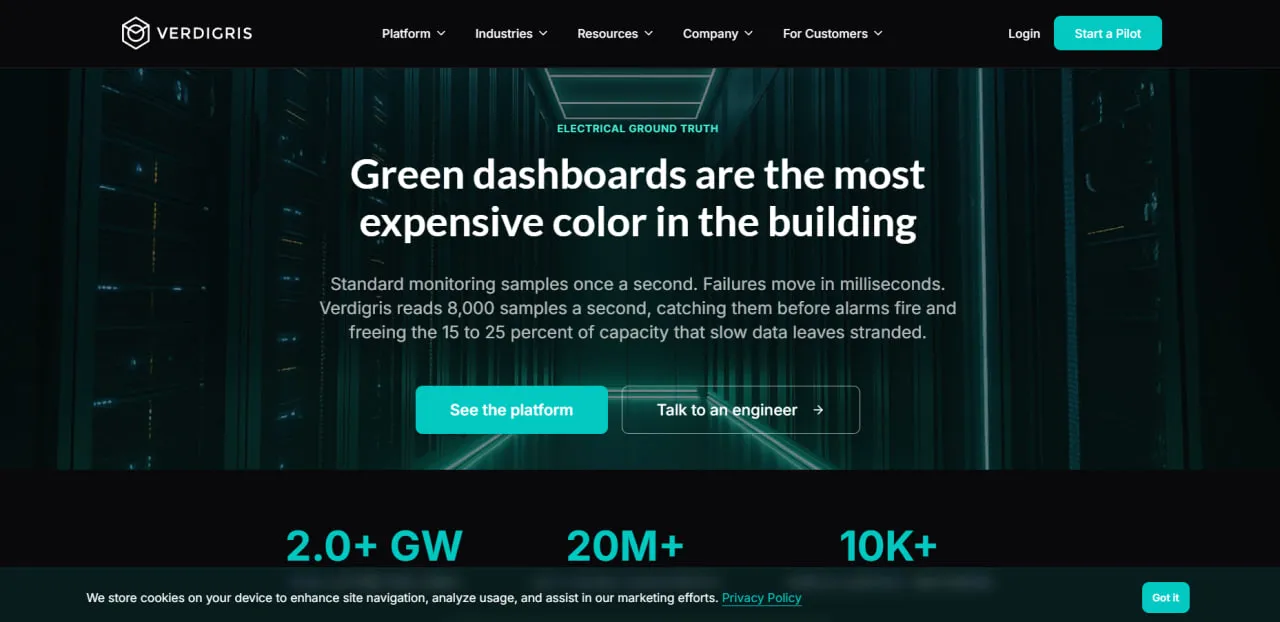
A typical building management system (BMS) polls power once a second. That is enough for billing and trend charts, but at that rate a 200-millisecond harmonic spike from an aging UPS rectifier looks like a normal reading, and operators who hold circuits at 60 to 80% of nameplate as a safety margin have no measured basis for loading them further.
Verdigris addresses both gaps for AI, colocation and enterprise data centers. Its meters record each circuit’s waveform continuously, and its software flags degrading equipment and works out how much headroom each circuit really has. At T-Mobile, it found 4% of the UPS rectifier fleet degrading while the BMS had raised no alarm, up to 21 days before failure. It is not a solar PV monitoring tool, and its dedicated hardware makes little sense for small offices or homes.
Pros and Cons
Pros
- Catches degradation that once-a-second BMS polling misses, giving weeks to plan a UPS repair instead of reacting to an outage.
- Non-invasive clamp-on installation with no downtime on the monitored circuits; at T-Mobile, each gateway took roughly two hours to install.
- Can defer electrical build-out: one operator recovered 1 MW of stranded capacity at a single facility, worth $8M to $14M in deferred capital spending by Verdigris’s estimate.
- Flexible buying: Cloud is an OpEx subscription with hardware financed, Forge a CapEx license, and both can be combined with Sentinel under one contract.
- Starting prices and a deployment cost estimator are published openly, with no email required.
Cons
- Requires the installation of proprietary hardware; the Cloud subscription bundles and finances it, but the Forge license means buying it upfront.
- Published prices are only starting points (from $25,000 per MW per year), so a firm budget still requires a scoping call with Verdigris engineers.
- Little to offer small offices or homes; the payoff depends on large UPS fleets and capacity-constrained data halls.
- Automated degradation detection is shipped only for UPS systems so far; transformers, generators, switchgear and cooling plant are still on the roadmap.
Features
Real-Time Circuit-Level Monitoring
Each EV2 meter records 14 three-phase or 42 single-phase circuits at 8,000 samples per second, with four voltage channels (100 to 480 Vac) and a current range of 0.25 A to 15,000 A.
Automated Fault Detection
The Signals module tracks 5th- and 7th-order harmonic distortion, the band that carries a degrading UPS rectifier’s signature, and flags units that standard BMS alarms miss.
Predictive Maintenance Insights
Alerts reach the Verdigris inbox within 30 seconds of detection, so a flagged unit can be serviced in a planned window instead of after an outage.
Energy Usage Analytics and Reporting
Logs energy, real and reactive power, power factor and total harmonic distortion for every circuit, with automated reports on consumption trends.
Demand Response Management
Supplies the sub-second circuit data and validated limits that your own control system or grid-response platform uses to decide which loads to curtail.
Customizable Dashboards
A web app for KPIs, historical trends and live alerts that also works in phone and tablet browsers.
Capacity Planning Tools
Sets validated operating limits for each circuit from measured data instead of nameplate derating, keeping an 8% margin below nameplate; Verdigris targets 15 to 25% recovery of stranded capacity.
Verdigris Pricing
Verdigris publishes starting prices on its website: the Cloud subscription starts at $25,000 per MW of monitored capacity per year with hardware bundled, sites under 1 MW pay from $2,500 per gateway per year, and the Forge perpetual license starts at $193,000 per MW in year one plus 18% annual maintenance. The Sentinel tier for regulated workloads is quote-only. The online estimator puts Cloud at roughly $27,000, $44,000 or $96,000 per MW per year for light, mid and heavy usage, and 1-year and 3-year commitments cut the rate by 10% and 15%, but these are order-of-magnitude figures: final prices are set on a scoping call.
Potential users can start with a no-commitment pilot at one facility (5 gateways, 30 to 90 days) or talk to an engineer. In Verdigris’s own T-Mobile case study, monitoring 800+ UPS rectifiers delivered up to 6:1 return on investment (ROI) and a 5-month payback. Data center operators can also request a free four-week Rectifier Health Audit, which installs two Verdigris Pro Gateways (theirs to keep) and requires no hardware commitment.
Integrations
Verdigris’s own data comes from EV2 hardware, but the platform also ingests readings from Schneider, Honeywell, Eaton or Vertiv meters already on site, so most brownfield sites need no custom integration work:
- Building Management Systems (BMS): Connects over BACnet, Modbus, REST or MQTT, both to pull in existing meter data and to feed validated limits to BMS, DCIM and control systems.
- API Access: REST API and webhooks, documented publicly at docs.verdigris.co without an NDA, plus CSV export; alerts can also open ServiceNow work orders or go to Slack and Prometheus/Grafana.
- Cloud Infrastructure: Runs as a cloud-based web application, and Verdigris holds SOC 2 Type II certification; the Sentinel tier adds ISO 27001 and NIST 800-53 controls and is FedRAMP-ready for regulated workloads.
- Hardware Compatibility: EV2 is certified for use in 38 countries, but its 4G connectivity partners cover only the US; elsewhere, gateways connect over Wi-Fi or Ethernet.
How to Set Up Verdigris
- Start with a pilot or the free Rectifier Health Audit; Verdigris engineers go through your single-line diagrams to scope the deployment and agree on success metrics.
- Receive the IoT energy data gateways and sensors tailored to your facility’s panel configuration.
- Have a qualified electrician mount the gateway on the panel, clamp the current sensors onto the circuits and connect the voltage taps. The served circuits normally stay in service.
- Connect the data gateways to the internet through Wi-Fi, Ethernet, or a cellular connection.
- The installer validates and activates each gateway in the Verdigris mobile app; circuit data then appears in the web dashboard from the first day.
- Configure alerts, custom reports, and user access levels for your facility team.
How to Use Verdigris
Day to day, the critical-facilities team works from the alert inbox. A typical alert names a specific UPS rectifier whose harmonic signature is drifting; an engineer reviews the waveform, confirms the root cause and schedules the unit for maintenance before any alarm trips.
Capacity planning runs on a longer cycle. Before adding GPU racks to a hall, planners check each circuit’s measured peak against its validated operating limit rather than the nameplate derate. Monthly, circuit-level consumption feeds cost-allocation reports, and after an outage, sites with EV2 Pro meters have an event-triggered, sub-second waveform record for the investigation.
What You Can Manage with Verdigris
- Energy Intelligence Dashboards: Visual summaries of real-time and historical electricity usage.
- Equipment Health Records: Logs of identified faults and degradation patterns for predictive maintenance.
- Cost Allocation Reports: Breakdowns of energy spending by circuit, department or tenant.
- Capacity Headroom: Safe limits for each circuit in amps and kW, also available through the API.
- Carbon Footprint Tracking: Data exports for Scope 2 emissions reporting and LEED certification support.
- Peak Load Alerts: Notifications that help avoid expensive utility demand charges.
FAQs
What does Verdigris do?
Verdigris monitors data center electrical systems circuit by circuit at 8,000 samples per second. Its software flags degrading equipment, starting with UPS rectifiers, before standard BMS alarms fire, and calculates how much spare capacity each circuit actually has.
Who is Verdigris best for?
The tool is best suited for operators of data centers, including AI, colocation and enterprise facilities; for manufacturing plants, hotels and commercial offices, Verdigris now refers new projects to its partner EnergyHUB 360. It is most useful to teams that maintain large UPS fleets or need to add load to halls that look full on paper.
Is Verdigris free?
No. Verdigris is sold as a Cloud subscription or a Forge perpetual license, with no free plan. However, data center operators can request a free four-week Rectifier Health Audit that flags at-risk UPS rectifiers, with no hardware commitment.
What are the main limitations of Verdigris?
Verdigris needs its own hardware installed by an electrician, and pricing starts at $25,000 per MW per year, with final figures set only on a scoping call. The software measures and alerts but does not control loads, its coverage roadmap lists only UPS systems as shipped for degradation detection, and 4G connectivity is offered only in the US. New commercial and industrial building projects go to partner EnergyHUB 360.
What are the best alternatives to Verdigris?
For data center power monitoring, the closest peers are Schneider Electric EcoStruxure (notably EcoStruxure IT) and the DCIM and power-monitoring tools from Vertiv and Eaton. Siemens Insights Hub (formerly MindSphere) and ABB Ability are broader industrial IoT platforms. For commercial buildings, Panoramic Power and Wattics, part of EnergyCAP since 2022, are closer fits.


