
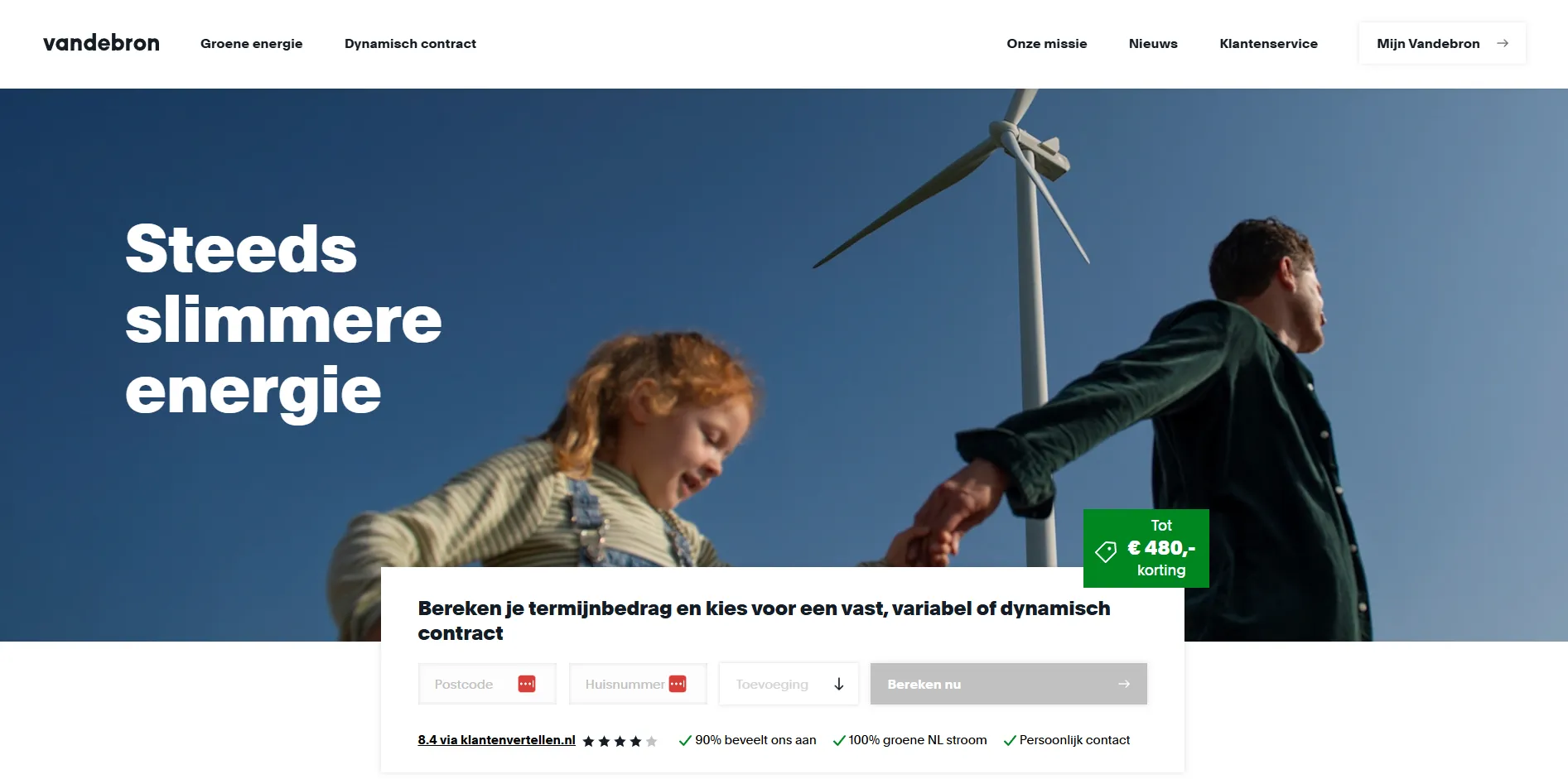
What Is Vandebron Platform?
Vandebron Platform is a Dutch green energy marketplace run by a licensed supplier: customers pick the wind, solar or bioenergy producer in the Netherlands whose power they buy. Vandebron started supplying in 2014, is based in Amsterdam, has about 200,000 customers and has belonged to Essent (E.ON group) since 2019 while trading under its own brand.
It fits Dutch households, EV owners with a home charger and small businesses using up to 50,000 kWh a year; larger commercial users and anyone outside the Netherlands cannot sign up. Wind and solar parks producing at least 250 MWh a year can sell through Vandebron, which also handles their balancing, curtailment and PPAs.
Pros and Cons
Pros
- You know which Dutch producer your money goes to, not a mix made green with certificates.
- Local producers get above-market prices for their guarantees of origin.
- Smart Charging lowers EV charging costs and eases grid peaks without daily effort.
- One app for usage, costs, advance payments and Smart Charging.
- On a dynamic contract, moving laundry, heating or EV charging to cheap hours can cut the bill.
- Park owners get PPAs, balancing, congestion services and curtailment from one partner.
Cons
- Netherlands only; business contracts stop at 50,000 kWh a year.
- Pricing can be difficult to understand due to multiple fees and contract types.
- Solar feed-in fees may reduce returns for households exporting excess electricity.
- The dynamic contract, and with it Smart Charging, requires a smart meter.
- On the dynamic contract, solar exports are paid at the hourly price, which can turn negative.
- Customer support can be slower during volatile energy market periods.
Features
Energy Marketplace
Profiles of Dutch wind, solar and bioenergy producers; you choose the one your electricity comes from.
Smart Charging
Schedules charging at your own home charger into low-price hours and pauses the session when prices rise.
Usage Insights
The Vandebron app (iOS and Android) shows electricity and gas usage and costs.
Curtailment Management
Producers’ wind and solar parks are turned down at negative prices; the household solar curtailment pilot has ended.
Dynamic Contracts
Hourly electricity prices that follow the wholesale market, visible in the app.
Gas with Local Investment
Gas contracts include a small extra contribution per m³ that Vandebron invests, with Trees for All, in planting trees, food forests and hedgerows in the Netherlands.
Blockchain Pilot
In 2017–2018 Vandebron tested blockchain-recorded EV flexibility with TenneT and IBM; today its producer marketplace is a supplier-run form of peer-to-peer trading that does not use blockchain.
Vandebron Platform Pricing
Vandebron separates energy costs from its fixed monthly supply costs. The final price depends on the selected producer, contract type, energy usage, and applicable Dutch taxes and grid charges.
No Traditional Free Trial: Energy supply contracts do not usually include a free trial.
Monthly Service Fee: Customers pay fixed monthly supply costs (vaste leveringskosten) on top of their energy use; Vandebron says it makes no margin on electricity consumption.
Fixed Contracts: Rates are locked for 1, 2 or 3 years; leaving early costs an exit fee.
Variable Contracts: Rates follow the market and change, in principle, every three months.
Dynamic Contracts: Billed at each hour’s wholesale-based price; requires a smart meter.
Feed-In Fees: Solar owners pay terugleverkosten on exported power (Vandebron was the first Dutch supplier to charge them, in August 2023); they weigh more once net metering ends on 1 January 2027.
Integrations
- Home EV Chargers: Vandebron sells home chargers with installation; Smart Charging requires one at home.
- Tesla: Tesla Model S, 3, X, Y and Cybertruck are supported for Smart Charging, alongside models from Audi, BMW, Cupra, Hyundai, Kia, MINI, SEAT, Škoda, Volkswagen and Volvo.
- Smart Meters: Uses Dutch smart meter data for consumption tracking and dynamic pricing features.
- Producer Assets: Connects to the wind farms, solar parks and battery systems (BESS) of its producers and steers them in real time for curtailment and trading on day-ahead, imbalance and aFRR markets.
- Snowflake Data Cloud: Vandebron’s internal platform for reporting and analytics, not a connection customers use.
- Grid Operators: Vandebron is a certified balance responsible party, balancing service provider (with TenneT) and congestion service provider (with regional grid operators).
How to Set Up Vandebron Platform
- Visit the Vandebron website.
- Enter your postal code and estimated annual energy consumption.
- Review available renewable energy producers in your area.
- Pick a producer and a fixed, variable or dynamic contract.
- Complete the online registration form with personal and payment information.
- Allow Vandebron to manage the switch from your current energy supplier.
- Download the Vandebron app and log in to monitor your energy usage.
How to Use Vandebron Platform
Day to day, customers use the Vandebron app or the Mijn Vandebron web portal to check electricity and gas usage and costs and to change the monthly advance payment.
On a dynamic contract, hourly prices show when to run appliances or charge an EV. EV owners with a dynamic contract, a home charger and a supported car can enable Smart Charging in the app, which schedules charging into the cheapest hours (often also the greenest) and pauses it when prices rise; a pilot extends it to fixed-contract customers.
Producers sell their output through Vandebron, which trades it and handles balancing and curtailment; their producer profile is how consumers find them.
What You Can Manage with Vandebron Platform
- Renewable energy source selection.
- Monthly advance payments.
- Electricity and gas consumption tracking.
- Dynamic electricity pricing.
- EV Smart Charging sessions.
- Solar feed-in activity.
- Gas supply with the Lokaal investeren contribution to Dutch nature projects.
- Energy cost history.
- Contract type: fixed, variable or dynamic.
FAQs
What does Vandebron do?
Vandebron is a Dutch green energy supplier that lets customers choose the local producer they buy from, with dynamic hourly tariffs and EV Smart Charging. Park owners also use it for PPAs, balancing and curtailment.
Who is Vandebron best for?
Households and small businesses in the Netherlands that want to know which park supplies them, and EV owners who can leave charging to the cheapest hours. Businesses above 50,000 kWh a year and customers abroad are not served.
Is Vandebron free?
No. Customers pay for electricity or gas usage, monthly service fees, grid charges, taxes, and any applicable feed-in or contract-related costs.
How much does Vandebron cost?
Fixed monthly supply costs plus usage at a fixed, variable or dynamic rate, grid charges and energy tax. Vandebron’s dynamic electricity price averaged €0.24–0.34 per kWh from November 2025 to October 2026, including energy tax but before fixed costs and grid charges.
What are the main limitations of Vandebron?
The main limitations are Netherlands-only availability, pricing complexity, solar feed-in fees, and the need for smart meter data to access advanced features such as the dynamic contract and Smart Charging.
What are the best alternatives to Vandebron?
Popular alternatives in the Netherlands include Greenchoice, Pure Energie and Powerpeers; SunContract follows a similar peer-to-peer model but operates in Slovenia rather than the Netherlands.


