
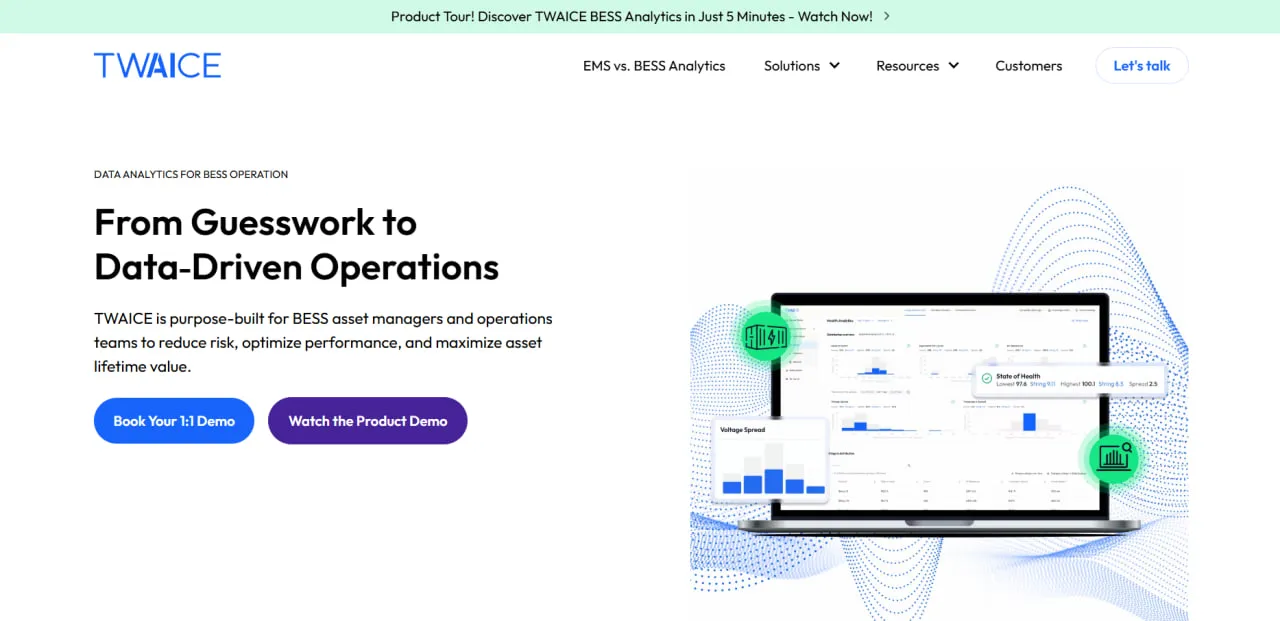
What Is TWAICE?
TWAICE builds digital twins of lithium-ion batteries to model how they age and perform. It works as an independent analytics layer on top of the battery management system (BMS) and the site EMS (Energy Management System): it reads their data but does not control dispatch or charging. The platform now serves only battery energy storage owners and operators; EV work runs through TWAICE’s separate Battery Experts business for battery makers and EV manufacturers.
Where a BMS handles immediate control and safety limits, TWAICE uses battery models and AI to follow aging, usable energy and remaining useful life over the long term. Founded in 2018 as a Technical University of Munich spin-off and headquartered in Munich, the company has raised about $90 million in venture funding, plus a €24 million venture-debt loan from the European Investment Bank in February 2026. BESS customers include Verbund and BW ESS; in its earlier EV-focused years it also counted Audi and Mercedes-Benz as customers.
TWAICE is analytics software for battery energy storage systems (BESS). It turns the data a storage site already produces into answers to an asset manager’s routine questions: how fast the batteries are aging, how much energy is lost to imbalance or offline racks, which racks show early safety warnings, and whether the site runs within its warranty terms.
It is built for IPPs, utilities and O&M providers running large storage sites, such as BayWa r.e., the O&M provider for the 137.5 MW / 282 MWh Alfeld BESS in Lower Saxony. It is not meant for home batteries or a single small system: pricing is quote-only, and setup needs a data pipeline from the BMS or SCADA system built with TWAICE engineers.
Pros and Cons
Pros
- An independent read on battery health, separate from the supplier’s own BMS figures, which matters in warranty disputes.
- Puts a number on lost energy: TWAICE reports an average 5% gain in recoverable energy across customer deployments (vendor figure).
- Severity-ranked safety alerts with recommended actions tell O&M teams which rack to inspect first.
- Proven at portfolio scale: TWAICE says it has analyzed more than 20 GWh of BESS across 120+ projects.
- Supplier- and chemistry-independent, so a portfolio built with batteries from several makers is measured with one set of KPIs.
- Storage customers include Verbund, BW ESS and Second Foundation, which uses it across a 500+ MWh multi-site portfolio.
Cons
- No public pricing, free plan or self-serve trial; every evaluation goes through sales.
- Primarily focused on large-scale enterprise users, making it less accessible for small projects.
- Setup depends on data access: the BMS or SCADA system must deliver continuous, high-resolution data.
- Analytics only: it does not control dispatch or charging, so it runs alongside the BMS and EMS rather than replacing either.
Features
Continuous Battery Health Monitoring
Tracks state of health (SoH) and state of charge (SoC) over time; TWAICE’s own SoC estimate can be compared with the BMS value to expose SoC errors.
Safety Monitoring and Alerts
Watches internal resistance, temperature trends and imbalance for early signs of thermal runaway and ranks issues as high, medium or low severity, each with a recommended response.
Usable and Recoverable Energy Analysis
Shows energy lost to imbalances, weak cells or offline strings and racks, and recommends fixes such as rebalancing or replacing components.
Warranty Management
Tracks 15+ KPIs, including availability, round-trip efficiency (RTE) and SoH, filtered to mirror the supplier’s warranty terms; flags breaches and keeps an audit trail for claims.
Digital Commissioning
Adds an independent report with SoH, capacity and RTE baselines to site acceptance testing, before a new BESS enters commercial operation.
Predictive Simulation Models
Aging models that test trading load profiles and stress factors (depth of discharge, temperature, SoC window, C-rate), benchmark cells and check suppliers’ data.
Automated Reporting
Standardized portfolio reports and role-based dashboards replace reports assembled by hand.
TWAICE Pricing
TWAICE does not publish prices; quotes depend on deployment size (for example, MWh of storage connected) and the modules chosen. There is no free plan or self-serve trial: the route in is a one-to-one demo or a 30-minute live group demo.
Integrations
TWAICE is a cloud service that needs read access to battery data at cell, module, string and PCS level from the site’s BMS or SCADA system.
- Industrial Protocols and Data Sources: Takes in battery data from the site’s data acquisition system through cloud-to-cloud integrations or APIs.
- BMS and EMS Integration: The Error Codes feature collects native BMS, PCS and HVAC alarms in one view, grouped by component and sorted by severity.
- Cloud Infrastructure: Built for high-volume BESS time-series data; TWAICE has held ISO 27001 information-security certification since October 2024.
Few third-party integrations are named publicly: a Modo Energy link converts recoverable energy into estimated real-time-market revenue for ERCOT and UK sites (TWAICE cites Modo data putting 1% more availability at about $2,000 per MW a year), and the TWAICE Reporting API, a REST API launched in April 2026, brings TWAICE KPIs into internal dashboards.
How to Set Up TWAICE
- Book a demo so the TWAICE team can review your storage sites and what you need from the analytics.
- Go through a technical assessment to confirm your BMS or SCADA system can deliver the data TWAICE needs.
- Collaborate with TWAICE engineers to set up the data pipeline and configure your digital twins.
- Access the cloud platform and customize your dashboards, alerts, and KPI thresholds.
- Onboard your asset management or O&M teams through TWAICE-guided training.
How to Use TWAICE
A typical day starts with the portfolio’s health status and open alerts, highest severity first. If a rack shows an unusual temperature trend, an engineer opens it in Data Explorer and plots its sensors alongside TWAICE KPIs to find the root cause.
Operations teams use Performance Manager to see where rebalancing pays off: when “Recoverable Energy” shows capacity lost to cell imbalance, they schedule the work. Automated reports then show stakeholders whether each site stayed within warranty limits and met its revenue targets.
What You Can Manage with TWAICE
- Battery Health Records: SoH history and current status for every site, usable as an independent record for suppliers, investors or insurers.
- Warranty Compliance: Data-backed tracking of cycling limits and temperature exposure.
- Maintenance Schedules: Proactive planning based on predictive health alerts rather than fixed intervals.
- Revenue Performance: Usable energy and availability per site, the two figures that set how much a storage asset can earn.
- Safety Logs: A history of detected safety anomalies with their severity and the recommended action.
- ROI Forecasts: Simulations of how different market strategies will affect long-term battery degradation.
FAQs
What does TWAICE do?
TWAICE is analytics software for battery energy storage systems. It uses digital twins of the batteries to track state of health, recoverable energy, safety anomalies and warranty compliance across a portfolio. EV work now runs through TWAICE’s separate Battery Experts business.
Who is TWAICE best for?
BESS asset managers, O&M teams, independent power producers (IPPs) and utilities with several large storage sites. For a home battery or a single small system, the setup work and quote-only pricing are hard to justify.
Is TWAICE free?
No. There is no free plan or self-serve trial; you can book a demo, but using the platform requires a paid subscription or license.
How much does TWAICE cost?
The cost is not publicly disclosed as it depends on the scale and complexity of the user’s assets. Custom quotes are provided after a consultation with the sales team.
What are the main limitations of TWAICE?
It only analyzes; dispatch and charging stay with the EMS. It needs continuous, high-resolution data from the BMS or SCADA system, and quote-only pricing makes it a poor fit for owners of a single small battery.
What are the best alternatives to TWAICE?
Common alternatives in the battery analytics and energy management space include ACCURE Battery Intelligence, volytica diagnostics, and specialized modules within broader EMS platforms like Schneider Electric EcoStruxure.


