
What Is Tesla Autobidder?
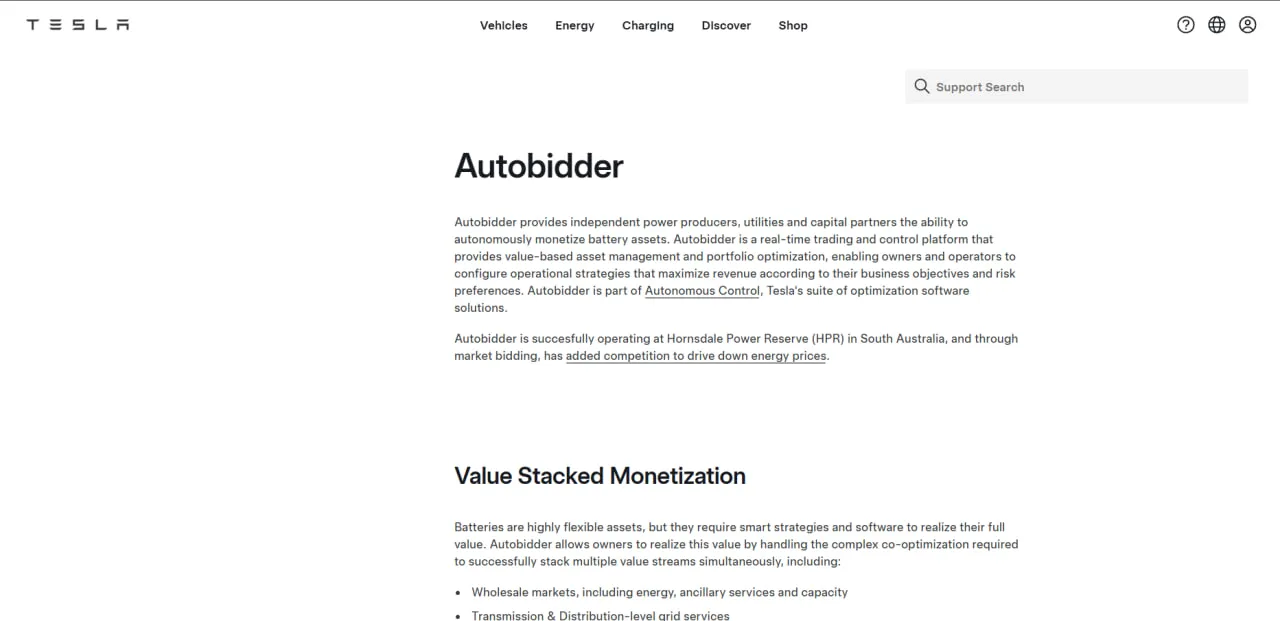
Autobidder is a real-time trading and control platform, listed in this catalog under Battery Monitoring and Energy Management Systems (EMS). For each Megapack site it decides when to charge, hold, or discharge, turns that plan into market bids, and dispatches the battery against them, revising the plan as prices move.
The main lever is value stacking: committing the same battery to several services at once, such as frequency regulation and energy arbitrage, instead of chasing a single revenue stream. Tesla reports more than 8 GWh across more than 30 projects under Autobidder; reference sites include the Hornsdale Power Reserve in South Australia and a 125 MW/250 MWh Megapack project in North Texas (ERCOT).
Tesla Autobidder is the software that trades Tesla Megapack batteries in wholesale electricity markets. Tesla sells it as a managed revenue-optimization service, not a self-serve trading tool: the owner sets business objectives and risk preferences, and an in-house Tesla team of machine-learning and optimization engineers oversees performance.
It suits independent power producers, utilities, and capital partners that own or are developing Megapack projects for wholesale markets. It is not for owners of other battery brands or of Powerwall systems, for trading desks that want to run their own algorithms or see inside the strategy logic, or for buyers who need on-premise software.
Pros and Cons
Pros
- Tesla says Autobidder-optimized sites consistently rank in the top quartiles of their markets for revenue.
- Returned over $330 million in trading profit to early storage investors, according to Tesla (2023).
- One Tesla contract covers hardware, operations and maintenance, and trading, with no hand-off between battery vendor and optimizer.
- Runs 24/7 under Tesla’s oversight, so owners need no round-the-clock trading desk of their own.
- Optional revenue guarantee backed by Tesla’s balance sheet gives lenders contracted revenue and improves project debt ratios.
- Sites keep their standard storage warranties and maintenance agreements under Autobidder.
- Runs in very different markets, from Australia’s NEM to Texas’s ERCOT, with more than 8 GWh across 30+ projects.
Cons
- Sold as a service for Tesla Megapack projects; Tesla does not advertise support for third-party batteries, so a mixed-brand fleet needs a second optimizer.
- Owners set objectives and risk limits but cannot run their own algorithms or see inside the strategy logic.
- No public pricing, and the fee is often folded into the Megapack agreement, so it is hard to benchmark against independent optimizers.
- Cloud-only deployment may not suit utilities requiring on-premise control systems.
- The entry ticket is a utility-scale Megapack project; Powerwall and other residential owners cannot buy Autobidder.
Features
Price, Load, and Generation Forecasting
Machine-learning forecasts of energy prices, load, and generation are the starting point for every bid and dispatch decision.
Dispatch Optimization
Chooses when to charge and discharge for the highest value, counting battery degradation as a cost of each cycle.
Value-Stacked Monetization
Co-optimizes wholesale energy, ancillary services and capacity, transmission- and distribution-level grid services, renewable firming and shaping, and bilateral contracts on the same asset.
Automated Market Bidding
Bids continuously in day-ahead, real-time, and continuous markets where they exist, within parameters a human operator sets and adjusts.
Warranty Protection Management
Counts warranty and maintenance-agreement terms in the cost of every potential action, so trading stays within the battery warranty.
Smart Bidding Algorithms
Adapts to the rules of each new market or service and keeps improving from operating data.
Tesla Autobidder Pricing
Tesla does not publish Autobidder pricing; for a figure, contact Tesla’s Autobidder team directly. Tesla is the single contracting entity for Megapack hardware, operations and maintenance, and revenue optimization, so the Autobidder cost is often folded into the wider project financing and service agreements. An optional revenue guarantee, backed by Tesla’s balance sheet, sets a minimum annual revenue for the project plus a share of the upside; Tesla markets it as bankable and says it improves project debt ratios.
Integrations
- Tesla Hardware Integrations: Directly integrated with Tesla Megapack, the hardware Tesla now sells Autobidder for; Tesla has also used it to dispatch aggregations of residential batteries.
- Market Operator Interfaces: Integrates directly with electricity market and system operators, such as ERCOT in Texas and AEMO in Australia.
- Opticaster: Tesla’s on-site optimization engine, enabled on every Megapack, draws on the same library of forecasting and dispatch-optimization algorithms as Autobidder.
- APIs: Interfaces with market operators, network providers, and customer networks via secure web APIs; site data can also be pulled through Tesla’s Powerhub API or exported for in-house reporting.
How to Set Up Tesla Autobidder
- Contact the Tesla Energy sales team to initiate a site audit and project feasibility study.
- Purchase and install Tesla Megapack energy storage hardware.
- Commission the Megapack site and its communication link to Tesla’s cloud, where Autobidder is hosted.
- Configure business objectives, risk preferences, and operational constraints within the platform.
- Link the system to the relevant local energy market operator for automated bidding.
- Monitor performance through the centralized dashboard as the system begins autonomous dispatch.
How to Use Tesla Autobidder
Day to day, an asset manager supervises rather than trades. Autobidder places the bids, so users rarely enter trades by hand; they review real-time performance and revenue in the dashboard and use portfolio views to see how each site performs against market forecasts.
When market rules or conditions change, managers adjust the high-level strategy rather than individual bids, for example choosing a more conservative risk preference so the battery cycles less during extreme price volatility. The platform’s reports also feed financial audits and sustainability tracking.
What You Can Manage with Tesla Autobidder
- Energy Storage Portfolios: One Megapack site or a multi-site portfolio, optimized together and reviewed from one dashboard.
- Market Bidding Strategies: The business objectives, risk preferences, and operating constraints that bound what Autobidder bids.
- Revenue Streams: Energy arbitrage, frequency response, and spinning reserves, run side by side on the same battery.
- Battery State of Health: Tracking of degradation, cycles, and warranty status.
- Financial Performance Reports: Real-time data on trading profits and operational costs.
- Grid Compliance: Automated adherence to local grid codes and market participation rules.
FAQs
What does Tesla Autobidder do?
It bids Tesla Megapack batteries into wholesale electricity markets and dispatches them, using machine-learning forecasts of prices, load, and generation to maximize the owner’s revenue. Tesla runs it as a managed service, with in-house engineers overseeing performance.
Who is Tesla Autobidder best for?
Independent power producers, utilities, and capital partners that own or are developing Tesla Megapack projects in wholesale markets. It fits best when the owner wants Tesla to handle hardware, operations and maintenance, and market trading under one contract, or needs a revenue guarantee to finance the project.
Is Tesla Autobidder free?
No. Tesla sells Autobidder as a paid service for Megapack projects and quotes it per project, often inside the wider hardware and service agreement. There is no public price list and no free trial.
What are the main limitations of Tesla Autobidder?
The main one is lock-in: Tesla sells Autobidder as a revenue optimization service for Megapack projects and does not advertise support for third-party batteries. It runs only on Tesla’s cloud, with no on-premise option, and owners set objectives and risk limits rather than running their own algorithms or inspecting the strategy logic.
What are the best alternatives to Tesla Autobidder?
Common alternatives for energy storage optimization include Habitat Energy PowerIQ, Fluence Mosaic, and Stem’s PowerTrack Optimizer (formerly Athena). When comparing them, check the two points where Autobidder is most restrictive: support for non-Tesla batteries and how much of the trading logic the owner can see and control.

