
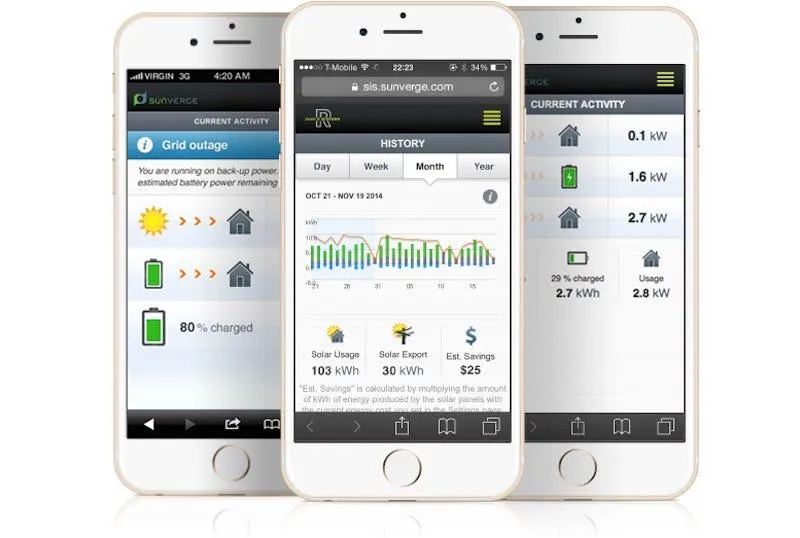
What Is Sunverge Energy Platform?
Sunverge sold the platform as cloud SaaS with an edge-to-cloud design. A Sunverge Infinity edge controller at each site handles real-time local control of the battery, solar and connected loads, while the cloud layer forecasts, optimizes and dispatches the whole fleet as one grid-aware resource.
Its customers were utilities and retail energy providers using customer batteries for peak load management, frequency regulation and price-based dispatch. SMUD aggregated 34 storage systems for automated demand response; Con Edison, Arizona Public Service, Consumers Energy in Michigan, Puget Sound Energy and Toronto’s Alectra Utilities also ran projects on it, and PG&E piloted it with LG Electronics and Eaton.
Sunverge says its first real-time VPP combining load control, energy storage and distributed solar launched in 2012. In August 2024, Budderfly bought the platform from Sunverge Energy (an asset deal, not the company), and the sunverge.com site is no longer online.
Sunverge Energy Platform is cloud software for running Virtual Power Plants (VPPs) and distributed energy resource management (DERMS) on behind-the-meter assets: home batteries, rooftop solar, EV chargers and smart loads. A utility or energy retailer enrolls customer systems and dispatches them for peak reduction or frequency regulation, while the platform keeps enough charge in each battery for the household’s backup power.
The platform was built for utilities and retail energy providers, and today it makes most sense for those already running a Sunverge-based program: since Budderfly bought it in 2024, it has lost its product website and has no public sales channel. It is not for homeowners, who could only ever join through a utility or retailer program, or for commercial sites looking for a DERMS license of their own.
Pros and Cons
Pros
- Utility VPP projects since 2012 in eight US states, Canada and Asia-Pacific.
- Homes keep backup power through grid and internet outages, because control runs on site.
- Serves utility and household at once: SMUD customers saw about 15% extra bill savings over solar alone.
- No lock-in to one battery brand: Infinity also runs third-party batteries and inverters.
- Fast enough for frequency regulation and contingency reserves, not only scheduled peak shaving.
- Solar, batteries, smart loads and EV chargers in one program, not separate device-specific tools.
Cons
- Not sold to homeowners or small businesses; households joined only through utility or retailer programs.
- Full real-time control needs an Infinity controller at every site, adding hardware cost per home.
- Setup requires professional assessment, integration, and utility-grade commissioning.
- Public pricing information is unavailable, making initial budgeting difficult.
- Uncertain future: sunverge.com is offline and there is no public documentation, demo or sales channel.
Features
Real-Time DER Control
Near-real-time, automatic control of each enrolled device, so the fleet responds to grid events and price signals without an operator in the loop.
Virtual Power Plant Aggregation
Groups individual residential or commercial battery systems into a single virtual resource that utilities can dispatch to reduce peak demand or provide frequency support.
Multi-Objective Optimization
Weighs goals on both sides of the meter at once, such as a household’s bill savings and backup reserve against the utility’s calls for grid services.
Dynamic Pricing Support
Charges batteries when power is cheap and discharges them into expensive peaks, following day-ahead or hourly prices; Con Edison’s project used NYISO price signals sent every 24 hours.
Grid-Edge Intelligence
The Sunverge Infinity controller makes decisions on site, so a home keeps backup power through grid and internet outages.
Predictive Analytics
Learns consumption and generation patterns to forecast future energy needs, helping customers manage demand charges and peak load.
EV Charging Orchestration
Schedules home EV charging to limit its load on local distribution feeders; later releases added vehicle-to-home (V2H) and vehicle-to-grid (V2G) control.
Sunverge Energy Platform Pricing
Pricing is not public. With sunverge.com offline, any inquiry about licensing the platform has to go to its owner, Budderfly.
Expect a deployment to combine:
Hardware costs for Sunverge Infinity edge controllers.
Implementation and commissioning fees for integration with utility systems.
Recurring SaaS subscription fees; Sunverge priced per connected node (home or site), with a base platform fee plus consumer, grid-services and wholesale-market modules.
Additional costs for custom integrations, analytics, and ongoing technical support.
Integrations
- Energy Storage SystemsAnnounced integrations with Panasonic EverVolt (2021) and the LG Electronics home ESS (LG inverter with an LG Chem battery); Sunverge’s own earlier systems used Schneider Electric XW inverters.
- EV Charging InfrastructureResidential EV charger and smart-breaker control through a collaboration with Eaton, expanded in March 2023.
- Grid and Utility ProtocolsSupports CIM-based utility standards (IEC 61850, IEC 61968 and IEC 61970) for integration with DMS, ADMS, EMS and wholesale market management systems.
- Utility SystemsAPI connections to SCADA, billing and other utility back-office systems, alongside the CIM interfaces above.
- Budderfly EcosystemBudderfly uses the platform to aggregate DERs across its commercial customer sites; its VPP has been active in CAISO, ISO-NE, PJM and SPP since June 1, 2025.
How to Set Up Sunverge Energy Platform
- Ask Budderfly, the platform’s owner, whether it will support your program; if it will, start with an assessment of grid requirements and candidate sites.
- Design a pilot or full-scale deployment plan that identifies the types of distributed energy resources to be aggregated.
- Install Sunverge Infinity edge controllers and compatible battery or EV charging hardware at participating sites.
- Integrate the cloud platform with the utility’s existing management, SCADA, and billing systems through APIs.
- Configure VPP parameters, including optimization objectives, pricing signals, backup requirements, and alert thresholds.
- Test device communications and control commands during the commissioning process.
- Launch the orchestration workflow to begin aggregating and dispatching connected resources.
How to Use Sunverge Energy Platform
Day to day, utility operators work from a fleet dashboard showing real-time available capacity, state of charge across the network and the effect of any running demand-response event.
During a demand peak, an operator can trigger a discharge event across the VPP to relieve specific feeders. Between events, the platform dispatches on its own against configured price signals, grid conditions and optimization rules.
For the household, the system runs in the background, holding back enough battery charge for backup while the rest of the capacity serves the utility program.
Energy managers can use the reporting tools to analyze performance, verify peak-load reductions, and calculate the financial credits earned through grid participation.
What You Can Manage with Sunverge Energy Platform
- Virtual Power Plants: Aggregated groups of batteries and other resources operating as a single grid asset.
- Distributed Energy Resources: Individual solar arrays, battery systems, EV chargers, and flexible loads.
- Grid Services: Peak shaving, frequency regulation, contingency reserves, voltage support, demand charge management and demand response.
- EV Charging Infrastructure: Charging schedules and energy load management for residential EV chargers.
- Utility Billing Data: Energy usage, program participation, and DER performance data used for financial settlement.
- Fleet Analytics: Real-time and historical reports covering the health, capacity, availability, and efficiency of connected assets.
FAQs
What does Sunverge Energy Platform do?
Sunverge Energy Platform combines software and edge hardware to aggregate distributed energy resources, such as residential batteries, into a Virtual Power Plant. This allows utilities to manage grid demand in real time while helping consumers save money and maintain backup power.
Who is Sunverge Energy Platform best for?
It suits utilities, retail energy providers and grid operators running programs built on customer-owned batteries, solar and EV chargers. Since the 2024 sale to Budderfly, it fits best where a Sunverge-based program is already running. Homeowners and small businesses cannot buy it directly.
Is Sunverge Energy Platform free?
No. Sunverge sold it as a paid subscription priced per connected home or site, with a base platform fee and add-on modules, plus edge hardware. There is no free tier or public price list.
Does Sunverge Energy Platform support integrations?
Yes. Documented integrations include Panasonic EverVolt and LG Electronics home batteries, Eaton EV chargers and smart breakers, and utility SCADA, billing, DMS/ADMS and EMS systems through APIs, including CIM-based standards (IEC 61850, IEC 61968 and IEC 61970).
What are the main limitations of Sunverge Energy Platform?
The biggest is its status: since the 2024 sale to Budderfly, sunverge.com has gone offline and there is no public documentation, demo or sales channel. It was also sold only to utilities and retailers, and full real-time control needs Sunverge Infinity hardware at each site plus professional commissioning.
What are the best alternatives to Sunverge Energy Platform?
For utility programs built on customer-owned batteries, EVs and thermostats, the closest alternatives are EnergyHub and Generac Grid Services’ Enbala Concerto. Schneider Electric EcoStruxure covers grids, buildings and microgrids more broadly, and Tesla Autobidder trades and dispatches utility-scale Megapack batteries rather than managing home systems.


