
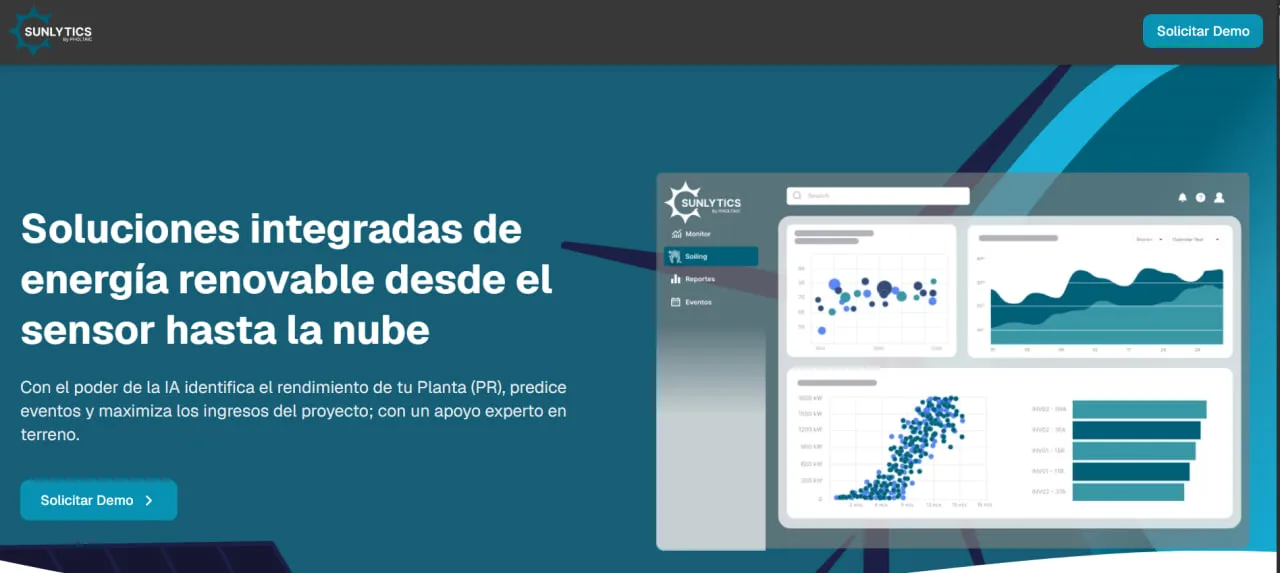
What Is Sunlytics?
Sunlytics is a cloud platform for monitoring operating photovoltaic plants. It combines on-site sensor readings with SCADA and field test data to calculate the plant’s performance ratio (PR) and availability, locate and quantify losses, and forecast generation.
Pholtaic works in Chile, Peru, Argentina and Bolivia with its own field engineers, and the portal and website are in Spanish. Sunlytics therefore fits owners and O&M teams of utility-scale and mid-size plants in those countries. It is not meant for residential or small commercial rooftops, or for buyers who need an English interface or published prices. The vendor’s two sites give different scale figures: the Sunlytics website cites more than 150 clients and over 7,500 MW of renewable assets managed, while Pholtaic’s company site lists more than 1,200 MW monitored.
Once a PV plant is running, the useful question is no longer how much it will produce but why it produced less than it should. Answering it takes reliable on-site weather data, a performance ratio you can trust and a way to tell a dirty array from a stuck tracker or an inverter derating in the heat.
Sunlytics is Pholtaic’s portal for that job. Pholtaic, a Santiago, Chile, supplier of measurement instruments and field services for solar and wind plants, works from the sensor up: it installs the weather stations and soiling sensors, and the portal turns their data into KPIs, fault reports and forecasts.
Pros and Cons
Pros
- One supplier installs, calibrates and analyzes the sensors, so data quality has a single owner.
- PR and availability come straight from the contract’s own formulas, ready to check against guarantees.
- Sensor faults are kept apart from real losses, so crews don’t chase problems that exist only in the data.
- Production forecasts help with electricity market participation.
- Local engineering and field support in Latin America.
Cons
- Interface and documentation are in Spanish.
- Offered together with Pholtaic’s hardware and services, with no public pricing or self-serve trial.
- No local field support outside Chile, Peru, Argentina and Bolivia.
- Not intended for residential or small commercial rooftop systems.
Features
Weather station monitoring
Real-time GHI and plane-of-array irradiance (front and rear side on bifacial plants), albedo, module temperature, wind speed and direction, rainfall, ambient temperature, humidity and pressure.
Automatic KPIs
The contract’s formulas are entered during onboarding, after which temperature-corrected PR (per IEC 61724-1), energy availability and the comparison with contractual values are calculated automatically.
Loss analysis by sector
PR and losses are broken down for each section of the plant.
Fault detection and diagnosis
Algorithms detect, quantify and diagnose anomalies such as tracker losses, disconnected strings, soiling, vegetation shading and inverter derating at high temperatures.
Fault classification
Separates data acquisition problems (sensors out of range, frozen or drifting) from real generation faults and from forecast errors.
Digital twin and forecasts
A digital replica of the plant compares actual output with the original yield estimate and predicts future generation from weather forecasts.
Sunlytics Pricing
Pholtaic does not publish prices for Sunlytics. The portal is sold with Pholtaic’s weather stations, sensors and field services rather than as a self-serve subscription, so quotes depend on plant size, sensor count and the services included. The process starts with a demo request on the Sunlytics website; there is no free plan or self-serve sign-up.
Integrations
Sunlytics combines data from hardware supplied and installed by Pholtaic, such as pyranometers, weather stations and the Dust-X soiling sensor, with the plant’s cloud SCADA, thermographic inspections and I-V curve measurements. The weather stations output Modbus RTU/TCP and can feed either the plant SCADA or Sunlytics. Data can be exported as CSV or pulled through an API by the owner’s analysts, and alerts notify the operations team about detected faults.
How to Set Up Sunlytics
- Request a demo through the Sunlytics website.
- Agree with Pholtaic on the sensors and weather stations needed at the plant.
- Connect the plant’s SCADA and other data sources to the portal.
- Enter the contractual KPI formulas together with the Pholtaic team.
- Set up users, alerts and reports for the O&M and asset management teams.
How to Use Sunlytics
Operators check the dashboard for current weather, power output and PR of each plant. When performance drops, the fault module shows where the energy is lost, for example a group of trackers stuck in the wrong position, disconnected strings or rising soiling losses, and how many megawatt-hours each problem costs. For soiling, it also shows the daily loss and the break-even point for the next panel wash.
Asset managers work in the KPI and forecast views: monthly PR and availability against contractual values, and the digital twin’s comparison of actual production with the original yield estimate. Plants that sell into the electricity market use the generation forecast to plan their output.
What You Can Manage with Sunlytics
- Plant performance: PR, availability and energy yield for each plant and plant sector.
- Faults and losses: Detected anomalies with their cause and energy impact.
- Contract KPIs: Automatic comparison with guaranteed performance values.
FAQs
What does Sunlytics do?
Sunlytics is a solar monitoring platform that tracks the performance of operating PV plants, calculates PR and availability, diagnoses losses and forecasts generation.
Who is Sunlytics best for?
It suits owners, asset managers and O&M teams of medium and large PV plants, especially in Chile, Peru, Argentina and Bolivia, where Pholtaic provides local field support.
Is Sunlytics free?
No. Pricing is quoted per project after a demo.
What are the main limitations of Sunlytics?
The platform and website are in Spanish, prices are not public, and on-site support covers only Chile, Peru, Argentina and Bolivia. Sunlytics is sold as part of Pholtaic’s sensor and service package, not as a self-serve subscription.
What are the best alternatives to Sunlytics?
Alternatives include Meteocontrol VCOM Cloud, Power Factors Drive, QOS Energy, Solytic and Solargis Monitor.


