
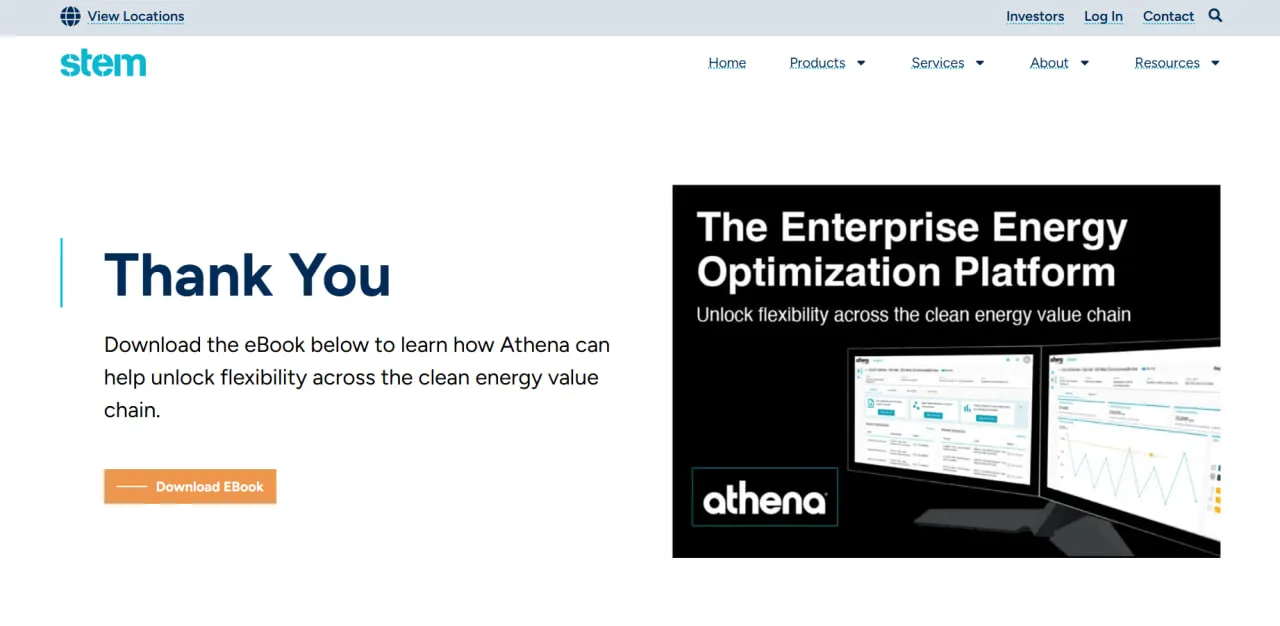
What Is Stem Athena?
Stem Athena is a cloud-based EMS for battery energy storage systems (BESS), including batteries paired with solar. It combines forecasting, value stacking, real-time dispatch and financial optimization: one battery can earn from several value streams (tariff management, energy arbitrage, demand response, wholesale markets), and Athena decides which one to serve. Stem also uses it for project valuation, modeling a battery’s expected returns before and during operation.
The architecture has two parts: an on-site edge controller connected to the battery and power conversion system (PCS), and Stem’s cloud, which combines equipment telemetry with weather feeds and utility pricing and sends dispatch commands back to the controller.
Stem Athena is the AI-based energy management system (EMS) that decides when a battery charges and discharges, weighing utility tariffs, weather forecasts and grid signals. Its status has changed twice: in September 2025 Stem renamed it PowerTrack Optimizer, and on November 16, 2026 Stem sold the Athena intellectual property to Voltus, Inc. for $10 million in cash. Stem now uses Athena only for its existing managed services customers, so new buyers should not expect to buy it from Stem.
Today Athena matters mainly to C&I businesses, independent power producers (IPPs) and utilities whose batteries already run on it under a Stem managed services contract. It does not suit teams that want to operate dispatch software in-house: Stem describes PowerTrack Optimizer as tools that experts on its Managed Services team use. If you need PV performance monitoring, that is the job of Stem PowerTrack; Athena handles solar only as part of dispatching hybrid solar-plus-storage sites.
Pros and Cons
Pros
- Stacks several value streams on one battery (demand charge cuts, energy arbitrage, demand response, wholesale markets) instead of optimizing for a single program.
- Hardware-agnostic, so a fleet with batteries and PCS units from different manufacturers can run under one EMS.
- Proven track record: Stem reports Athena supports more than 800 battery storage sites across North America and over 75 utility jurisdictions.
- Run by Stem’s Managed Services team, including market registration, scheduling and settlement tracking, so owners need no in-house trading or dispatch staff.
- Suits everything from single commercial sites to utility-scale storage projects.
Cons
- Lack of transparent, public pricing makes initial budgeting difficult for smaller operators.
- Not self-serve: Stem’s Managed Services team operates it, so it does not fit teams that want to run dispatch in-house.
- Deployment typically requires specialized hardware controllers and professional installation.
- Much of the value comes from demand response and grid programs, and Stem’s documented footprint for these is North America.
- Uncertain future: Stem sold the Athena intellectual property to Voltus in November 2026 and now uses the platform only for its existing managed services customers.
Features
Real-Time Monitoring
A central dashboard shows the health and performance of storage assets, from a single site to a multi-site portfolio.
Predictive Analytics
Uses machine learning to forecast energy prices and site-specific load patterns, drawing on weather forecasts, utility tariffs and real-time market signals.
Automated Energy Optimization
Schedules charging and discharging for the highest economic value, for example discharging during peak-demand windows to cut demand charges, or charging in cheap hours and discharging in expensive ones (energy arbitrage).
Demand Response Participation
Enrolls storage in utility demand response and grid programs and dispatches it automatically when an event is called; for wholesale markets, Stem also handles registration, scheduling and settlement tracking.
Battery Management and Diagnostics
Tracks battery state of health and fault diagnostics, so operators can plan maintenance and protect asset life.
Customizable Reporting
Produces performance and financial reports that track savings, avoided emissions and system uptime.
Configurable Alerts
Sends real-time alerts when the system detects abnormalities or equipment failures, reducing downtime.
Stem Athena Pricing
Stem does not publish pricing, and with Athena now reserved for existing managed services customers, a new buyer should not expect to get a quote for it from Stem.
For existing customers, the cost sits inside Stem’s Managed Services agreements (until Stem’s 2024 shift away from reselling battery hardware, Athena was also bundled with the batteries Stem sold). Fees scale with system capacity (kW/kWh), the number of sites and the grid services the batteries take part in.
Integrations
- Hardware Integrations: Controls batteries and PCS units from multiple manufacturers through Stem’s on-site edge controller.
- Cloud and API: Site data can be shared with third-party asset management or monitoring tools.
- Grid and Utility Interfaces: Receives dispatch signals from utilities and market operators for demand response and grid service events.
- Industrial Protocols: Uses standard industrial communication protocols for local device connectivity; Stem does not publish a protocol list for Athena.
How to Set Up Stem Athena
- Confirm availability first: Stem now uses Athena only for its existing managed services customers and has sold the Athena IP to Voltus, so a new project should not plan on onboarding through Stem.
- For a site under a Stem managed services agreement, Stem’s team scopes the project and confirms that the battery and PCS hardware are compatible.
- Install the Stem on-site edge controller and connect it to the local energy assets.
- Commission the system through the Athena cloud platform to establish secure data communication.
- Configure site-specific parameters, such as utility rate structures and operational constraints.
- Launch the automated optimization workflow and set up user access for the monitoring dashboard.
How to Use Stem Athena
Athena runs in the background, charging and discharging the battery on its own against the economic or sustainability goals set for the site, while Stem’s Managed Services team oversees the optimization. The customer’s part is mostly review: logging into the dashboard to see how the battery responded to building load and grid signals, live or over recent days.
Facility managers pull weekly or monthly reports on energy savings and avoided emissions. At sites enrolled in demand response, the event history shows how the battery performed during each utility call. When something fails, technicians use Athena’s diagnostics to pinpoint the module or component that needs service.
What You Can Manage with Stem Athena
- Energy Storage Assets: Monitor battery state of charge and control charge and discharge cycles.
- Solar PV Systems: Coordinate battery dispatch with on-site solar at hybrid solar-plus-storage sites; PV performance monitoring itself is done in PowerTrack.
- Utility Costs: Cut peak demand charges and time-of-use costs by timing battery discharge against the site’s tariff.
- Grid Service Revenue: Manage participation in programs that pay for grid stability and capacity.
- Sustainability Goals: Track and export data related to greenhouse gas emissions and clean energy usage.
FAQs
What does Stem Athena do?
Stem Athena, renamed PowerTrack Optimizer in 2025, is AI-based software that forecasts site load and energy prices and dispatches batteries, including at solar-plus-storage sites, to cut utility bills and earn revenue from demand response, grid services and wholesale markets. Stem’s Managed Services team operates it for existing customers.
Who is Stem Athena best for?
Today it serves C&I businesses, independent power producers and utilities whose batteries already run on Athena under a Stem managed services agreement. It does not fit new buyers hoping to purchase it from Stem, teams that want to operate dispatch software in-house, or anyone who mainly needs PV monitoring, which Stem covers with PowerTrack.
Is Stem Athena free?
No. Athena has been sold as part of Stem’s paid Managed Services agreements, priced per project.
What are the main limitations of Stem Athena?
The biggest is availability: Stem sold the Athena intellectual property to Voltus in November 2026 and now uses the platform only for its existing managed services customers, so a new buyer cannot count on getting it, or a long-term roadmap for it, from Stem. Beyond that, pricing is not public, every site needs Stem’s on-site controller, the software is operated by Stem’s team rather than offered as self-serve SaaS, and savings depend on local utility rates and on grid service markets; Stem’s documented footprint for these is North America.
What are the best alternatives to Stem Athena?
Alternatives include Tesla Opticaster, Fluence OS, Schneider Electric EcoStruxure, and specialized EMS providers like Energy Toolbase or Geli (now owned by Qcells). Voltus, which bought the Athena IP to help customers get value from distributed batteries, is also worth a look.


