
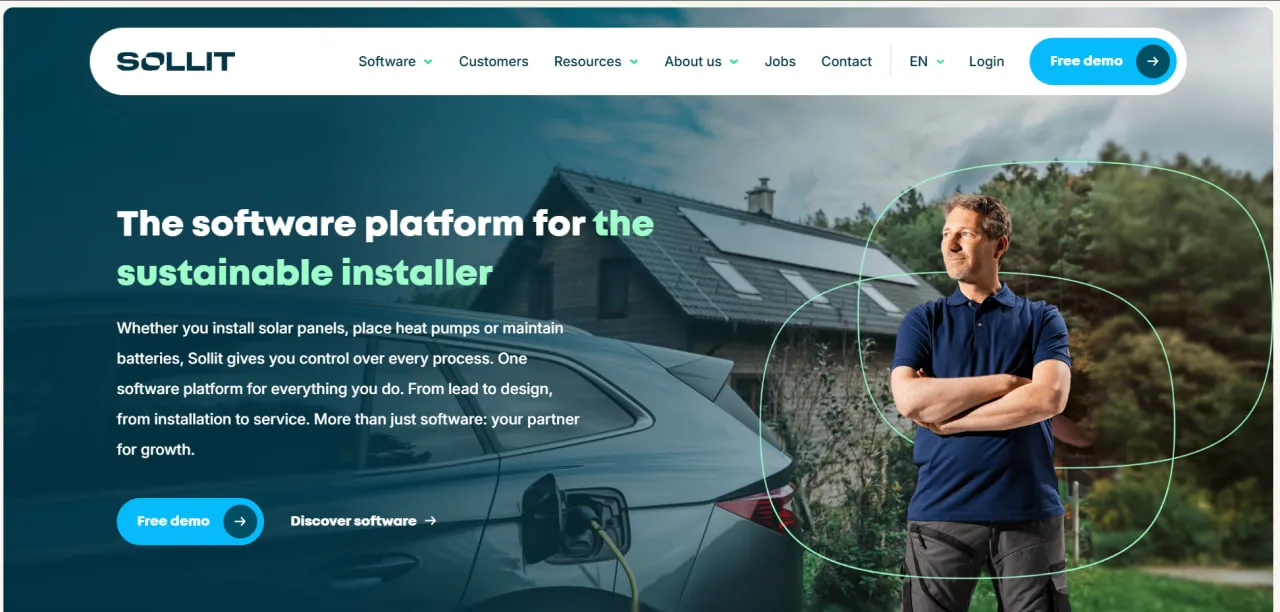
What Is Sollit?
Sollit is a SaaS product from a company founded in 2013 in Zwolle, the Netherlands. The product was called 2Solar until July 2025, when it was renamed because non-solar products (heat pumps, air conditioners, EV chargers, batteries) had come to account for more than half of the designs and quotes made in it. In October 2025 Sollit acquired Zolar Installer Services, the installer business of Berlin-based Zolar, and now also runs the zolar Marketplace, where installers buy solar and heat pump leads.
Sollit says more than 8,000 installers, planners, salespeople and managers use the platform, at companies such as Breman Warmteadvies (a customer since 2016) and Ensys. The company holds ISO 27001 certification for information security and received an FD Gazellen growth award every year from 2019 to 2024.
Sollit is a Dutch platform that runs an installation company’s work from first lead to after-sales service: CRM, roof design, quoting, installation planning, technician work orders and maintenance contracts. More than 1,000 installation companies use it, and Sollit operates in four countries: the Netherlands, Belgium, Germany and Spain.
It fits installers of solar panels, batteries, EV chargers and heat pumps in those countries who want leads, designs, quotes and planning in one system rather than in a CRM, a design tool and spreadsheets. It is not built for C&I or utility-scale engineering, and installers elsewhere, including in the US and UK, lose most of its value because the imagery, wholesaler and lead-generator integrations are local.
Pros and Cons
Pros
- Unlike a general-purpose CRM, it covers the installer’s whole job (lead, roof design, quote, planning, service), so customer and project data are entered once.
- Sales staff can design a roof on aerial imagery and send a priced quote without a site visit; Sollit says quoting is up to four times faster.
- Links to the mounting systems, wholesalers, accounting packages and lead generators that Benelux and German installers already use, so prices, materials and leads need not be re-typed.
- Modules and product lines can be added later, so a solar installer moving into heat pumps or batteries does not have to change software.
- ISO 27001:2022 certified for information security (recertified in April 2026).
- Photos, delivery forms and customer signatures come back from the technician app digitally, which keeps project records ready for quality audits.
Cons
- No public prices and no free trial: you need a demo and a quote to learn the cost.
- Setting up modules, templates, price tables and user roles takes time and staff training.
- Built for four markets (the Netherlands, Belgium, Germany and Spain): installers elsewhere lose most of the local imagery, wholesaler and lead-generator integrations.
- Design works on 2D aerial imagery; Sollit does not advertise 3D modeling, LiDAR or P50/P90 yield reports, so C&I and utility-scale projects need a separate engineering tool.
Sollit Features
Lead and CRM Management
Leads arrive from website forms, from online inspection forms that customers fill in themselves (photos, roof and site details), and via API from lead-generation partners. Each lead gets a customer file with its history, appointments and quotes, and moves through a sales pipeline on one dashboard.
PV Design Software
Panels are drawn by hand on aerial imagery of the roof, pitched or flat. The software fills in slope angles, shading estimates, PVGIS-based yield, string distribution, the mounting structure and an inverter suggestion from the installer’s own product range; Sollit says a basic layout takes one to two minutes.
Automated Quoting
One click turns the layout into a quote, with prices, the material list and the company’s branding taken from the design. Sollit says this makes quoting up to four times faster.
Payback Calculations
Solar quotes show ROI and payback period based on the customer’s consumption, battery capacity and expected yield. Heat pump quotes add available subsidies and a savings report based on gas consumption and (S)COP values.
Project Management and Planning
A signed quote becomes a project. The planning module shows team availability, calculates travel times and sends customers automatic confirmations and reminders. Technicians get the work order and material list in an iOS/Android app, where they add photos and have the customer sign the delivery form on site.
Modular Product Support
The Solar product line covers panels, home batteries and EV chargers; a separate HVAC line covers heat pumps and air conditioners. An installer that adds heat pumps to its solar business keeps working in the same system.
Monitoring Integration
After handover, Sollit pulls data from the inverter’s monitoring portal into the customer file, so the service team can spot an underperforming system and contact the customer first.
Sollit Pricing
Sollit prices by module, so companies pay only for the functions they use. It does not publish prices or tiers.
Free Demo
There is no free trial. Sollit offers a free demo with one of its specialists, who goes through the modules your business would need.
Paid Plans
Subscriptions are generally customized based on the modules selected (Lead, Design, Sales, Execution and Service, for the Solar and/or HVAC product lines) and the number of users.
Enterprise Pricing
Larger organizations get a custom quote after a consultation with the sales team.
Sollit Integrations
Sollit lists more than 50 integration partners, including aerial imagery (Cyclomedia, PDOK, Kadaster, Google Maps, Airteam, Plan3D), mounting systems (K2 Systems, Esdec, Blubase, Van der Valk), wholesalers (Natec, Vekto, Amara Nzero), Mollie payments and Sign2Cloud e-signatures.
CRM and Sales Integrations
The CRM is built in and can be linked to other sales tools through the API. More than a dozen Dutch, Belgian and German lead generators, such as Solvari, Homedeal and Bobex, feed leads in via API, and the zolar Marketplace sells each lead to at most three installers, with no minimum order and monthly cancellation.
Hardware Monitoring
The platform pulls performance data from the solar monitoring portals of Enphase, SolarEdge, Growatt, Huawei, Solis, GoodWe, APSystems, Solarman and Sundata.
Accounting and ERP
Financial data syncs with the Dutch accounting and ERP packages Exact and AFAS; for other software, data can be exported.
API Availability
API access allows companies to build custom connections between Sollit and their existing databases or third-party applications.
How to Set Up Sollit
- Book a free demo through the Sollit website to discuss your business needs and product groups.
- Work with a Sollit account manager to select the necessary modules (Lead, Design, Sales, Execution, Service) for your product lines, such as Solar (panels, batteries, EV chargers) or HVAC.
- Configure your workspace by adding your brand identity, document templates, and pricing tables.
- Import existing customer data and lead lists into the CRM module.
- Set up roles and permissions for sales staff, designers, managers, and installation technicians.
- Connect accounting (Exact or AFAS), the Outlook calendar, lead sources, wholesalers and inverter monitoring portals.
How to Use Sollit
A typical job starts as a lead in the CRM. When the customer shows interest, the salesperson enters the address, the design module loads aerial imagery of the roof, and the salesperson places the panels, checks shading and settles the system size without a site visit.
The finished design becomes a quote with payback figures and a full bill of materials. Once the customer signs it digitally, the project moves to planning: the office schedules the installation and sends the work order to the technician’s phone.
After installation, the Service module keeps each system’s monitoring data, maintenance records, service requests and maintenance contracts in the customer file.
What You Can Manage with Sollit
- Customer Records: Detailed histories of customer interactions, quotes, and installations.
- PV Designs: Technical layouts and energy yield simulations for solar projects.
- Sales Pipelines: Visual tracking of leads from initial contact to closed deals.
- Quotes: Branded quotes with prices, materials and payback figures.
- Project Schedules: Installation dates, team availability and technician work orders.
- Material Lists: Project-specific lists of panels, inverters, batteries, and mounting hardware, with purchase forecasts based on the installation schedule.
- Performance Data: Post-installation monitoring and maintenance records.
Sollit FAQs
What does Sollit do?
Sollit is modular software for installers of solar panels, batteries, EV chargers, heat pumps and air conditioners. It covers lead generation and CRM, remote roof design, quoting, installation planning, technician work orders, monitoring and after-sales service in one system.
Who is Sollit best for?
It suits installers in the Netherlands, Belgium, Germany and Spain that sell solar panels, batteries, EV chargers, heat pumps or air conditioners and are big enough to have separate sales, planning and installation staff. One-person businesses, installers in other countries and C&I or utility-scale engineering teams are better served by other tools.
Is Sollit free?
No. There is no free plan or free trial; Sollit offers a free demo, followed by a custom quote.
How much does Sollit cost?
Pricing is not publicly listed because it is based on the selected modules, number of users, and scale of the company’s operations. Businesses must contact Sollit for a personalized quote.
What are the main limitations of Sollit?
Prices are not published, and setting up modules, templates and price tables takes time. PV design is done by hand on 2D aerial imagery; Sollit does not advertise 3D modeling, LiDAR, automatic roof detection or P50/P90 yield reports. Its heat pump quotes do not mention a heat-loss calculation, and most integrations are specific to the Dutch, Belgian, German and Spanish markets.
What are the best alternatives to Sollit?
For PV design and proposals, the best-known alternatives are Aurora Solar, HelioScope, and OpenSolar. A closer like-for-like option in the Netherlands is OpusFlow, which also combines CRM, PV design, quoting and planning for solar and heat pump installers. Companies that do not need solar design may consider general CRM platforms such as HubSpot or Salesforce.


