
What Is RoofSnap?
RoofSnap is a cloud-based roofing estimator, listed here under solar design software for its roof measurements. A former roofer founded it as a simple iOS measurement app; today RoofSnap, LLC is based in Denver and belongs to EverCommerce’s EverPro family of home-services software.
Imagery comes from three sources: Hexagon for standard aerial photos, high-definition imagery from Nearmap, and Google and Bing maps for finding and viewing the property. The user “sketches” the roof lines over the image, and RoofSnap calculates the square footage, the lengths of ridges and valleys, and the waste percentage. RoofSnap states that a correctly drawn roof is accurate to within 2%, and every ordered report goes through a quality review before delivery.
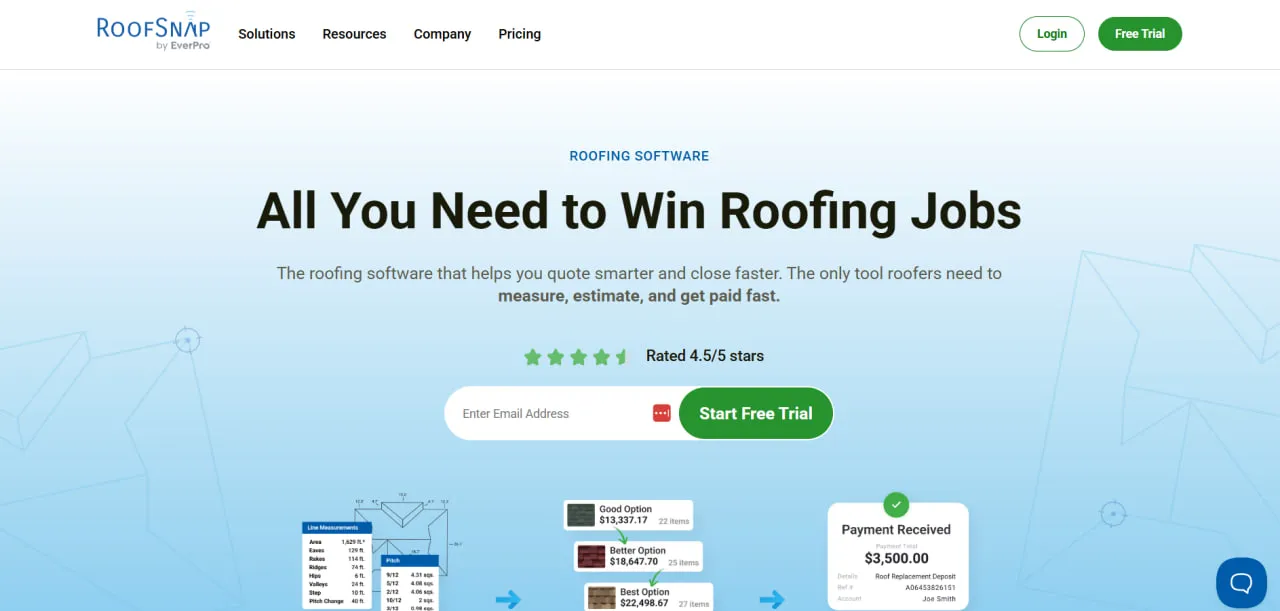
RoofSnap replaces the ladder and tape measure with aerial imagery. You either sketch the roof yourself in the web or mobile app, or order a measurement report from RoofSnap’s team. The measurements then flow into the material list, the estimate, the proposal, and the contract, and subscribers can take the homeowner’s deposit in the same app.
It is built for small and mid-size residential roofing crews, solo roofers, and insurance adjusters who want to measure, quote, and sign a job in one visit. It is not a solar design tool: there is no PV layout, shading analysis, string sizing, or yield estimate, so a solar installer can use its roof measurements but still needs separate PV design software. Companies that want a full sales CRM will need one alongside it.
Pros and Cons
Pros
- No subscription needed for occasional jobs: a Half Snap report costs $13.
- Annual billing cuts the per-user price from $105 to $78, $61, or $52 a month, depending on team size.
- Unlimited “Draw-It-Yourself” measurements on every subscription, so a busy estimator does not pay per roof.
- A rep can measure, present good-better-best options, collect a signature, and take a deposit on a tablet in one visit.
- Measuring from aerial images means fewer ladder climbs, which saves time and reduces fall risk.
Cons
- Annual discounts start at two users, so a solo roofer pays the full $105 a month.
- No built-in CRM for pipelines and follow-ups, so you need AccuLynx, MarketSharp, or another CRM alongside it.
- Accuracy can be limited in rural areas where high-resolution map imagery is unavailable.
- Manual sketching takes practice before estimators are fast and accurate with it.
- No PV layout, shading, string sizing, or yield estimates, so solar installers need a separate design tool.
Features
Aerial Measurement Tools
Draw roof lines on high-resolution images to get lengths, areas, and pitches without visiting the property.
Measurement Report Ordering
An optional “done-for-you” service where RoofSnap’s team measures the roof and delivers the report, usually within 2 to 4 hours. Rush delivery is guaranteed within 1 hour for $25 extra (RoofSnap advertises as little as 30 minutes), and orders are processed Monday to Saturday, 9am to 5pm Eastern.
Estimating and Material Ordering Suite
Turns measurements into a bill of materials and labor costs using the contractor’s own prices, overhead, and sales commission rates.
Good-Better-Best Proposals
Generates five estimate options from one measurement in under 10 seconds, according to RoofSnap, so the homeowner can compare material grades and prices side by side.
Mobile App for iOS and Android
Field teams open measurements and contracts on tablets and phones through the RemodelerGo app, so the homeowner can sign on the spot.
In-App Payments and Deposits
Collect deposits and final payments from the project screen by card (from 2.9% + $0.30 per transaction) or ACH (1% per charge).
Customizable Contracts and Documents
Add your own legal language and logo to generate ready-to-sign PDF agreements.
RoofSnap Pricing
Pay-as-you-go users can order reports and build quick good-better-best estimates. Draw-It-Yourself sketching, custom material pricing, branded contracts, and in-app payments require a subscription.
Free Trial: A 7-day free trial with access to all tools and no credit card required.
Pay-As-You-Go: A Half Snap report costs $13 for any roof size. A detailed Full Snap report costs $35 for roofs under 50 squares and 15 facets, and $55 for larger or more complex roofs. Suits contractors who need only occasional reports.
Monthly Subscription: Starts at $105 per user per month. This plan includes unlimited DIY measurements, the estimating and material ordering suite, and 5 HD images per user per month.
Annual Starter: $78 per user per month (billed annually, 2-user minimum). Includes all monthly features plus 240 bonus HD images per user per year.
Annual Pro: $61 per user per month (billed annually, 5-user minimum), with the same 240 bonus HD images per user per year.
Annual Enterprise: $52 per user per month (billed annually, 10-user minimum), roughly half the monthly price per seat, with the same 240 bonus HD images per user per year.
Subscriber Report Pricing: Discounted reports at $10 for a Half Snap and $11–$37 for a Full Snap on roofs up to 80 squares ($11–$47 above that), priced by facet count.
Integrations
The list is short: two roofing CRMs, Stripe for payments, and Nearmap for imagery. Anything else, such as a Salesforce connection, is a custom API project.
- Payment Integrations: RoofSnap Payments, powered by Stripe, handles deposits and final project payments with 40+ payment methods, including cards and ACH. Subscribers can also offer homeowner financing through Acorn Finance in their proposals.
- CRM and Lead Management: Official integrations with AccuLynx and MarketSharp (RoofSnap reports ordered within MarketSharp cost a flat $30).
- Imagery Providers: Nearmap is RoofSnap’s HD imagery partner (subscriptions include HD image credits), Hexagon supplies the standard imagery, and users with their own Nearmap subscription can link it to their RoofSnap account.
- API Availability: RoofSnap has described its API as open to custom integrations with the CRMs its customers use, scoped case by case (its own example sent measurement orders from Salesforce and synced the finished sketches back).
How to Set Up RoofSnap
- Sign up for a 7-day free trial on the official website to explore the interface.
- Choose a pricing model: pay-as-you-go measurement orders, or a monthly or annual subscription.
- Configure your account settings by uploading your company logo and legal contract language.
- Set up your “Office” by entering your material prices, labor rates, and tax information.
- Download the RemodelerGo app (iPhone, iPad or Android), through which RoofSnap is now offered on mobile, or use the RoofSnap web app in a browser.
- Invite team members to the workspace and assign their specific roles and permissions.
How to Use RoofSnap
A job starts with the property address, which RoofSnap locates on satellite or aerial imagery. Subscribers outline the roof’s ridges, valleys, and eaves with the “Draw-It-Yourself” tools and assign a pitch to each facet; pay-as-you-go users order a Half Snap or Full Snap report instead. Either way, the result is a measurement report.
Next, the contractor picks a material template (for example, architectural shingles), and RoofSnap calculates the quantities needed, including waste. The proposal often shows several price points to the homeowner. If the homeowner agrees, the contractor finalizes the contract, collects a digital signature on the tablet, and takes a deposit through RoofSnap Payments, all without leaving the driveway.
What You Can Manage with RoofSnap
- Aerial Measurement Reports: Square footage, pitch, and line lengths for each roof, plus separate gutter and lighting measurement reports when needed.
- Professional Proposals: Branded quotes that offer homeowners different material and pricing options.
- Material Lists: Quantities of shingles, underlayment, and accessories for each job, including waste.
- Signed Contracts: PDF agreements with your own legal language and logo, signed on screen.
- Project Payments: Collection of deposits and final project funds via integrated payment processing.
- Estimating Templates: Standardized labor and material costs that ensure consistent pricing across the team.
FAQs
What does RoofSnap do?
RoofSnap measures roofs from aerial imagery, either from a sketch you draw yourself or from a report ordered from RoofSnap’s team. It then turns the measurements into material lists, good-better-best proposals, and contracts, and collects signatures and deposits in the same app.
Who is RoofSnap best for?
It suits small and mid-size residential roofing companies, solo roofers, and insurance adjusters who need roof dimensions quickly. Solar installers can use its roof measurements, but they will still need a PV design tool for layout, shading, and string sizing.
Is RoofSnap free?
RoofSnap is not free, but it offers a 7-day free trial that does not require a credit card. After the trial, users can order measurement reports pay-as-you-go from $13 per order or subscribe from $105 per user per month (from $52 per user per month on annual plans for teams of 10+).
Does RoofSnap support integrations?
Only a few. It has built-in payments powered by Stripe, Nearmap imagery, and CRM integrations with AccuLynx and MarketSharp. Other connections, such as Salesforce, are custom API work scoped case by case.
What are the main limitations of RoofSnap?
It is roofing software only, with no PV layout, shading, or string sizing tools, and it has no built-in CRM for sales pipelines and follow-ups. Accuracy depends on the aerial imagery available, and annual discounts start at two users.
What are the best alternatives to RoofSnap?
Common alternatives include Roofr, whose free Starter plan charges $19 per measurement report and whose Measure+ plan ($109 per month) cuts that to $13, and EagleView, which is known for high-accuracy third-party reports but costs significantly more per project.


