
What Is QOS Energy?
QOS Energy is a French software company, founded near Nantes in 2010, that built monitoring and asset performance management software for renewable plant owners and operators. Envision Digital acquired it in July 2022, and QOS Energy is now part of Univers, the name Envision Digital has used since September 2023.
Its platform, Qantum, is a cloud data hub for plant data, with analytics, reporting and maintenance management built on top. Before the rebrand, QOS reported more than 12 GW across solar, wind, storage, hydro and biomass, over 8,000 assets and 100+ clients in 23 countries.
QOS Energy’s Qantum is cloud software for companies that run many renewable plants on equipment from different vendors, mostly in the commercial and industrial (C&I) segment. It pulls plant data into one place, flags underperforming equipment, builds recurring technical and financial reports and handles maintenance tickets in a built-in CMMS.
It is not meant for residential systems or a single plant, and buying it is a sales process with Univers, which now owns QOS Energy, rather than a sign-up.
Pros and Cons
Pros
- Mixed solar, wind and storage portfolios get one set of KPIs and reports instead of a tool per technology.
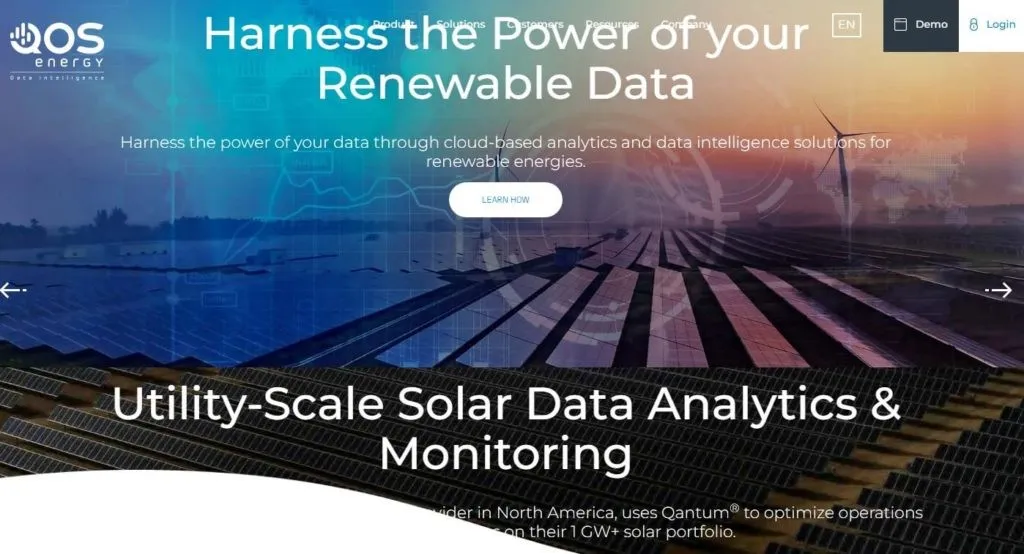
- Proven on large fleets: O&M provider SOLV uses it on a 1 GW+ North American solar portfolio.
- Replaces a stack of vendor portals: Coronal Energy said it had used up to five monitoring platforms, with inconsistent KPIs, before moving to Qantum.
- Custom KPI formulas and report templates are defined once and applied across the whole portfolio, which cuts recurring reporting work.
- Alarms, tickets and intervention reports sit next to the performance data, so O&M teams can do without a separate CMMS.
- Backed by Univers (formerly Envision Digital), which also sells SCADA and AI analytics in the same EnOS Renewables range.
Cons
- No public pricing or self-serve trial; evaluation starts with a Univers demo.
- Onboarding is a vendor-led project (data mapping, dashboards, training), not a same-day sign-up.
- More than a residential system or a single site needs.
- Performance insights depend heavily on data quality from field hardware.
- No forecasting engine of its own: power forecasts have to come from a third-party provider.
- Univers no longer gives Qantum its own product page, only a listing in EnOS Renewables; ask about the roadmap before a long contract.
Features
Portfolio-Wide Monitoring
Solar, wind, storage, hydro and biomass plants in one portfolio, with separate technical, financial and maintenance dashboards.
Hardware-Agnostic Data Acquisition
Data from different plant types and acquisition systems is collected, cleaned and stored in one cloud data hub.
Performance Analytics
Smart alarms flag underperforming inverters, strings and sensors, and losses are measured against a digital-twin model of each plant.
Automated Reporting and KPI Tracking
Report templates apply to any plant, group of plants or period, so recurring technical and financial reports are not rebuilt by hand.
Integrated Maintenance Management
A built-in CMMS covers preventive and corrective maintenance plans, ticketing, technician calendars and contract SLAs.
Forecast Integration
Enrich analytics and KPIs with power forecasts from third-party forecast providers.
Storage Monitoring
Track storage facilities next to generation, including hybrid solar-storage-diesel microgrids.
QOS Energy Pricing
Univers, not QOS Energy, now handles Qantum sales and quotes.
Custom Quotes: Pricing depends on installed capacity, number of sites, and required features.
Demo Access: Evaluation starts with a booked demo; there is no self-serve trial.
No Public Pricing: Subscription costs are not published online.
Enterprise Licensing: Designed for multi-site commercial and industrial (C&I) and utility-scale portfolios.
Integrations
QOS Energy advertised more than 250 ways to connect Qantum to plants, databases and outside services.
- SCADA and Data Loggers: Data collected from plant SCADA, dataloggers and databases, regardless of equipment brand.
- Third-Party Data: Weather, satellite irradiance, power forecasts, remote meter readings, PPA terms and market prices.
- Cloud APIs: The Qantum API follows the JSON:API standard and feeds CMMS, invoicing, asset management or BI tools; a developer portal documents it.
- Univers Ecosystem: Qantum is part of Univers’ EnOS Renewables portfolio, alongside Bazefield, EnOS SCADA and AI Analytics for solar and wind.
How to Set Up QOS Energy
- Book a consultation and portfolio assessment with the Univers team.
- Review existing SCADA systems, sensors, and hardware infrastructure.
- Map data sources and configure cloud connectivity.
- Customize dashboards, KPIs, alerts, and reporting workflows.
- Configure maintenance ticketing and operational permissions.
- Train operations teams and launch monitoring workflows.
How to Use QOS Energy
Asset managers usually start from the portfolio dashboard: production, equipment status and active alarms across all plants. When a plant underperforms, the analytics help trace the cause, whether an inverter fault, unusual weather or an open maintenance issue.
Maintenance teams then open a ticket, schedule the intervention and close it with an intervention report. Technical and financial reports for owners and investors are generated on a schedule.
What You Can Manage with QOS Energy
- Renewable Asset Dashboards: Monitor production, weather, and operational KPIs.
- Maintenance Workflows: Follow each incident from alarm to closed ticket, with intervention reports and time to resolution.
- Performance Analytics: Compare plants with each other and trace the root causes of production losses.
- User Access: Custom rights for partners, investors, owners and service providers working from the same data.
- Asset Health Records: Maintain long-term equipment performance histories.
- ROI and Financial Reporting: Track each asset’s financial and contractual parameters, such as PPA prices, alongside its technical data.
FAQs
What does QOS Energy do?
QOS Energy developed the Qantum platform, now sold by Univers (formerly Envision Digital), which helps renewable energy operators monitor, analyze, and optimize solar, wind, biomass, and storage portfolios.
Who is QOS Energy best for?
It is designed for renewable asset owners, asset managers, O&M providers and EPCs managing multi-site portfolios. QOS Energy built its business mainly in the commercial and industrial (C&I) segment, and Univers now positions Qantum for C&I assets.
Is QOS Energy free?
No. Qantum is a paid subscription priced by quote, and there is no free plan or self-serve trial.
What are the main limitations of QOS Energy?
Prices are not published and there is no self-serve trial. Qantum has no forecasting engine of its own, so power forecasts must come from a third-party provider. It is built for multi-site portfolios, and since Univers lists it only inside EnOS Renewables rather than on its own product page, buyers should ask about its roadmap.
What are the best alternatives to QOS Energy?
Alternatives include Power Factors, Stem PowerTrack and 3E SynaptiQ; for sites built on SMA inverters, SMA Sunny Portal is the hardware-specific option. Within Univers, Bazefield is the fleet-wide platform for wind, PV and storage.


