
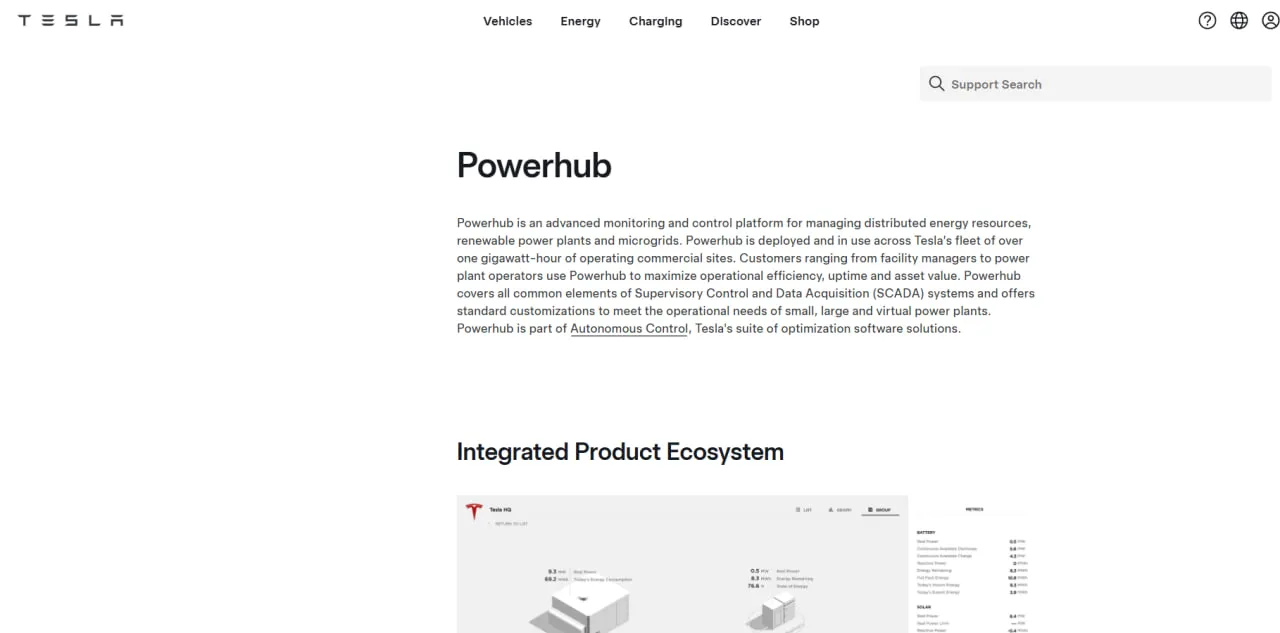
What Is Tesla Powerhub?
Tesla Powerhub is a monitoring and control platform for distributed energy resources, renewable power plants and microgrids. Its product page still cites a fleet of more than one gigawatt-hour of operating commercial sites, a figure Tesla has quoted since at least 2020.
The platform covers the common elements of a SCADA (supervisory control and data acquisition) system and offers standard customizations for small and large sites as well as virtual power plants.
Powerhub should not be confused with PowerHub Inc., a Toronto company whose renewable asset management software was bought by BayWa r.e. in 2019.
Tesla Powerhub is the software Tesla uses to monitor and control its own energy products, from a single commercial battery site or microgrid to a virtual power plant of thousands of home batteries. It suits utilities, aggregators, plant operators and commercial site owners who run Tesla storage or solar. It is not for mixed-vendor battery fleets or for buyers who want self-serve software with a trial and public documentation.
Powerhub is part of Autonomous Control, Tesla’s suite of optimization software, alongside Tesla Autobidder for wholesale market bidding.
Pros and Cons
Pros
- Virtual power plant dispatch is built in, from the cloud interface or the API, and the same platform runs Tesla’s own Powerwall-based virtual power plants.
- Monitoring, alarms and plant-level control in one platform, from a single site to a whole fleet.
- Pairs with Tesla Autobidder for wholesale market trading of Megapack batteries.
- Alerts cover the balance of plant, including transformers, breakers and fire detection, not just the batteries.
Cons
- Not built for fleets that mix Tesla and other makers' batteries.
- No public pricing, trial or self-serve sign-up.
- Thin public documentation compared with standalone SCADA vendors, so technical due diligence goes through Tesla.
Features
Real-time monitoring
Live data from site meters, individual battery blocks, solar inverters and diesel generators, for each site and across the whole fleet.
Remote control
Operators can control power plants in real time, either by issuing direct power commands from an on-site control room or by updating operating parameters remotely.
SCADA functions
Alarms, event logs and trends, plus troubleshooting recommendations for faults that fall outside Tesla's service scope.
Virtual power plant dispatch
Many distributed batteries can be dispatched together from the Powerhub cloud interface.
Microgrid support
Visibility and control for sites that combine solar, storage and backup generation.
Analytics and reporting
Real-time performance metrics, historical trends, custom reports and data export for further analysis.
API and DERMS integration
Aggregators can dispatch virtual power plants through the Powerhub API, and site telemetry can be fed into a third-party DERMS.
Tesla Powerhub Pricing
Tesla does not publish prices for Powerhub. It is usually supplied together with Tesla energy projects such as Megapack or Powerwall fleets, and the terms are agreed with Tesla Energy. There is no free trial or self-serve plan.
Integrations
Powerhub is built around Tesla hardware, including Megapack, Powerwall and Tesla solar. Tesla names only three kinds of non-Tesla equipment: generators, breakers and transformers. An API gives access to site data and dispatch, and telemetry can be fed into third-party DERMS platforms. Powerhub works with Tesla Autobidder, which trades battery capacity in wholesale markets, and with Tesla's Microgrid Controller, which is fully integrated with Powerhub for real-time microgrid control.
How to Set Up Tesla Powerhub
- Contact Tesla Energy about a new or existing Tesla storage or solar project.
- Agree which sites, devices and third-party equipment Powerhub will monitor and control.
- Tesla commissions the sites and connects them to Powerhub.
- Set up user access, alarms and reporting for the operations team.
- Connect the API to other systems, such as a utility DERMS, if needed.
How to Use Tesla Powerhub
Day to day, operators open a fleet view that shows every site, its state of charge, power flows and alarms. From there they can drill into a single site, check device-level data and change how it runs, for example by setting quiet hours for a microgrid, adjusting frequency/watt set points or scheduling a future dispatch for demand response.
For aggregators and utilities, Powerhub groups many batteries into one dispatchable resource. A dispatch can be started by hand from the cloud interface or sent through the Powerhub API, for example a scheduled dispatch for aggregate demand response. Performance metrics and custom reports help asset owners see where value is lost and plan maintenance.
What You Can Manage with Tesla Powerhub
- Energy storage sites: Commercial and utility batteries, including Megapack installations.
- Solar plants: Generation data and control for connected PV systems.
- Microgrids: Sites combining solar, storage, generators and switching equipment.
- Virtual power plants: Fleets of distributed batteries dispatched as one resource.
- Balance of plant: Transformers, breakers and fire detection systems on the alerts dashboard.
FAQs
What does Tesla Powerhub do?
Tesla Powerhub is asset management and control software that monitors and controls batteries, solar plants, microgrids and virtual power plants in real time.
Who is Tesla Powerhub best for?
It suits commercial and industrial site owners, utilities, aggregators and power plant operators who run Tesla storage or solar and need SCADA-level monitoring and control.
Is Tesla Powerhub free?
Tesla publishes no price for Powerhub. It is provided as part of Tesla energy projects, and the terms are agreed with Tesla.
What are the main limitations of Tesla Powerhub?
It is built around Tesla hardware, so fleets with other makers' batteries are better served by vendor-neutral platforms. Pricing is not public, and technical documentation is thin.
What are the best alternatives to Tesla Powerhub?
Alternatives include Fluence Mosaic, FlexGen HybridOS, Stem Athena and Power Factors Unity.


